
CITE THIS NOTEBOOK: What should space look like in the Wolfram model? by Lev Chizhov. Wolfram Community JAN 12 2023.
The global goal of the project is to investigate conditions on hypergraphs to represent our physical space. In particular, the focus is on its isotropy. I defined rotations for hypergraphs, and studied the groups of rotational symmetries of hypergraphs. I introduced several properties of the models relevant to determine connections between the Wolfram Physics Project and the traditional physics and checked them for different models.
Space
Space
To be able to model the universe in our models, our hypergraphs have to be a discrete approximation of space. For that, we need it to have several properties. I will consider empty space here, which is supposed to approximate -dimensional Euclidean space. I will use for simplicity (in particular, for easy visualization). Here are the properties: 1. Translational invariance 2. Isotropy 3. The hypergraph has to be able to be embedded in the -dimensional space such that all edges are local in the embedding. For , the condition of edges not intersecting on a plane is sufficient, but not necessary. Alternatively, we can take balls of different radii and see how the volume changes in order to calculate the dimension.Next, I will generate some examples of how a hypergraph with ambitions to represent space might look like.
n
n2
n
n2
Some examples
Some examples
Here I will generate some example models which have some space-like properties.
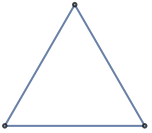
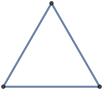
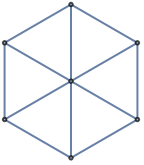
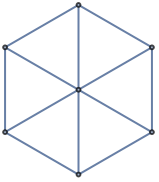
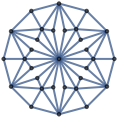
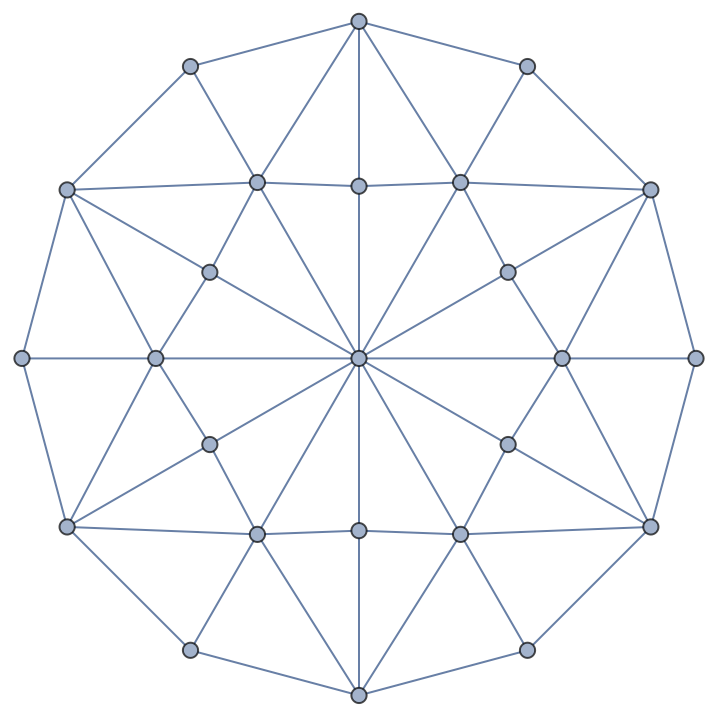
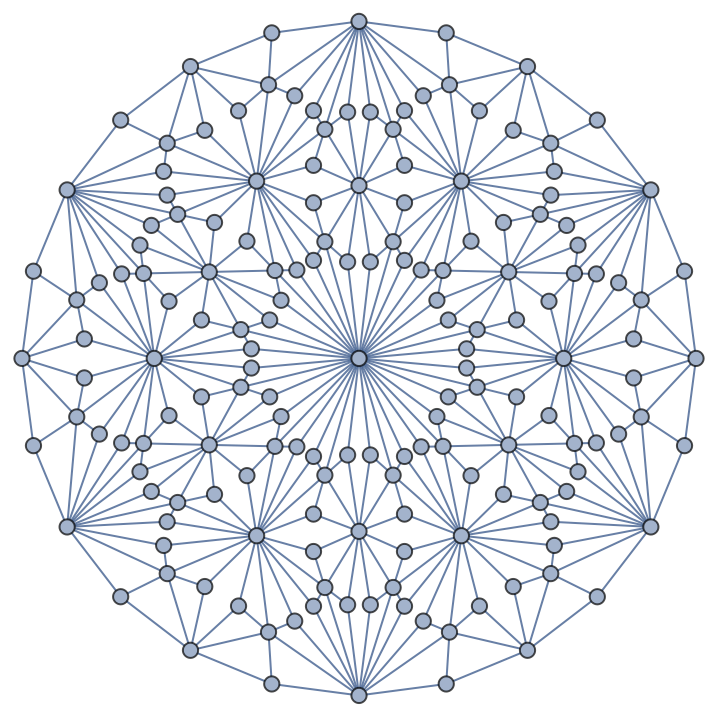
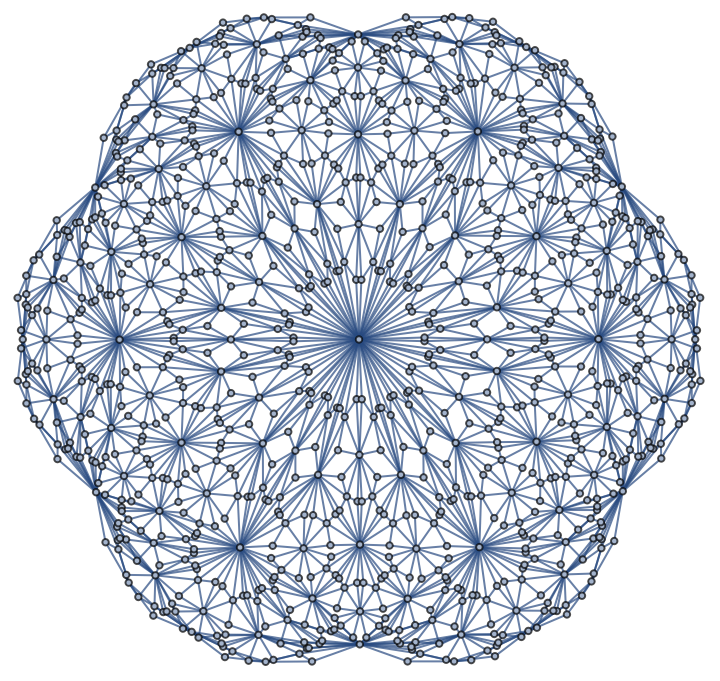
The first example is a “trigrid” obtained by splitting triangles:
In[]:=
appRule1[ev_]:=Join[ev,{ResourceFunction["WolframModel"][{{1,2,3}}->{{1,5,4},{2,5,4},{1,6,4},{3,6,4},{2,7,4},{3,7,4}},ev[[-1]],1,"FinalState"]}]appRule2[ev_]:=Join[ev,{ResourceFunction["WolframModel"][{{{1,2,3},{4,2,3},{1,6,5},{4,6,5}}{{1,2,3},{4,2,3},{1,2,5},{4,2,5}}},ev[[-1]],1,"FinalState"]}]changingEvol[ev_,n_]:=If[n==0,ev,changingEvol[If[Mod[n,2]==0,appRule2,appRule1][ev],n-1]]plotEvol[ev_]:=SimpleGraph[#,GraphLayout->"TutteEmbedding"]&/@Catenate/@Map[UndirectedEdge@@@Partition[#,2,1,{1,1}]&,ev,{2}]
In[]:=
plotEvol[changingEvol[{{{1,2,3}}},6]]
Out[]=
,
,
,
,
,
,
In[]:=
triangles=(DeleteDuplicates[Map[Sort,#]]&/@(Catenate/@Map[UndirectedEdge@@@Partition[#,2,1,{1,1}]&,changingEvol[{{{1,2,3}}},13],{2}]))trigridUndirected=triangles[[8]]trigrid=DeleteDuplicates[Catenate[({{#[[1]],#[[2]]},{#[[2]],#[[1]]}})&/@trigridUndirected]]trigridN[n_]:=DeleteDuplicates[Catenate[({{#[[1]],#[[2]]},{#[[2]],#[[1]]}})&/@triangles[[n*2]]]]GraphPlot[trigridUndirected]
Out[]=
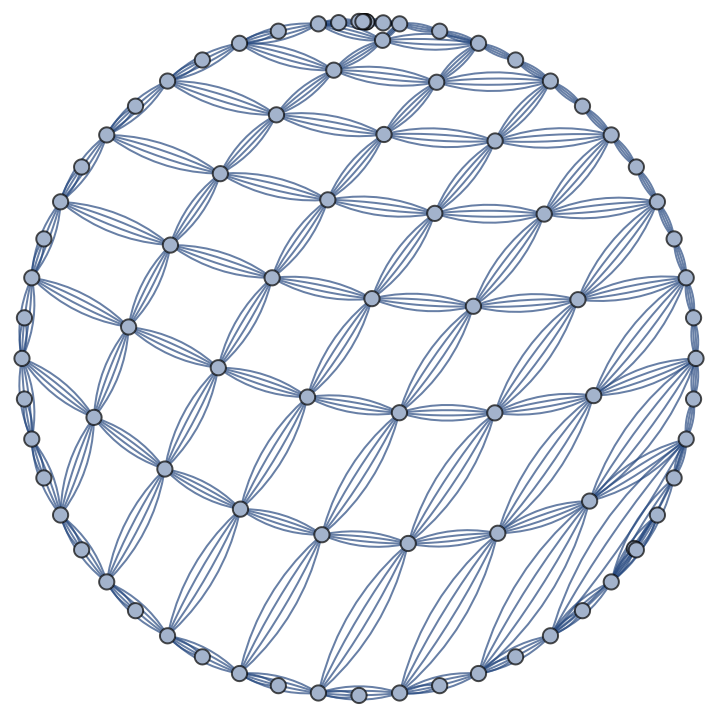
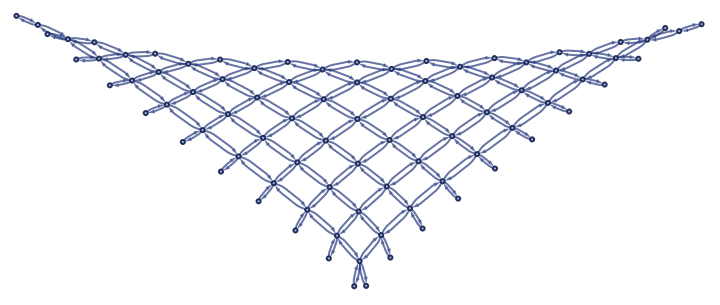
The second example is a simple rectangular grid:
It is used as an example of a grid which easily represents Euclidean space, but clearly contradicts our understanding of how a hypergraph for isotropic space would look.
It is used as an example of a grid which easily represents Euclidean space, but clearly contradicts our understanding of how a hypergraph for isotropic space would look.
In[]:=
rectgridUndir[n_]:=DeleteDuplicates[Map[Sort,#]]&/@Flatten[Flatten[Table[{UndirectedEdge[{i,j},{i-1,j}],UndirectedEdge[{i,j},{i+1,j}],UndirectedEdge[{i,j},{i,j-1}],UndirectedEdge[{i,j},{i,j+1}]},{i,-n,n},{j,-n,n}],1]]remapVert[gr_]:=({Position[VList[gr],#[[1]]][[1]][[1]],Position[VList[gr],#[[2]]][[1]][[1]]})&/@grrectgrid[n_]:=remapVert[Select[DeleteDuplicates[Catenate[({{#[[1]],#[[2]]},{#[[2]],#[[1]]}})&/@rectgridUndir[n]]],#[[1]]!=#[[2]]&]]GraphPlot[rectgridUndir[5],GraphLayout->"TutteEmbedding"]
Out[]=
In[]:=
ResourceFunction["WolframModelPlot"][rectgrid[5]]
Out[]=
Rotating graphs: definitions and criteria
Rotating graphs: definitions and criteria
Definition of rotation

Rotating hypergraph imagined by Stable Diffusion
What do we want from space?
What do we want from space?
Finding automorphism groups
Finding automorphism groups
HypergraphAutomorphismGroup finds the group of transformations which convert the hypergraph into an isomorphic hypergraph. It creates a graph from the hypergraph and uses GraphAutomorphismGroup to find the permutations.
FindGroup finds known groups isomorphic to the given permutations. From there, we can use FiniteGroupData to get, for instance, the standard notation.
FindGroup finds known groups isomorphic to the given permutations. From there, we can use FiniteGroupData to get, for instance, the standard notation.
These functions find the rotation groups using spheres and shells:
We can now calculate automorphism groups:
We can also find its notation, order, and generators:
Let’s apply test 1 to the triangular grid:
It’s not too much points as it gets much more computationally expensive with each rule application, but the group order does tend to infinity with the number of rule applications.
This means, that this
This means, that this
Clearly, the triangular grid does not pass the second test. The reason for that can be seen visually:
The hypergraph has some natural directions in it, which disappear in the limit as we apply the rule, but in each given hypergraph don’t allow the group order to rise as radius increases.
Here are the same tests
As we can see, the rectangular grid doesn’t pass both of the tests.
Concluding remarks
Concluding remarks
This project determined properties a hypergraph with ambitions to represent space should have, but the perfect representation of space is yet to be found. I hope that it will bring the Wolfram Physics Project at least a bit closer to success in the search for the theory of everything.
Keywords
Keywords
◼
Wolfram Physics Project
◼
Space
◼
Rotational Symmetry
Acknowledgment
Acknowledgment
I thank my mentors Nik Murzin and Sotiris Michos for helping me with the project and Stephen Wolfram for inspiring this project as well as creating the Physics Project in the first place.
References
References