ABSTRACT (original article): Quantum speed limit (QSL) is the study of fundamental limits on the evolution time of quantum systems. For instance, under the action of a time-independent Hamiltonian, the evolution time between an initial and a final quantum state obeys various mutually complementary lower bounds. These include the Mandelstam–Tamm (MT) bound, the Margolus–Levitin (ML) bound, the Luo–Zhang bound, the Lee–Chau (LC) bound, and the dual ML bound introduced by Ness and coworkers. Here we show that the MT bound can be obtained by optimizing the LC bound over a certain parameter. More importantly, we report a QSL that includes all the above bounds as special cases before optimizing over the physically meaningless reference energy level of a quantum system. This unifying bound depends on a certain parameter p . For any fixed p, we find all pairs of time-independent Hamiltonian and initial pure quantum state that saturate this unifying bound. More importantly, these pairs allow us to compute this bound accurately and efficiently using an oracle that returns certain pth moments related to the absolute value of energy of the quantum state. Moreover, this oracle can be simulated by a computationally efficient and accurate algorithm for finite-dimensional quantum systems as well as for certain infinite-dimensional quantum states with bounded and continuous energy spectra. This makes our computational method feasible in many practical situations. We further compare the performance of this bound for the case of a fixed p as well as the case of optimizing over p with existing QSLs. We find that if the dimension of the underlying Hilbert space is ≲2000, our unifying bound optimized over p can be computed accurately in a few minutes. CITATION (original article): H. F. Chau and Wenxin Zeng (2024), A unifying quantum speed limit for time-independent Hamiltonian evolution, J. Phys. A: Math. Theor. 57 235304. https://doi.org/10.1088/1751-8121/ad4c32
There is no free lunch in the quantum world --- evolution between two distinct quantum states takes non-zero time. In other words, time is a resource in quantum information processing. Surely, one can compute the evolution time from a given initial state to target state by tracing the quantum evolution under a given Hamiltonian either analytically or numerically. This method, however, is ineffective as the system may not evolve to the target state or may approach it only asymptotically. Even if the target state can be reached in finite time, finding it by following the state evolution is generally very slow. Furthermore, this approach does not highlight the fundamental nature of the non-zero evolution time.
The way to go is to “coarse gain” the system by studying the evolution time between any two states whose fidelity between them equals ϵ. Moreover, instead of specifying the Hamiltonian, we only specify certain energy parameter(s) of the system. Under these specifications, sometimes it is possible to obtain a lower bound of the evolution time. This type of bounds are called quantum speed limits (QSLs).
The first QSL was the Mandelstamm-Tamm (MT) bound. It states that the evolution time τ obeys
τ
ℏ
≥(
-1
cos
ϵ
)ΔE
where is the standard deviation of the energy of the system evolving under a time-independent Hamiltonian. (Many people not in this field sometimes misquote this bound as the time-energy uncertainty relation.)
Many QSLs have been found. One of them is the Margolus-Levitin (ML) bound, namely,
ΔE
Many QSLs have been found. One of them is the Margolus-Levitin (ML) bound, namely,
τ
ℏ
where is the expectation value of the system energy relative to the ground state of the time-independent Hamiltonian. The ML bound is a slightly more complicated to calculate as it needs to optimize over the parameter θ.The MT and ML bounds are based on different energy parameters of the system, namely, and , respectively. Hence, they are complimentary. Recent, we found a unifying bound based on optimization over a family of energy parameters of the system evolve under a time-independent Hamiltonian [arXiv:2310.08813]. This bound is at least as good as all the existing QSLs for time-independent Hamiltonian evolution including the MT and ML bounds. By writing the initial normalized pure quantum state as the formal sum where ’s are distinct energy eigenstates of the time-independent Hamiltonian of the system, our bound readswhere and are unique solution of the equation
ΔE
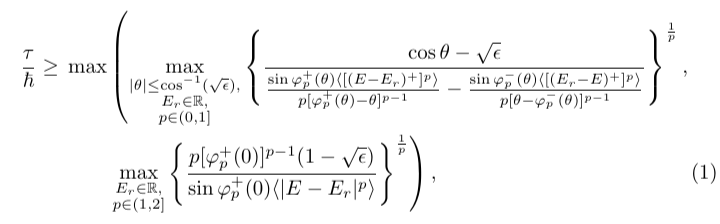
in the interval and , respectively. In addition,
and
In the form of Eq. (1), our QSL bound requires optimization over three parameters and hence is inefficient to calculate. In arXiv:2310.08813, we report an algorithm to do so efficiently in a lot of cases including perhaps the most commonly encountered situation of a finite-dimensional Hamiltonian. The code posted here works for finite dimensional systems (except for the trivial case of one-dimensional Hamiltonian in which ).
τ=0
The following parameter ranges are assumed without any validity check, with plowerlimit set to 10^(-12) in all optimization routines to avoid numerical instability and with pcritical set to 10^(-5) so that extra precision is used to compute these bounds,,Suppose the normalized initial state is in the form where 's are distinct energy eigenstates of the Hamiltonian, then one should set energydata as Tranpose[{E_j, |a_j|^2},...}] with and is strictly increasing with more than 1 elementNote that when extra precision is used in the calculation when is small, the warning that the precision of the argument function is less than WorkingPrecision will be issue; this is harmless
p∈[plowerlimit,2]
p
E
j
p
Do not touch these global variables
Minimum p that one search for optimal solution, it cannot be set to 0 for the quantum speed limit may be unbounded in this limit
Minimum p that one search for optimal solution, it cannot be set to 0 for the quantum speed limit may be unbounded in this limit
plowerlimit=10^(-12);
The critical value for p and the extra precision needed to control error of the CZ bound obtained when p is less than this critical value
pcritical=10^(-5);workprecision=32;
Functions to compute , and
θ
opt
E
r,opt
varphipplus[p_?NumericQ,theta_?NumericQ]:=Block[{varphi},varphi/.FindRoot[p(Cos[theta]-Cos[varphi])==(varphi-theta)Sin[varphi],{varphi,Pi},WorkingPrecision->If[p>pcritical,MachinePrecision,workprecision]]];varphipminus[p_?NumericQ,theta_?NumericQ]:=Block[{varphi},varphi/.FindRoot[p(Cos[theta]-Cos[varphi])==(varphi-theta)Sin[varphi],{varphi,-Pi},WorkingPrecision->If[p>pcritical,MachinePrecision,workprecision]]];thetaopt[p_?NumericQ,rteps_?NumericQ,muplus_?NumericQ]:=Block[{theta},theta/.FindRoot[muplusSin[(varphipplus[p,theta]-theta)/2](Cos[(varphipplus[p,theta]-theta)/2]-rtepsCos[(varphipplus[p,theta]+theta)/2])/(varphipplus[p,theta]-theta)^p+(1-muplus)Sin[(varphipminus[p,theta]-theta)/2](Cos[(varphipminus[p,theta]-theta)/2]-rtepsCos[(varphipminus[p,theta]+theta)/2])/(theta-varphipminus[p,theta])^p==0,{theta,0},WorkingPrecision->If[p>pcritical,MachinePrecision,workprecision]]]
Returns {, {{, }, ...}}
Epopt[energydata_,p_?NumericQ]:=Block[{optidx,pluspart,minuspart,tmplist,opter,optpluspart,optminuspart,er,loweridx,upperidx},Which[0<p<1,(*whenHilbertspacedimensionis2,thetwoelementsofthistablearethesameandsymmetricandhenceoneofthemcanbedropped*)pluspart=Table[(energydata[[1,j+1;;]]-energydata[[1,j]])^p.energydata[[2,j+1;;]],{j,If[Length[First[energydata]]>2,Length[First[energydata]],1]}];minuspart=Table[(energydata[[1,j]]-energydata[[1,;;j-1]])^p.energydata[[2,;;j-1]],{j,If[Length[First[energydata]]>2,Length[First[energydata]],1]}];tmplist=pluspart+minuspart;optidx=Flatten[Position[tmplist,Min[tmplist]]];Return[{tmplist[[First[optidx]]],Table[{pluspart[[optidx[[j]]]]/tmplist[[optidx[[j]]]],energydata[[1,optidx[[j]]]]},{j,Length[optidx]}]}],p>1,loweridx=1;upperidx=Length[First[energydata]];While[upperidx-loweridx>1,optidx=IntegerPart[(upperidx+loweridx)/2];If[(Sign[First[energydata]-energydata[[1,optidx]]]Abs[First[energydata]-energydata[[1,optidx]]]^(p-1)).Last[energydata]>0,loweridx=optidx;,upperidx=optidx;]];opter=er/.FindRoot[(Sign[First[energydata]-er]Abs[First[energydata]-er]^(p-1)).Last[energydata]==0,{er,energydata[[1,loweridx]]},WorkingPrecision->If[p>pcritical,MachinePrecision,workprecision]];optpluspart=(If[#>0,#,0]&/@(First[energydata]-opter))^p.Last[energydata];optminuspart=(If[#>0,#,0]&/@(opter-First[energydata]))^p.Last[energydata];Return[{optpluspart+optminuspart,{{optpluspart/(optpluspart+optminuspart),opter}}}],p==1,opter=Median[WeightedData[First[energydata],Last[energydata]]];optidx=Position[First[energydata],opter,1,1][[1,1]];pluspart=energydata[[1,optidx+1;;]].energydata[[2,optidx+1;;]]-energydata[[1,optidx]]Total[energydata[[2,optidx+1;;]]];minuspart=energydata[[1,optidx]]Total[energydata[[2,;;optidx-1]]]-energydata[[1,;;optidx-1]].energydata[[2,;;optidx-1]];Return[{pluspart+minuspart,{{pluspart/(pluspart+minuspart),opter}}}],True,Return[{Infinity,{{0.5,0}}}]]]
Returns {CZ bound for fixed and, , , }, here the CZ bound refers to R . H . S . of Eq . (1) but with fixed
p
ϵ
θ
+
μ
opt
p
CZboundwithfixedp[energydata_,p_?NumericQ,rteps_?NumericQ]:=Block[{optmupluserlist,optthetalist,czlist,theta,optidx},optmupluserlist=Epopt[energydata,p];optthetalist=If[p<=1,Table[thetaopt[p,rteps,optmupluserlist[[-1,j,1]]],{j,Length[Last[optmupluserlist]]}],ConstantArray[0.,Length[Last[optmupluserlist]]]];czlist=Table[p(Cos[optthetalist[[j]]]-rteps)/(optmupluserlist[[-1,j,1]]Sin[varphipplus[p,optthetalist[[j]]]]/(varphipplus[p,optthetalist[[j]]]-optthetalist[[j]])^(p-1)-(1-optmupluserlist[[-1,j,1]])Sin[varphipminus[p,optthetalist[[j]]]]/(optthetalist[[j]]-varphipminus[p,optthetalist[[j]]])^(p-1)),{j,Length[Last[optmupluserlist]]}];optidx=First[Ordering[czlist,-1]];Return[{(czlist[[optidx]]/First[optmupluserlist])^(1/p),optthetalist[[optidx]],optmupluserlist[[-1,optidx,2]],optmupluserlist[[-1,optidx,1]]}]]CZboundwithfixedpvalueonly[energydata_,p_?NumericQ,rteps_?NumericQ]:=First[CZboundwithfixedp[energydata,p,rteps]]
Interestingly, this bound equals the exact evolution time of this system
CITE THIS NOTEBOOK
CITE THIS NOTEBOOK
A Unifying Quantum Speed Limit For Time-Independent Hamiltonian Evolution
by H. F. Chau
Wolfram Community, STAFF PICKS, November 1, 2023
https://community.wolfram.com/groups/-/m/t/3059079
by H. F. Chau
Wolfram Community, STAFF PICKS, November 1, 2023
https://community.wolfram.com/groups/-/m/t/3059079