Minimal Hodgkin-Huxley Model: DC Stimulus
Minimal Hodgkin-Huxley Model: DC Stimulus


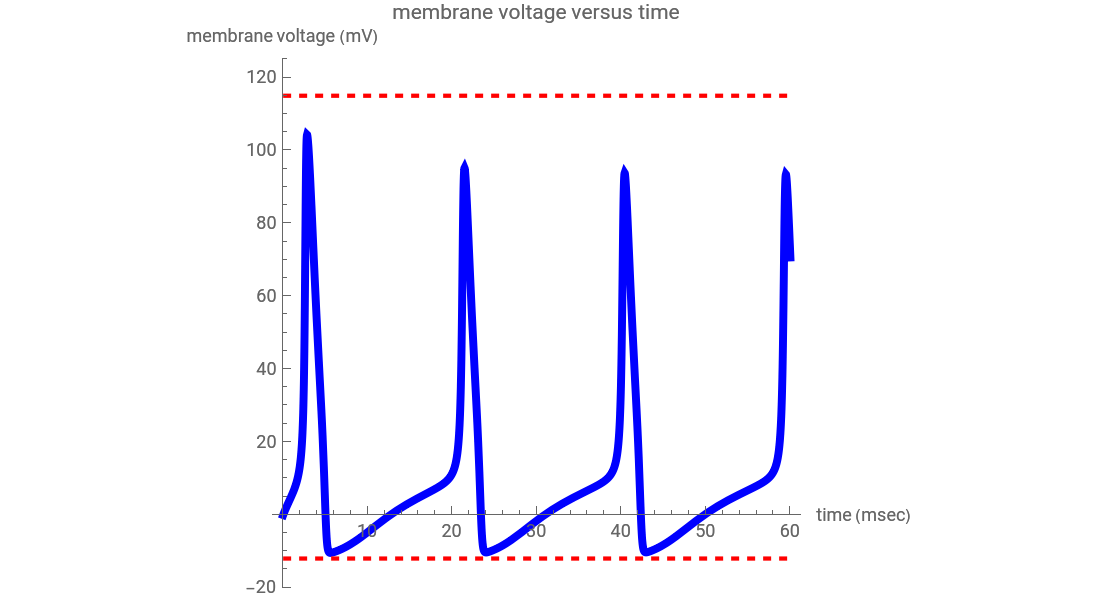
Electrical properties of neurons are described by the Hodgkin–Huxley (HH) model with multiple phenomenological parameters. They include the axon-membrane capacitance and the equilibrium potentials and conductances for sodium, potassium, and leakage channels. A signature of an HH neuron is the spiking membrane-voltage response to a stimulus current above a threshold. This Demonstration plots the "action potential" response, and shows that it is robust even in the absence of membrane capacitance or leakage channels, or a significant variation in the equilibrium potentials for the sodium (potassium) channel, shown by the top (bottom) dashed red line.
Details
Details
The memristive nature of sodium and potassium channels in the HH model, along with increasing interest in memristors, raises the following question: What is the minimal HH model that shows the salient properties of a neuron? This Demonstration selectively eliminates parts of the HH model and plots the resultant voltage response for a DC stimulus current.
Snapshot 1: for an HH model, sub-threshold stimulus current gives graded membrane voltage response that decays with time
Snapshot 2: the action-potential behavior persists after removing the capacitor and increasing the sodium equilibrium voltage
Snapshot 3: the action-potential behavior persists with only sodium and potassium channels, and vanishing potassium equilibrium voltage
External Links
External Links
Permanent Citation
Permanent Citation
Qurat-ul-Ann (Anna) Mirza, Yogesh Joglekar
"Minimal Hodgkin-Huxley Model: DC Stimulus"
http://demonstrations.wolfram.com/MinimalHodgkinHuxleyModelDCStimulus/
Wolfram Demonstrations Project
Published: February 13, 2013