This article demonstrates a generalized version of Thales’s theorem in ellipse.
Right triangle in circle
Right triangle in circle
One can retrieve the original version of the Thales’ theorem either from:
◼
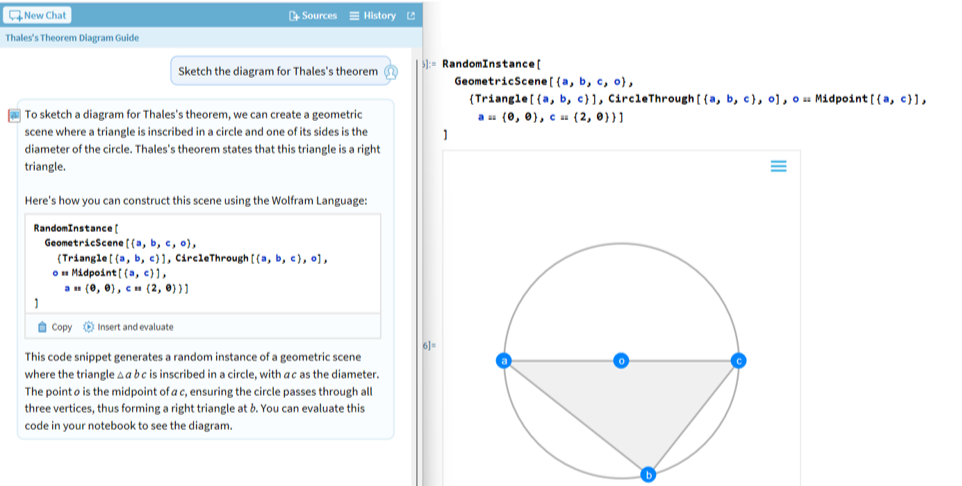
Notebook Assistance interface and code
◼
Entity framework
In[]:=
Out[]=
In[]:=
Out[]=
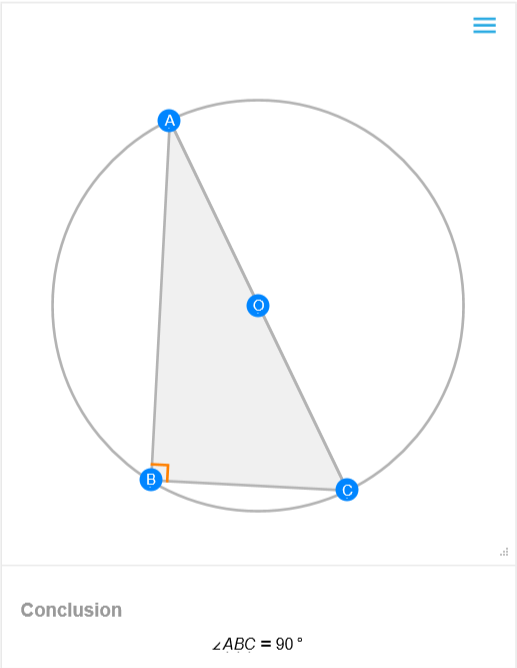
If , and are points on a circle and the line passes through the center of the circle, then the angle is a right angle.
A
B
C
AC
O
∠ABC
In[]:=
Out[]=
◼
Wolfram Alpha interface
In[]:=
Thales' theorem
Right triangle in an ellipse
Right triangle in an ellipse
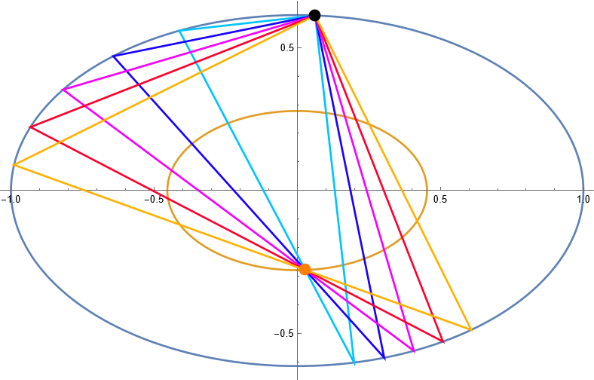
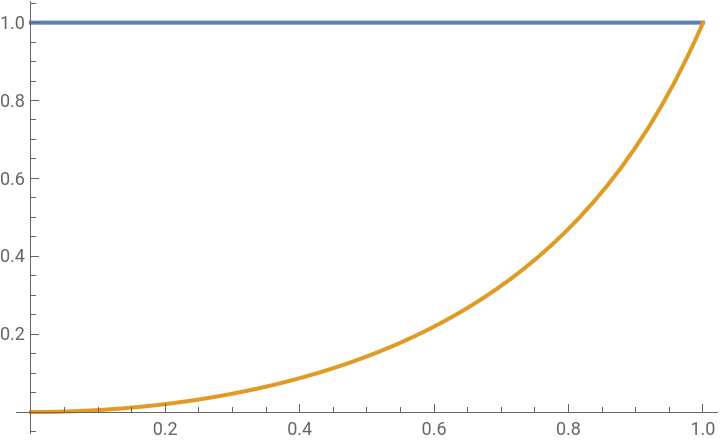
Given the black point sitting on the boundary of an ellipse with the length of major axis =1 and eccentricity = . If the black point is also the 90-degree vertex of any inscribed right triangle, the hypotenuse of all such right triangles meet at one fixed point (orange). This fixed point is uniquely determined by the location of the black point. If the black point travels alone the ellipse, the trajectory of the orange point is also an ellipse. The inner ellipse comes from shrinking the outer one by a factor of .Notice this expression is less than one for .
e
2
e
2-
2
e
0<e<1
In[]:=
Plot[{1,ecc^2/(2-ecc^2)},{ecc,0,1},PlotLegends->"Expressions"]
Out[]=


When , the degenerated case is that the outer ellipse is circle. Then the fixed point and the inner ellipse becomes the origin, which is exactly the setup in Thales’ theorem: the mid point of hypotenuse of inscribed right triangle is the center of the reference circle. What’s more, if the black point travels counter-clockwise alone the outer ellipse, the orange point travels clockwise.
e=0
The following code creates the animation in the post, where the variable is slope of some hypotenuse:
k
In[]:=
DynamicModule{x0,y0,shrink},Manipulateshrink=ecc^2(2-ecc^2);x0=Cos[θ];y0=),(-y0+(1-ecc^2)(-2kx0+y0))((1-ecc^2)+),{x0,-y0},With{k=Tan[θ+i*Degree]},IfAbs[k]<1000.,(x0+(-1+)x0+2ky0)(1-(-1+)),(y0+(-1+)k(2x0+ky0))(-1+(-1+)),{-x0,y0},{i,10,10+n*5,5},PointSize[0.02],Orange,Pointshrink*Cos[θ],-shrink
1-ecc^2
Sin[θ];ParametricPlotCos[t],1-ecc^2
Sin[t],shrink*Cos[t],-shrink1-ecc^2
Sin[t],{t,-π,π},PlotRange->{{-1.05,1.05},{-1.05,1.05}},AspectRatio->1,ImageSize->600,Epilog->TableEdgeForm[{Thick,Hue[i/(10+n*5)+1/4]}],Transparent,Triangle{x0,y0},With{k=Tan[θ+i*Degree]},IfAbs[k]<1000.,(-(1-ecc^2)x0+k(kx0-2y0))(1-ecc^2+2
k
2
k
2
k
2
ecc
2
k
2
ecc
2
k
2
ecc
2
ecc
2
k
1-ecc^2
Sin[θ],PointSize[0.02],PointCos[θ],1-ecc^2
Sin[θ],{{ecc,0.3,"Eccentricity"},0.3,0.9},{{θ,-π,"Rt. Vertex"},-π,3π},{{n,0,"# of Rt."},0,8},TrackedSymbols:>{ecc,θ,n}CITE THIS NOTEBOOK
CITE THIS NOTEBOOK
Thales' theorem in an ellipse
by Shenghui Yang
Wolfram Community, STAFF PICKS, December 11, 2024
https://community.wolfram.com/groups/-/m/t/3337073
by Shenghui Yang
Wolfram Community, STAFF PICKS, December 11, 2024
https://community.wolfram.com/groups/-/m/t/3337073