Batch Rectification of pentane, hexane, heptane and octane mixture
Authors: Housam Binous and Ahmed Bellagi
Batch Rectification of pentane, hexane, heptane and octane mixture
Authors: Housam Binous and Ahmed Bellagi
Authors: Housam Binous and Ahmed Bellagi
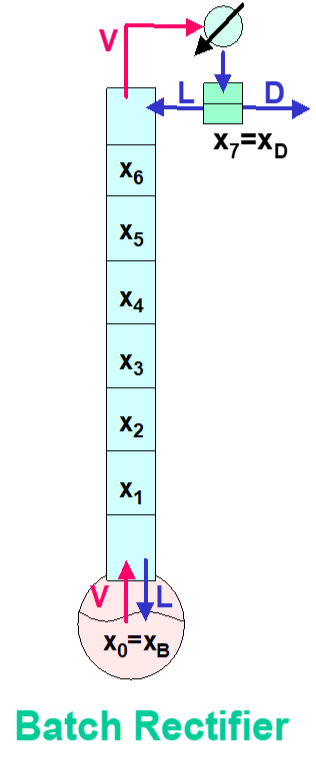
Batch Rectification of pentane, hexane, heptane and octane mixture.
Reflux ratio is 5 and number of theoretical stages is 7.
Pentane = component 1
Hexane = component 2
Heptane = component 3
Octane = component 4
The method of solution is based on Doherty and Malone's textbook Conceptual Design of Distillation Systems page 395. It uses constant molar overflow assumption to get the equation of the operating line. The method also relates the composition of the still and distillate thanks to the overall and components quasi-steady-state material balances. The solution given here uses equilibrium relationships, operating lines and Dalton's law to compute the distillate composition for a given still composition. Then, Euler's method is used to compute the still composition at a later time using a time step equal to h=0.01.
Still initial composition: 25% Pentane, 25% Hexane, 25% Heptane and 25% Octane.
Reference: Doherty and Malone, Conceptual Design of Distillation Systems, McGraw-Hill, 2001
Total Pressure
In[]:=
P=101.325;
Reflux ratio
In[]:=
r=5.;
Vapor Pressure of Pentane (component 1), Hexane (component 2), Heptane (component 3) and Octane (component 4).
In[]:=
PS[i_,1]:=Exp[63.3315-5117.78/T[i]-7.48305Log[T[i]]+7.7660610^-6T[i]^2];PS[i_,2]:=Exp[70.4265-6055.60/T[i]-8.37865Log[T[i]]+6.6166610^-6T[i]^2];PS[i_,3]:=Exp[78.3285-6947.00/T[i]-9.44866Log[T[i]]+6.4748110^-6T[i]^2];PS[i_,4]:=Exp[86.9970-7890.60/T[i]-10.6255Log[T[i]]+6.4744110^-6T[i]^2];
Boiling temperature of pentane, hexane, heptane and octane
In[]:=
FindRoot[PS[i,1]P,{T[i],300}]
Out[]=
{T[i]309.31}
In[]:=
FindRoot[PS[i,2]P,{T[i],300}]
Out[]=
{T[i]342.384}
In[]:=
FindRoot[PS[i,3]P,{T[i],300}]
Out[]=
{T[i]371.803}
In[]:=
FindRoot[PS[i,4]P,{T[i],300}]
Out[]=
{T[i]399.08}
Operating Line
In[]:=
Op[i_,n_]:=y[i-1,n]r/(r+1)x[i,n]+1/(r+1)x[7,n]
Raoult’s Law
In[]:=
Ra[i_,n_]:=y[i,n]x[i,n]PS[i,n]/P
Dalton Law
In[]:=
Da[i_]:=PSum[x[i,n]PS[i,n],{n,1,4}]
Forming the system of equations to be solved by FindRoot
In[]:=
Sys3=Table[Op[i,n],{n,1,4},{i,1,7}];Sys4=Table[Ra[i,n],{n,1,4},{i,0,6}];Sys5=Table[Da[i],{i,0,7}];System2=Flatten[Join[Sys3,Sys4,Sys5]];
Initial condition (composition of still)
In[]:=
xB[1][0]=0.25;xB[2][0]=0.25;xB[3][0]=0.25;xB[4][0]=0.25;
Integration using Euler's method. Please note that computation may take 15 minutes. Distillate composition is printed.
In[]:=
h=0.01;i=0;
In[]:=
While[i<200,{x[0,1]=xB[1][i],x[0,2]=xB[2][i],x[0,3]=xB[3][i],x[0,4]=xB[4][i],sol=FindRoot[System2,{x[1,1],0.5},{x[2,1],0.5},{x[3,1],0.5},{x[4,1],0.5},{x[5,1],0.5},{x[6,1],0.5},{x[7,1],0.5},{x[1,2],0.5},{x[2,2],0.5},{x[3,2],0.5},{x[4,2],0.5},{x[5,2],0.5},{x[6,2],0.5},{x[7,2],0.5},{x[1,3],0.5},{x[2,3],0.5},{x[3,3],0.5},{x[4,3],0.5},{x[5,3],0.5},{x[6,3],0.5},{x[7,3],0.5},{x[1,4],0.5},{x[2,4],0.5},{x[3,4],0.5},{x[4,4],0.5},{x[5,4],0.5},{x[6,4],0.5},{x[7,4],0.5},{y[0,1],0.5},{y[1,1],0.5},{y[2,1],0.5},{y[3,1],0.5},{y[4,1],0.5},{y[5,1],0.5},{y[6,1],0.5},{y[0,2],0.5},{y[1,2],0.5},{y[2,2],0.5},{y[3,2],0.5},{y[4,2],0.5},{y[5,2],0.5},{y[6,2],0.5},{y[0,3],0.5},{y[1,3],0.5},{y[2,3],0.5},{y[3,3],0.5},{y[4,3],0.5},{y[5,3],0.5},{y[6,3],0.5},{y[0,4],0.5},{y[1,4],0.5},{y[2,4],0.5},{y[3,4],0.5},{y[4,4],0.5},{y[5,4],0.5},{y[6,4],0.5},{T[0],320},{T[1],320},{T[2],320},{T[3],320},{T[4],320},{T[5],320},{T[6],320},{T[7],320},MaxIterations1000],xD[1][i]=Chop[sol[[7,2]]],xD[2][i]=Chop[sol[[14,2]]],xD[3][i]=Chop[sol[[21,2]]],xD[4][i]=Chop[sol[[28,2]]],TD[i]=sol[[64,2]],TB[i]=sol[[57,2]],xB[1][i+1]=xB[1][i]+h(xB[1][i]-xD[1][i]),xB[2][i+1]=xB[2][i]+h(xB[2][i]-xD[2][i]),xB[3][i+1]=xB[3][i]+h(xB[3][i]-xD[3][i]),xB[4][i+1]=xB[4][i]+h(xB[4][i]-xD[4][i]),Print[i," ",xD[1][i]," ",xD[2][i]," ",xD[3][i]," ",xD[4][i]],i++}]
0 0.998917 0.00108212 5.56242× 2.71419×
-7
10
-10
10
1 0.998855 0.00114405 5.91962× 2.90816×
-7
10
-10
10
2 0.998787 0.0012124 6.31691× 3.12557×
-7
10
-10
10
3 0.998711 0.00128819 6.76101× 3.37058×
-7
10
-10
10
4 0.998627 0.00137265 7.2602× 3.64835×
-7
10
-10
10
5 0.998532 0.00146731 7.82475× 3.96532×
-7
10
-10
10
6 0.998425 0.00157408 8.46758× 4.32968×
-7
10
-10
10
7 0.998304 0.00169534 9.20512× 4.75195×
-7
10
-10
10
8 0.998165 0.00183415 1.00586× 5.24586×
-6
10
-10
10
9 0.998004 0.0019945 1.10559× 5.82961×
-6
10
-10
10
10 0.997817 0.0021816 1.22341× 6.52777×
-6
10
-10
10
11 0.997596 0.00240252 1.3644× 7.37433×
-6
10
-10
10
12 0.997331 0.00266697 1.53563× 8.41735×
-6
10
-10
10
13 0.99701 0.00298867 1.7473× 9.72691×
-6
10
-10
10
14 0.99661 0.00338766 2.01448× 1.14087×
-6
10
-9
10
15 0.996103 0.00389429 2.36051× 1.36289×
-6
10
-9
10
16 0.995441 0.00455664 2.82316× 1.66622×
-6
10
-9
10
17 0.994541 0.00545541 3.4674× 2.09917×
-6
10
-9
10
18 0.99326 0.00673601 4.41392× 2.7539×
-6
10
-9
10
19 0.991308 0.00868628 5.91057× 3.82571×
-6
10
-9
10
20 0.988039 0.0119525 8.54108× 5.79294×
-6
10
-9
10
21 0.981731 0.0182554 0.0000139686 1.00911×
-8
10
22 0.96679 0.0331821 0.0000282324 2.23462×
-8
10
23 0.925939 0.0739859 0.0000748463 6.73877×
-8
10
24 0.844723 0.155081 0.000195691 2.00768×
-7
10
25 0.744194 0.255407 0.000398354 4.51621×
-7
10
26 0.642841 0.356487 0.000671575 8.21224×
-7
10
27 0.547643 0.45135 0.0010055 1.30547×
-6
10
28 0.461289 0.537319 0.00138992 1.89506×
-6
10
29 0.384757 0.613426 0.00181375 2.57565×
-6
10
30 0.318142 0.679588 0.00226591 3.32991×
-6
10
31 0.261018 0.736241 0.00273643 4.14001×
-6
10
32 0.212651 0.784126 0.00321733 4.99004×
-6
10
33 0.172147 0.824144 0.00370305 5.86761×
-6
10
34 0.138551 0.857252 0.00419058 6.7647×
-6
10
35 0.110916 0.884397 0.00467931 7.67789×
-6
10
36 0.0883542 0.906466 0.00517072 8.60812×
-6
10
37 0.0700546 0.924268 0.00566806 9.56031×
-6
10
38 0.0553001 0.938513 0.0061761 0.0000105429
39 0.0434682 0.949819 0.00670091 0.0000115675
40 0.0340271 0.95871 0.0072498 0.0000126489
41 0.026529 0.965626 0.00783133 0.000013805
Distillate mole fraction of pentane, hexane, heptane and octane versus warped time. Components appear in distillate in order of volatility (pentane fisrt and octane last).
Still mole fraction of pentane, hexane, heptane and octane versus warped time
Temperatures of the still and distillate. Each time a component with sufficient purity exit the column, we reach a temperature plateau. The temperature at these four plateau are the boiling temperatures of pentane, hexane, heptane and octane. As expected, the still temperature is higher than the distillate temperature.