Carbon nanobelts, with their impressive mechanical properties, offer significant potential for science and technology. This project sets out to model nanobelts, and explore a possible scientific application. I generated three nanobelts from two different nanotubes, the cyclacene and möbius cyclacene belts from the zigzag nanotube, and the möbius armchair nanobelt from the armchair nanotube. Once building the nanotubes, I looked at the radius of the cyclacene nanobelt and explored the potential of nanobelts to secure other molecules with possible applications in actinide decorporation and more broad biotechnology fields.
Introduction
Introduction
Carbon Nanobelts (CNBs) are segments of Carbon Nanotubes, and consist of a series of fused rings. Due to their unique properties and uses in biotechnology and electricity, CNBs have caught the attention of scientists for decades. CNBs are emerging nanomaterials with numerous possibilities, including medical applications. In this project, I explore CNBs abilities for holding and securing other molecules. This possibility could be applied in the medical procedures and treatments regarding Actinide decorporation, the removal of actinides, a series of radioactive metallic elements such as uranium or plutonium, one being chelation therapy. In order to dive into carbon nanobelts, I’ll model different kinds of nanobelts and then explore the holding properties of the cyclacene by looking into an ion.
Modeling the Cyclacene Belt
Modeling the Cyclacene Belt
The three types of single-walled Carbon nanotubes are armchair, zigzag, and chiral. Cyclacenes are the shortest zigzag carbon nanobelt. Proposed in 1954 as hypothetical models and synthesized in the late 1980’s, cyclacenes consist of fully fused benzene rings in a loop. his will be done in two parts; first I’ll make the polymer by creating a long strip of rings, an unconnected belt, and then I’ll connect it. While modeling the belt, I realized I needed to find a repeating unit that could repeatedly connect to finally form a belt. Through looking at the diagram of the cyclacene, I observed that the first four carbon bonds of the ring repeat, each connected by single bonds to the next.
Use MoleculePattern to create the repeating unit of 4 Carbon atoms with two double bonds:
In[]:=
cyclaceneMer1=MoleculePattern;


Pattern reactions take in reactants, products, and atom mapping (correlating what each atom’s coordinate on the reactant would be on the product). My repeating unit would be both of the reactants, but I needed to create a similar MoleculePattern to build the product. To connect both of the repeating units, there would need to be two single bonds in between them. Pattern Reactions allow me to repeatedly add rings so that I can eventually create a belt to the size of my preference. While in silico, you can grow the nanobelt through pattern reactions, growing nanobelts in the lab is different and involves organic synthesis.
Use MoleculePattern to create two reactants bonded to each other, store the atom mapping in a variable, and create the PatternReaction:
In[]:=
cyclaceneMer2=MoleculePattern;cyclaceneAtomMapping={{1,1}{1,1},{1,2}{1,2},{1,3}{1,3},{1,4}{1,4},{2,1}{1,7},{2,2}{1,8},{2,3}{1,5},{2,4}{1,6}};cyclacenePatternReaction=PatternReaction[{cyclaceneMer1,cyclaceneMer1}->{cyclaceneMer2},cyclaceneAtomMapping]

Out[]=
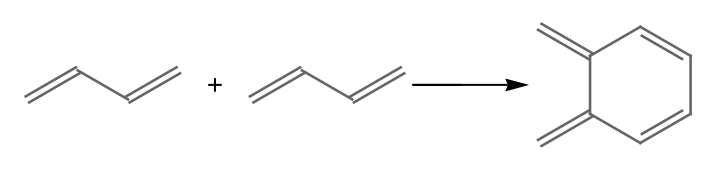
The PatternReaction can now be Applied to more reactants to create an unconnected belt.
Store the reactants as molecules and create a function for the ApplyReaction:
In[]:=
cyclaceneReactant=Molecule;ClearAll[buildBelt]buildBelt[mol_Molecule]:=First[ApplyReaction[cyclacenePatternReaction,{cyclaceneReactant,mol}]]

I’ll show an example of the buildBelt function. To grow the belt, you have to manually replace the input with the previous output to generate the belt of desired size. The output also gives multiple options, which will both be fixed in the next part.
Apply the function and use the previous output as the new input as many times as desired.
In[]:=
buildBelt[cyclaceneReactant]
Out[]=
Molecule

In[]:=
buildBeltMolecule
Out[]=
Molecule
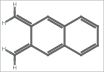
Based on the visualization of the belt, I can see that when connecting the ends, it needs to connect at atom 2 and 3. The coordinates of the atoms that connect to atoms 2 and 3 increase by 4 each time a ring is added. Using that knowledge, I created two functions to determine the coordinates of the connection points and a function that builds the cyclacenes. Initially, the belt builds twisted, which is why it’s necessary to optimize the belt using the first level of optimization, MMFF. As explained previously, we’ll need to nest the buildBelt function to get the length of choice, and select the molecule itself.
Create a function for both atoms 2 and 3 using the pattern recognized, create the function by nesting buildBelt and using Molecule Modifies, add both of the new bonds to connect the ends of the strip into a ring, and clean it up through EnergyMinimizeAtomCoordinates:
In[]:=
BondTo2[x_Integer]:=8+((x-1)4)-1BondTo3[x_Integer]:=8+((x-1)4)buildCyclacenes[n_Integer]:=MoleculeModify[MoleculeModify[MoleculeModify[Nest[buildBelt[#]&,cyclaceneReactant,n],{"AddBond",{3,BondTo3[n]}}],{"AddBond",{2,BondTo2[n]}}],{"EnergyMinimizeAtomCoordinates","MMFF"}]
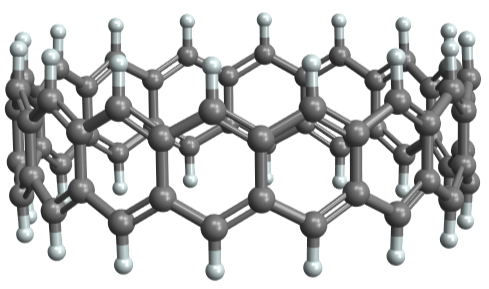
We can now create a belt with as many rings as we’d like. For example, to create a 16 belt ring, we’d use the function buildCyclacenes, and use 15 as n as we need 15 reactions to occur.
The output returns the molecule, the 2D plot, and the 3D plot:
In[]:=
buildCyclacenes[15]MoleculePlot@buildCyclacenes[15]MoleculePlot3D@buildCyclacenes[15]
Out[]=
Molecule

Out[]=
Variations of Nanobelts
Variations of Nanobelts
Möbius Cyclacene
Möbius Cyclacene
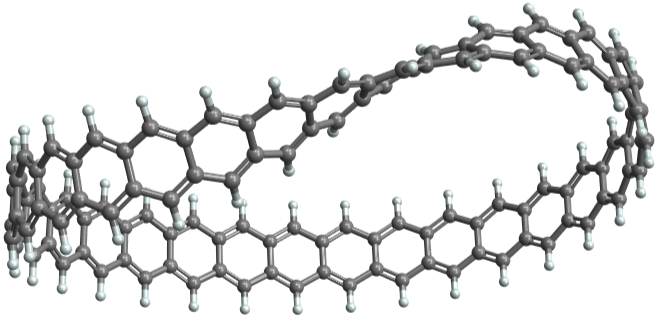
After creating the standard Cyclacene, I wanted to explore additional nanobelts that I could create. The Möbius Cyclacene interested me as it was a variation of the Cyclacene I had already modeled. The Möbius Cyclacene Belt has fascinating electronic properties with promising applications. In order to generate this belt, it was a simple tweak to the original cyclacene belt. Once the Cyclacene strip is created, if the connection points are switched, it is now a möbius belt.
Switch the functions BondTo2 and BondTo3 in the overall function, effectively switching the connection points, creating a Möbius Cyclacene:
In[]:=
buildMobiusCyclacenes[n_Integer]:=MoleculeModify[MoleculeModify[MoleculeModify[Nest[buildBelt[#]&,cyclaceneReactant,n],{"AddBond",{3,BondTo2[n]}}],{"AddBond",{2,BondTo3[n]}}],{"EnergyMinimizeAtomCoordinates","MMFF"}]MoleculePlot3D@buildMobiusCyclacenes[30]
Möbius Armchair Carbon Nanobelt
Möbius Armchair Carbon Nanobelt
After creating the cyclacene nanobelts, I tackled creating a nanotube stemming from the armchair nanotube, rather than the zigzag nanotube. This möbius belt is similar to the möbius cyclacene; however, the repeating unit slightly different for this. Following the same steps as the original Cyclacene belt, I simply switched the reactants and products for the patterns.
Use MoleculePattern to create the repeating unit of 3 and a half rings:
In[]:=
armChairMer1=MoleculePattern;
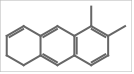
Pattern reactions take in reactants, products, and atom mapping (correlating the different coordinates from reactant to product). My repeating unit would be both of the reactants, but I needed to create a similar MoleculePattern to build the product.
Use MoleculePattern to create two reactants bonded to each other, store the atom mapping in a variable, and create the PatternReaction:
In[]:=
armChairMer2=MoleculePattern;armChairAtomMapping=;armChairPatternReaction=PatternReaction[{armChairMer1,armChairMer1}->{armChairMer2},armChairAtomMapping]
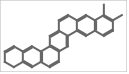
Out[]=
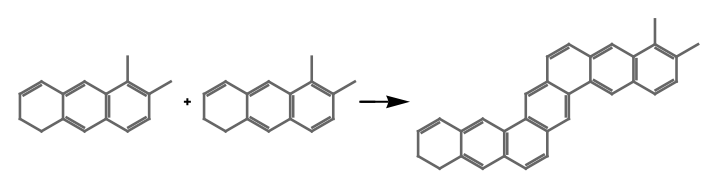
Similarly to above, in order to use an ApplyReaction, I needed to turn the molecule pattern into a molecule.
Store the reactants as molecules and create a function for the ApplyReaction:
In[]:=
armChairReactant=Molecule;buildArmChairBelt[mol_Molecule]:=ApplyReaction[armChairPatternReaction,{armChairReactant,mol},All]
The ApplyReaction created a long strip of the armchair reactants; however, we need to turn it into a belt. In order to do so, I needed to create two functions to find the atoms that should bond to each other and then create a function that creates the bonds and optimizes it.
Create a function to account for the atoms to connect to atoms 4 and 5. Similarly to the Cyclacene, nest the build belt function so that the new molecule is replaced with the second reactant in order for the first result to be the result desired and take only the first element using part. Then, using Molecule Modifies, add both of the new bonds to connect the ends of the strip into a ring, and clean it up through EnergyMinimizeAtomCoordinates:
Applications
Applications
Biomedical possibilities for Nanobelts is a promising area. Regarding the modeling of carbon nanobelts, I wondered about their abilities to hold other molecules effectively. Nanobelts could potentially help in actinide decorporation, specifically chelation therapy. In order to explore this, I looked at radius. I wanted to create a function that could take the radius of a molecule, and return the number of reactions necessary to the cyclacene for the size to be optimal. I first created a function that calculates the radius of a given nanobelt depending on how many pattern reactions it’s been through.
After figuring out the points that are across from each other, calculate the interatomic distance and divide it by 2 to achieve the radius of a cyclacene:
I then created a list of the radius of the cyclacenes from 3 rings to 80. The radius’ grow in a linear fashion as each ring is added, so I stored the difference in a variable in order to create the list.
Create the list using range and set the minimum, the maximum, and the step between list items (difference). Store the resulting list into a variable:
Convert the input given into angstroms and use the Nearest function to match it to the nearest item on the list of Cyclacene diameters. Then get rid of the brackets and add 2 to the string to get the result. Apply the Fe3+ to the function:
Conclusion
Conclusion
Through this project, I developed three different functions that built and modeled the nanobelts cyclacene, möbius cyclacene, and the möbius armchair belt with limits ranging from 80-100 rings. Additionally, to explore the cyclacene’s ability to secure other molecules, I generated a function which can take the radius of another molecule and return the size of the cyclacene necessary, indicating that it is feasible. This demonstrates a possible biotechnological and medical application that can be explored.
Future Directions
Future Directions
Future work to extend this project offers a multitude of possibilities. One possible addition could be creating more types of rings, and potentially generating nanotubes. Another direction is to use a higher level of quantum chemistry to model both the belts and the ions in one big calculations. With these additional and improved belts, one could also explore their abilities to hold other molecules and create larger functions that determines the best nanobelt to hold a molecule of choice.
Acknowledgements
Acknowledgements
Thank you to my mentor Jason Sonnenberg and the teaching assistants Alexander Do and Jenny Wang for helping me through the project.
References
References
CITE THIS NOTEBOOK
CITE THIS NOTEBOOK
Building nanobelts in silico
by Ananya Thota
Wolfram Community, STAFF PICKS, July 11, 2024
https://community.wolfram.com/groups/-/m/t/3214865
by Ananya Thota
Wolfram Community, STAFF PICKS, July 11, 2024
https://community.wolfram.com/groups/-/m/t/3214865