A condition for the Wolfram Physics Project (WPP) is its ability to generate a particle-like structure, and a key assertion for such structures is its ability to persist. Hence, it’s essential to study how the emergent structures stay stable under the hypergraph rewritings. This study aims to explore the stability of multiple rewriting rules.
1.Hypergraphs And Particle-Like Structures
1.Hypergraphs And Particle-Like Structures
1.1.Background
◼
Motivation
Particles are entities in the universe that possess localized structures which are preserved as they evolve through spacetime. Under the assumption of the Wolfram Physics Project (WPP) that the universe is fundamentally discrete and can be generated by simple rules, it is reasonable to assume that such rules produce structures that is conserved during evolution. In this work, we test how different rules preserve their structures when iterated over successive steps, a property referred to as stability.
◼
Relevant Definitions
-Branchial Graph BG := Summary of the multiway evolution where only the final states at a particular “time_step” t are apparent and if they are “historically” connected or not.
-Branchial Stability := Measure of how stable a rule is across time (steps) by assessing whether BG(t) is similar to BG(t+1), i.e., the vertices (states) do not change dramatically between t and t+1.
-Branchial Stability := Measure of how stable a rule is across time (steps) by assessing whether BG(t) is similar to BG(t+1), i.e., the vertices (states) do not change dramatically between t and t+1.
1.2. Methodology
◼
A list of rules is defined for the analysis.
◼
The branchial graphs are computed for each rule at successive time steps(t...tMax).
◼
The stability of the branchial graphs is evaluated across the time steps, and then the mean stability is computed.
◼
A grid of BG(t) is generated for the top 3 rules.
1. Setup
1. Setup
2.Bulling BG(t) For t=1 -->t= tMax
2.Bulling BG(t) For t=1 -->t= tMax
Define variables and a string rule :
In[]:=
tMax=6;timeLimit=2;maxVettices=800;maxEdges=3000;init="AABAA";rules={"A""AB","B""A"};
A function that generates a multiway graph by inputting a rule and initial state :
mw=mwMake[rules,init];bgRaw=safeEval@mwBranchialGraph[mw,3];Head[bgRaw]GraphQ[bgRaw]
Out[]=
Graph
Out[]=
True
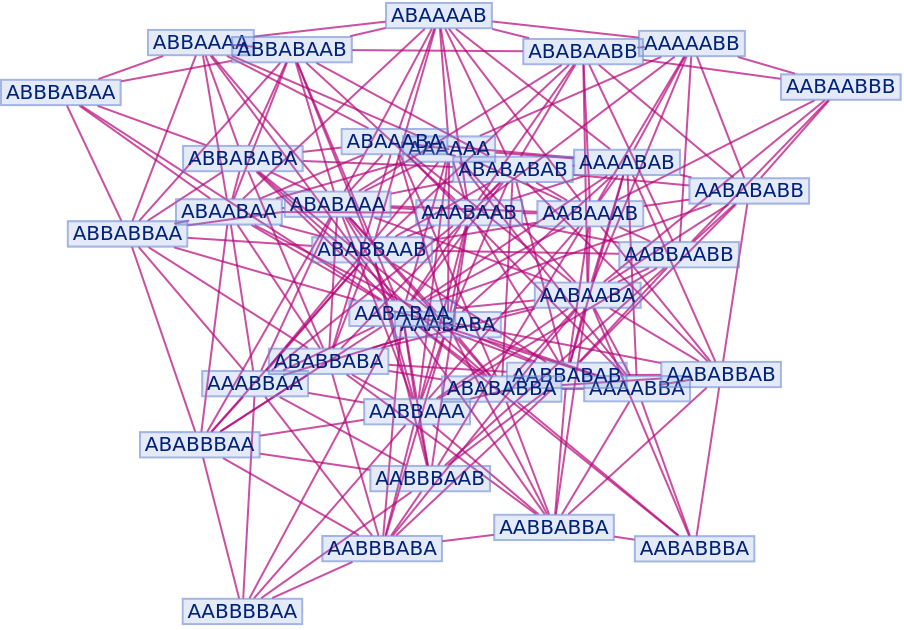
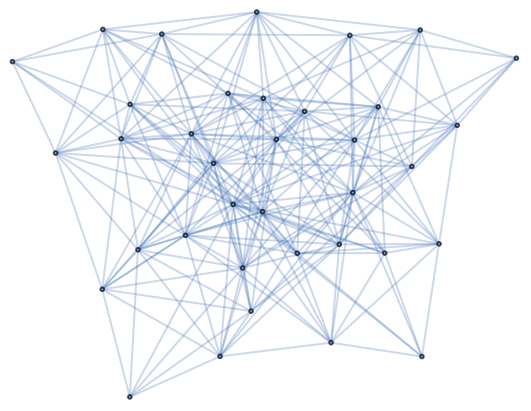
plot BG (t) for the rule defined above:
bg3=toGraph[bgRaw];Graph[bg3]bgPlot[bg3]
Out[]=
Out[]=
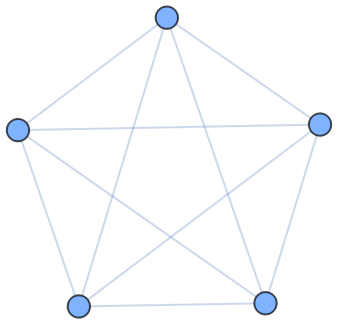
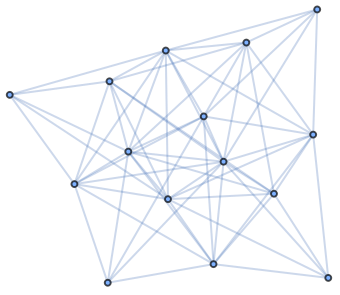
Plot BG (t) from t = 1 to t = tMax :
bgs=Table[With[{g=toGraph@safeEval@mwBranchialGraph[mw,t]},If[g===$Failed,Missing["Failed"],g]],{t,1,tMax}];Row[Table[If[MissingQ[bgs[[t]]],Style["failed at t="<>ToString[t],Red],Labeled[bgPlot[bgs[[t]]],"t="<>ToString[t],Top]],{t,1,tMax}],Spacer[10]]
Out[]=
t=1 |

t=2 |
t=3 |
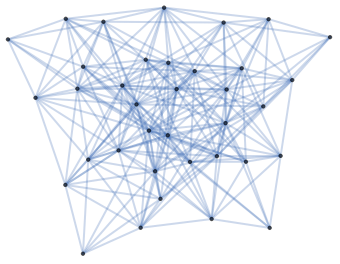
t=4 |
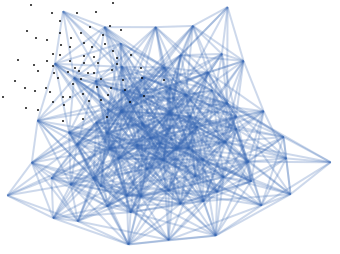
t=5 |
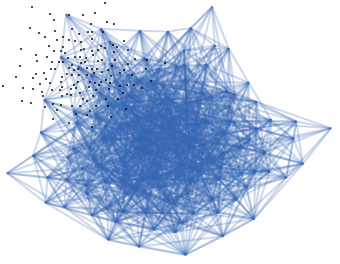
t=6 |
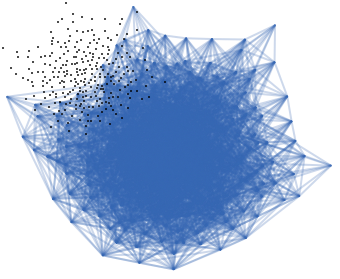
3. Simple Graph Metrics Per Time Step
3. Simple Graph Metrics Per Time Step
This define a metric graph function :
In[]:=
graphMetrics[g_Graph]:=Module[{ug,comps},ug=analysisGraph[g];comps=ConnectedComponents[ug];<|"VertexCount"->VertexCount[ug],"EdgeCount"->EdgeCount[ug],"ComponentCount"->Length[comps],"LargestComponentSize"->If[comps==={},0,Max[Length/@comps]]|>];
Evaluate it for the rule at hand :
metrics=Table[If[GraphQ[bgs[[t]]],graphMetrics[bgs[[t]]],Missing["Failed"]],{t,1,tMax}];Dataset[metrics]
Out[]=
Plot the behaviour of VertexCount & EdgeCount with steps t :
We can see that edges grow faster than vertices, and aligns with intuition when we see the plots above .
4. Similarity Across Time (t --> t+1)
4. Similarity Across Time (t --> t+1)
4.1 Jaccard Similarity J(set1,set2)
Jaccard similarity is a way to measure how similar two sets are, with values ranging from 0 to 1.
Let A, and B be sets. The Jaccard similarity J(A,B) is defined as:
∣A∪B∣\∣A∩B∣.
For this model, we can assess how similar two graphs are by computing the Jaccard similarity of their edge sets; however, this approach has limitations, because generally vertices at t+1 are not the same as vertices at 1, then the overlap will be near zero even if the overall shape of B(t) and B(t+1) are similar..
Define the a function that returns the values of jaccard similarity of two graphs :
See how similar BG (t) and BG (t + 1) are :
6.Many Rules + Ranking (Results)
6.Many Rules + Ranking (Results)
We now test the stability of a list of rules using a StabilityScore, which is based on degree, component, and size similarity and is label -free (the exact code and definitions is in the previous cell) :
Visualize top string rules across time :
7.Future work
7.Future work
In this work, we study the stability of different rules using simple stability scores. A key goal for future work is to explore in greater depth the rules that generate localized structures and to examine how these structures persist over time.
8.Acknowledgments
8.Acknowledgments
I would like to express my deepest gratitude to my mentor, Fatima Alhazmi, for her guidance and support throughout the program. I am also sincerely thankful to all the Wolfram staff who made this opportunity possible and turned these two weeks into a period rich with knowledge and new ideas. I am deeply grateful.
Special thanks go to Stephen Wolfram for his insightful feedback on my work and for sharing new scientific perspectives and ideas.
I have learned a great deal and discovered new ways of thinking, and I am excited to apply what I have learned in the future.
Special thanks go to Stephen Wolfram for his insightful feedback on my work and for sharing new scientific perspectives and ideas.
I have learned a great deal and discovered new ways of thinking, and I am excited to apply what I have learned in the future.
CITE THIS NOTEBOOK
CITE THIS NOTEBOOK
Branchial graph stability
by Rehab Almakrami
Wolfram Community, STAFF PICKS, January 15, 2026
https://community.wolfram.com/groups/-/m/t/3607514
by Rehab Almakrami
Wolfram Community, STAFF PICKS, January 15, 2026
https://community.wolfram.com/groups/-/m/t/3607514