Separation of binary mixtures by chromatography
Authors: Housam Binous and Ahmed Bellagi
Separation of binary mixtures by chromatography
Authors: Housam Binous and Ahmed Bellagi
Authors: Housam Binous and Ahmed Bellagi
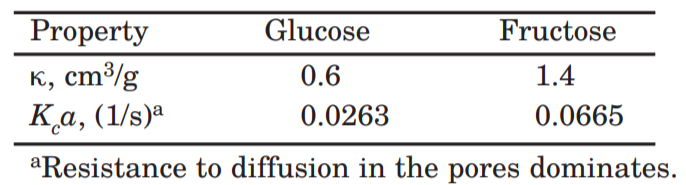
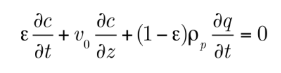
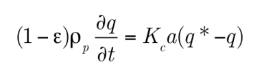
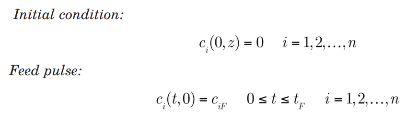
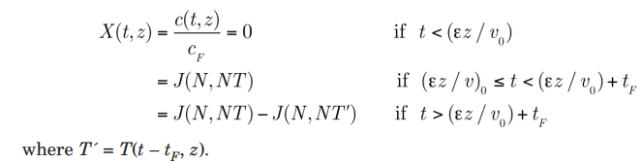
We propose to separate an aqueous solution containing 2 g/cm3 each of glucose and fructose by chromatography . The superficial velocity is 0.05 cm/s, the bed porosity is 39 %, and the bulk density of the bed is 0.5 g/cm3. The length of the bed is 2.0 m; the duration of the feed pulse is 500 s followed by elution with pure water .Also given:If one assumes linear adsorption isotherm and drop any axial dispersion then the system of equations with initial and boundary conditions are :Vermulen et al . have been solved this problem assuming no interaction between the solutes Ref . 1 - 2. This solution is given below :and (x) is the modified Bessel function of the first kind and zero order.Here, we compare our results with those reported in Ref. 2 using Mathcad.
with
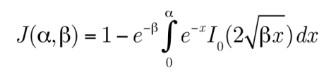
I
0
References :
[1] Vermeulen, T ., G . Klein, and N . K . Hiester, in J . H . Perry (ed .), Perry' s Chemical Engineers' Handbook, 5 th ed ., McGraw - Hill, New York (1973) .
[2] Jaime Benitez, Principles And Modern Applications Of Mass Transfer Operations, 3rd edition, NY: Wiley, 2017.
[1] Vermeulen, T ., G . Klein, and N . K . Hiester, in J . H . Perry (ed .), Perry' s Chemical Engineers' Handbook, 5 th ed ., McGraw - Hill, New York (1973) .
[2] Jaime Benitez, Principles And Modern Applications Of Mass Transfer Operations, 3rd edition, NY: Wiley, 2017.
The superficial velocity is 0.05 cm/s
In[]:=
v0=0.05;
The length of the bed is 2.0 m
In[]:=
Z=200;
The bed porosity is 39 %
In[]:=
ep=0.39;
The bulk density of the bed is 0.5 g/cm3
In[]:=
rhob=500;
Overall volumetric mass-transfer coefficient for glucose
In[]:=
Kca=0.0263;
Linear Adsorption coefficient for fructose
In[]:=
k=0.0006;
In[]:=
epZ/v0
Out[]=
1560.
In[]:=
NGz=KcaZ/v0
Out[]=
105.2
In[]:=
TGz=v0(t-epZ/v0)/rhob/Z/k;
In[]:=
TGz2=v0(t-500-epZ/v0)/rhob/Z/k;
In[]:=
f[a_,b_]:=1-Exp[-b]NIntegrate[Exp[-x]BesselI[0,2Sqrt[bx]],{x,0,a}]
In[]:=
g[t_]:=If[t<=1560,0,If[1560<=t<=1560+500,f[NGz,NGzTGz],f[NGz,NGzTGz]-f[NGz,NGzTGz2]]]
In[]:=
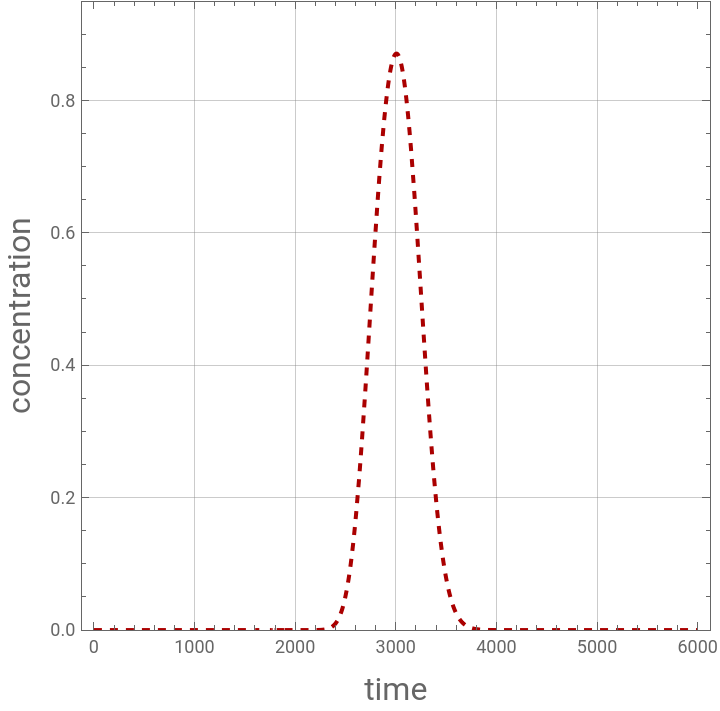
p1=Plot[g[t],{t,0,6000},PlotRange->{All,{0,0.95}},ImageSize->Medium,PlotStyle->{Thick,Dashed,Darker@Red},Frame->True,GridLines->Automatic,AspectRatio->1,FrameLabel->{Style["time",16],Style["concentration",16]}]
Out[]=
Overall volumetric mass-transfer coefficient for fructose
In[]:=
Kca=0.0665;
Linear Adsorption coefficient for fructose
In[]:=
k=0.0014;
In[]:=
epZ/v0
Out[]=
1560.
In[]:=
NGz=KcaZ/v0
Out[]=
266.
In[]:=
rhob=500;
In[]:=
TGz=v0(t-epZ/v0)/rhob/Z/k;
In[]:=
TGz2=v0(t-500-epZ/v0)/rhob/Z/k;
In[]:=
f[a_,b_]:=1-Exp[-b]NIntegrate[Exp[-x]BesselI[0,2Sqrt[bx]],{x,0,a}]
In[]:=
g[t_]:=If[t<=1560,0,If[1560<=t<=1560+500,f[NGz,NGzTGz],f[NGz,NGzTGz]-f[NGz,NGzTGz2]]]
In[]:=
p2=Plot[g[t],{t,0,6000},PlotRange->{All,{0,0.95}},ImageSize->Medium,PlotStyle->{Thick,Dashed,Darker@Blue},Frame->True,GridLines->Automatic,AspectRatio->1,FrameLabel->{Style["time",16],Style["concentration",16]}]
Out[]=
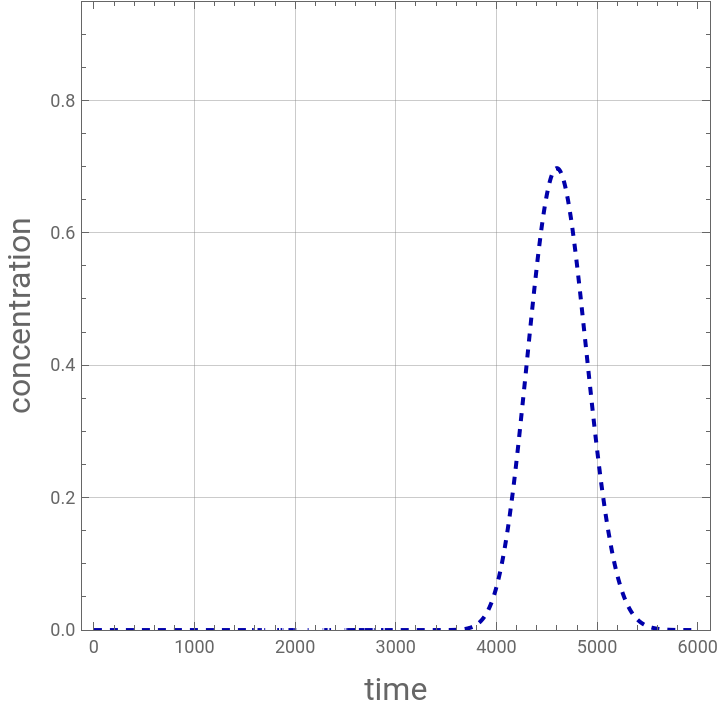
Comparison between our calculation and Figure 9.11 of Ref. 2.