ABSTRACT (original article): Compatibility with noisy intermediate - scale quantum (NISQ) devices is crucial for the realistic implementation of quantum cryptographic protocols . We investigate a cryptographic scheme based on discrete - time quantum walks (DTQWs) on cyclic graphs that exploits Parrondo dynamics, wherein periodic evolution emerges from a deterministic sequence of individually chaotic coin operators . We construct an explicit quantum circuit realization tailored to NISQ architectures and analyze its performance through numerical simulations in Qiskit under both ideal and noisy conditions . Protocol performance is quantified using probability distributions, Hellinger fidelity, and total variation distance . To assess security at the circuit level, we model intercept - resend and man - in - the - middle attacks and evaluate the resulting quantum bit error rate . In the absence of adversarial intervention, the protocol enables reliable message recovery, whereas eavesdropping induces characteristic disturbances that disrupt the periodic reconstruction mechanism . We further examine hardware feasibility on contemporary NISQ processors, specifically ibm_torino, incorporating qubit connectivity and state - transfer constraints into the circuit design . Our analysis demonstrates that communication between spatially separated logical modules increases circuit depth via SWAP operations, leading to cumulative noise effects . By exploring hybrid state - transfer strategies, we show that qubit selection and connectivity play a decisive role in determining fidelity and overall protocol performance, highlighting hardware - dependent trade - offs in NISQ implementations . CITATION (original article): Aditi Rath, Dinesh Kumar Panda, and Colin Benjamin (2026), NISQ - compatible quantum cryptography based on Parrondo dynamics in discrete - time quantum walks, arXiv:2602.14678, https://doi.org/10.48550/arXiv.2602.14678
1. Discrete-Time Quantum Walks on Cyclic Graphs
1. Discrete-Time Quantum Walks on Cyclic Graphs
1.1 Hilbert Space and Initial State
1.1 Hilbert Space and Initial State
A discrete-time quantum walk (DTQW) on a K-cycle graph evolves in the composite Hilbert space ⊗ , where is the K-dimensional position space spanned by {|x〉 : x ∈ {0,1,...,K-1}} and is the 2-dimensional coin space spanned by {|0〉, |1〉}. The walker is initialized at vertex |0〉 in a superposition of coin states:
H
C
H
P
H
P
H
C
|ϕ(0)〉=Cos0+Sin1|K=0〉
Θ
2
ω
Θ
2
where 0 ≤ Θ ≤ π and 0 ≤ ω < 2π.
1.2 The Coin Operator
1.2 The Coin Operator
The general coin operator takes the parametric form:
C(s,γ,δ)=
s | 1-s γ |
1-s δ | - s (γ+δ) |
with 0 ≤ s ≤ 1 and 0 ≤ γ, δ ≤ π. The parameter s controls the bias of the coin, while γ and δ introduce relative phases.
1.3 Shift Operator and Time Evolution
1.3 Shift Operator and Time Evolution
The conditional shift operator moves the walker counter-clockwise (clockwise) by one vertex conditioned on the coin state |0〉 (|1〉):
S
K
S
K
1
∑
l=0
F
l
F
l
K-1
∑
x=0
The single time - step unitary evolution operator is . The time evolution operator is formulated as: After t steps, the final state is given by |Φ(t)⟩ = |Φ(t = 0)⟩. If, after t = T steps, |Φ(t = T )⟩ = |Φ(0)⟩ = |Φ(0)⟩, the quantum walk is periodic with period T otherwise it is chaotic.
W=.(C⊗)
S
K
I
K

t
W
T
W
2. Parrondo's Paradox via Discrete-Time Quantum Walks
2. Parrondo's Paradox via Discrete-Time Quantum Walks
Parrondo's paradox, originally formulated in classical game theory, finds a remarkable quantum realization in DTQWs on cyclic graphs. Two unitary operators A and B that individually generate chaotic (non-periodic) quantum walks can, when combined in the deterministic sequence AABB…, produce a fully periodic quantum walk.
2.1 Coin Parameters for 4-Cycle and 3-Cycle Graphs
2.1 Coin Parameters for 4-Cycle and 3-Cycle Graphs
For a 4-cycle graph (K = 4), the chaotic coins are:
A:C(s=0.998489),B:C(s=0.119545)Sequence:AABB…Period:T=20
For a 3-cycle graph (K = 3), the chaotic coins are:
A':C(s=0.264734),B':C(s=0.801571)Sequence:A'A'B'B'…Period:T=20
Each coin individually produces chaotic evolution. Their combination in the AABB sequence generates a periodic walk with period T = 20, demonstrating Parrondo's paradox: order emerging from two sources of chaos.
Motivated by this interplay between order and chaos, we now develop a quantum cryptographic protocol in which periodicity emerging from chaotic operators enables a secure encryption-decryption mechanism.
Motivated by this interplay between order and chaos, we now develop a quantum cryptographic protocol in which periodicity emerging from chaotic operators enables a secure encryption-decryption mechanism.
3. The Parrondo's Paradox-Based Cryptographic Protocol
3. The Parrondo's Paradox-Based Cryptographic Protocol
The periodic revival induced by the Parrondo sequence forms the core of a public-key cryptographic protocol. The protocol proceeds in five stages:
3.1 Protocol Overview
3.1 Protocol Overview
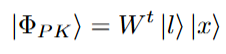
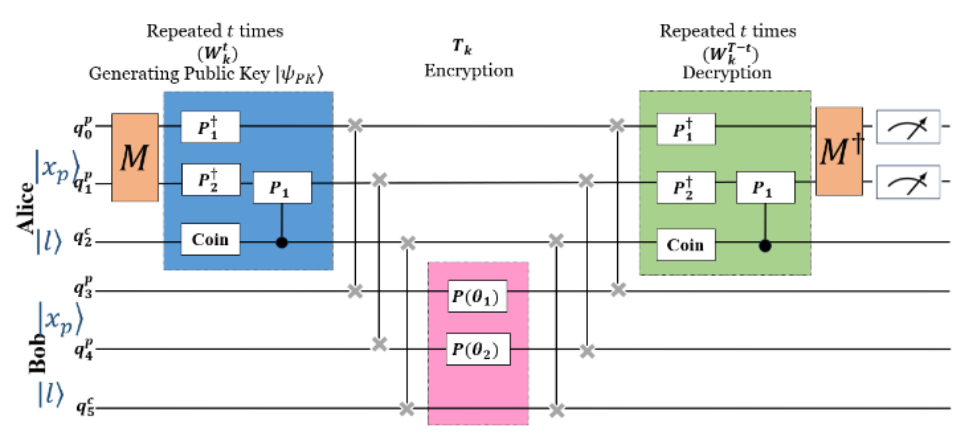
Stage 1 — Public Key Generation (Alice):If Bob (sender) intends to send a message k ∈ {0, 1, 2, ...K − 1} to Alice (receiver), where k is the vertex of the K-cyclic graph, then Alice first generates a public key based on the chaotic unitary operator W and the initial state of the walker |l⟩ |x⟩ as, , where = BB, with B being the chaotic unitary operator. The chaotic dynamics spread the walker into a highly delocalized, interference-rich state.Stage 2 — Public Key Transfer (Alice Bob):Alice transmits the public key 〉 to Bob over a quantum channel.Stage 3 — Message Encryption (Bob):Bob encodes a message k ∈ {0, 1, ..., K-1} by applying the spatial translation operator : |Φ(k)〉 = (I )|〉, where |x〉 = |(x + k) mod K〉.Stage 4 — Encrypted Message Transfer (Bob Alice):Bob sends the message |Φ(k)〉 to Alice over a quantum channel.Stage 5 — Decryption (Alice):Alice applies the inverse Parrondo sequence G = = AA, exploiting = = I. Here, it is essential that [W, ] = 0, such that the periodicitycondition emerging out of the Parrondo sequence can be satisfied. Further, Alice performs a measurement, M = and receives the message . Theoriginal message can be recovered via
t
W
|
Φ
PK
T
K
T
k
Φ
PK
T
k
(T-t)
W
4
(AABB)
t
GW
T
W
T
k
k
3.2 Security Mechanism
3.2 Security Mechanism
The security of the protocol rests on two pillars:(i) Chaotic Public Key: The public key 〉 is generated by a chaotic walk. Without knowledge of the Parrondo sequence, an adversary cannot invert the evolution or predict the decrypted distribution. The chaotic dynamics produce a highly sensitive, interference-dominated state.(ii) Private Parrondo Sequence: The decryption operator G = AA is the private key. Successful decryption requires applying precisely this sequence. Since there exist infinitely many possible coin operators and sequences, guessing G has negligible probability. Furthermore, any adversarial measurement collapses the quantum state, destroying the walk periodicity and making correct decryption impossible.
|
Φ
PK
4
(AABB)
3.3 Quantum Circuit Realization
3.3 Quantum Circuit Realization
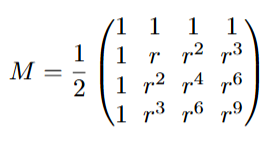
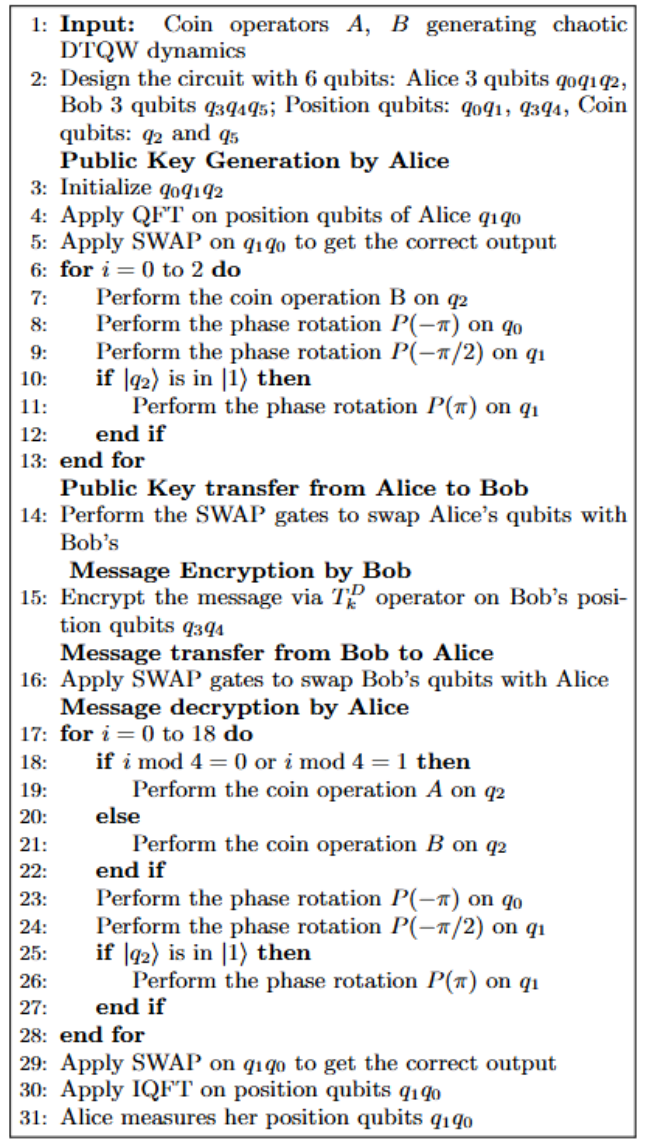
In a gate-based quantum circuit implementation, an K-cyclic graph is encoded using qubits. For an K = cyclic graph, the position Hilbert space is represented using n qubits, while a single additional qubit encodes the 2D coin space, thus requiring a total of n + 1 qubits. To have an efficient quantum circuit realization, the conditional shift operators are diagonalized via the quantum Fourier transform (QFT). Here, the illustration is provided for a 4-cycle graph but this can be generalized to any arbitrary size cyclic graph.The unitary time evolution operator is realized as (after diagonalization via QFT), with being the QFT and inverse QFT matrices which are unitary, given as, , r = , R and are the diagonalized decrement and increment shift operators.We propose a module-based quantum cryptography protocol, where communication is modeled through the transfer of quantum states across virtual modules of a quantum processor. Instead of relying on physically separate devices, Alice and Bob are assigned disjoint sets of qubits that act as their respective modules. The exchange of information is simulated using SWAP operations between these registers, enabling the preparation, transmission, and recovery of encoded messages entirely within a single NISQ device. The algorithm to realize the Parrondo Paradox based cryptographic protocol is given as, The schematic representation of the quantum circuit is:
n
2

M,
†
M
2πi/4
e
†
R
4. Implementation in the Wolfram Quantum Framework
4. Implementation in the Wolfram Quantum Framework
4.1 Setup and Package Loading
4.1 Setup and Package Loading
4.2 Implementing the cryptographic protocol without Noise
4.2 Implementing the cryptographic protocol without Noise
The following code demonstrates the probability distribution of the message decrypted by Alice for message k = 1 encrypted by Bob.
4.3 Noise Modeling with the Depolarizing Channel
4.3 Noise Modeling with the Depolarizing Channel
Noise is modeled as a depolarizing quantum channel acting at the qubit level on all six qubits (two position qubits and one coin qubit for each of Alice and Bob), applied after the full encryption-decryption circuit. This captures cumulative decoherence effects without attributing errors to specific gates.
The depolarizing channel acts on a qubit state ρ as:
ℰ(ρ) = (1 - p)ρ + (p/3)(XρX + YρY + ZρZ)
where p is the depolarizing probability.
Two noise levels are studied:
p = 0.03: Comparable to IBM superconducting processor gate noise
p = 0.20: Stronger decoherence regime to probe robustness
The depolarizing channel acts on a qubit state ρ as:
ℰ(ρ) = (1 - p)ρ + (p/3)(XρX + YρY + ZρZ)
where p is the depolarizing probability.
Two noise levels are studied:
p = 0.03: Comparable to IBM superconducting processor gate noise
p = 0.20: Stronger decoherence regime to probe robustness
4.4 Performance Metrics
4.4 Performance Metrics
5. Results Summary
5. Results Summary
5.1 Simulation Results in the Wolfram Quantum Framework
5.1 Simulation Results in the Wolfram Quantum Framework
The following results were obtained using the Wolfram Quantum Framework (Mathematica), providing platform-independent validation complementary to the Qiskit-based simulations reported in the main paper.
At the weak noise level (p = 0.03), the Wolfram simulation achieves Hellinger fidelity ~97%, indicating near-ideal recovery. Even at the stronger noise level (p = 0.20), fidelity remains ~81%, demonstrating that the periodic revival mechanism is robust against substantial decoherence.
6. Conclusion
6. Conclusion
This work demonstrates that dynamical phenomena intrinsic to quantum walks, specifically, the emergence of periodicity from chaos via the Parrondo mechanism, can serve as a foundation for secure, circuit-level quantum cryptographic protocols on near-term quantum devices.
Key open directions for future work include:
(i) Extension to Larger Cyclic Graphs: The framework scales naturally to K-cycle graphs, potentially enabling higher-dimensional message encoding.
(ii) Physically Distributed Implementation: Current NISQ hardware does not support inter-processor quantum communication. Future modular quantum architectures will enable faithful distributed realizations.
(iii) Advanced Adversarial Models: The current security analysis addresses intercept-resend and MITM attacks. Extension to coherent attacks, adaptive adversaries, and information-theoretic security proofs remains an important direction.
(iv) Error Mitigation: Quantum error mitigation techniques (e.g., zero-noise extrapolation, probabilistic error cancellation) could further improve fidelity on NISQ hardware without requiring full fault tolerance.
8. References
8. References
[1] A. Rath, D. K. Panda, and C. Benjamin, NISQ-compatible quantum cryptography based on Parrondo dynamics in discrete-time quantum walks, arXiv:2602.14678 [quant-ph] (2026).
[2] J. Parrondo, L. Dinis, Brownian motion and gambling: from ratchets to paradoxical games, Contemp. Phys. 45, 147 (2004).
[3] A. Panda and C. Benjamin, Order from chaos in quantum walks on cyclic graphs, Phys. Rev. A 104, 012204 (2021).
[4] L. Razzoli et al., Efficient Implementation of Discrete-Time Quantum Walks on Quantum Computers, Entropy 26, 313 (2024).
[5] Wolfram Research, Inc., Wolfram Quantum Framework (2025), https://www.wolfram.com/quantum-computation-framework/
[6] GitHub Repository: https://github.com/aaddycool/Parrondo-Paradox-based-Cryptographic-protocol
CITE THIS NOTEBOOK
CITE THIS NOTEBOOK
NISQ-compatible quantum cryptography based on Parrondo dynamics in discrete-time quantum walks
by Aditi Rath, Dinesh Kumar Panda, Colin Benjamin
Wolfram Community, STAFF PICKS, April 13, 2026
https://community.wolfram.com/groups/-/m/t/3685762
by Aditi Rath, Dinesh Kumar Panda, Colin Benjamin
Wolfram Community, STAFF PICKS, April 13, 2026
https://community.wolfram.com/groups/-/m/t/3685762