- Project goal: The first goal of this project is to find a way to calculate a local dimension measure (i.e. better than the current logarithmic-difference approximation) and then if it’s possible to reconstruct a discrete approximation to SO(n) for integer-dimensional hypergraphs.
- Computational strategy:
The Wolfram Model is a discrete spacetime formalism in which space is represented by a hypergraph whose evolution dynamics are determined by replacement operations on set systems, and in which the conformal structure of spacetime is represented by a causal graph. Using all the resources available to create the Wolfram Physics Project, together with the power of all the functions that Wolfram Language has, we will study global and local dimensions for several hypergraphs. To do this we will use as a dimension estimator the number of vertices as a function of their volume N∼, and then we investigate hypergraph automorphism groups that preserve the lengths of geodesics emanating from a single point, as the discrete analog of the SO(n) rotation group in n-dimensional space.
- Future work:
Study in a more qualitative way the connection of hypergraphs with groups of symmetries and a possible relation with the gauge/gravity conjecture.
Try to understand the meaning of SO(n), with n ∉ in the context of the Wolfram Models.
- Computational strategy:
The Wolfram Model is a discrete spacetime formalism in which space is represented by a hypergraph whose evolution dynamics are determined by replacement operations on set systems, and in which the conformal structure of spacetime is represented by a causal graph. Using all the resources available to create the Wolfram Physics Project, together with the power of all the functions that Wolfram Language has, we will study global and local dimensions for several hypergraphs. To do this we will use as a dimension estimator the number of vertices as a function of their volume N∼
d
r
- Future work:
Study in a more qualitative way the connection of hypergraphs with groups of symmetries and a possible relation with the gauge/gravity conjecture.
Try to understand the meaning of SO(n), with n ∉ in the context of the Wolfram Models.
The Wolfram Model, is a discrete spacetime formalism, in which space is represented by a hypergraph whose dynamics are determined by replacement operations on set systems, and in which conformal structure of spacetime is represented by causal graph. Without so many technicalities, they are a set of models which, starting from very simple rules, can exhibit a great complexity in their behavior. These types of models are very interesting not only in connection with physics but also in themselves.
Using all the resources available to created the Wolfram Physics Project, together with the power of all the functions that Wolfram Language has, we made estimates for the dimension of several hypergraphs.
How do we do it?
We consider the vertices of the graph as points in “space” and then calculate how these vary as the volume considered increases. We assume for this that the vertices grow following a power law of the type:
Using all the resources available to created the Wolfram Physics Project, together with the power of all the functions that Wolfram Language has, we made estimates for the dimension of several hypergraphs.
How do we do it?
We consider the vertices of the graph as points in “space” and then calculate how these vary as the volume considered increases. We assume for this that the vertices grow following a power law of the type:
n
v
d
r
With the number of vertices, a constant and d the dimension to estimate.
n
v
In some hypergraphs we can clearly observe two types of geometries, one that we call local (as if we observed the hypergraph near its hypersurface) and one global (as if we observed the hypergraph considering its totality). This is what we mean when we talk about the global or local dimension.
Once we know how to estimate the dimension for hypergraphs we move on to investigate the hypergraph automorphism groups that preserve the lengths of geodesics emanating from a single point, as the discrete analog of the SO(n) rotation group in n-dimensional space.
We created an algorithm to estimate geodesics of different lengths for graphs and hypergraphs:
Howdowedoit?
We created an algorithm to estimate geodesics of different lengths for graphs and hypergraphs:
findGeodesics[g_Graph,c_Integer,r_Integer?Positive]:=Join@@(FindPath[g,c,#,{r},All]&)/@GraphPeriphery[NeighborhoodGraph[g,c,r]]
So once we have the geodesics we can reconstruct the graphs that correspond to them,
c=First@GraphCenter[g]
In[]:=
geodesics=findGeodesics[g,c,#]&/@Range@20;Length/@%
In[]:=
edges=Function[geo,Union@@(UndirectedEdge@@@Partition[#,2,1]&)/@geo]/@geodesics;Length/@%
In[]:=
geodesicGraphs=Graph[#,VertexLabelsNone]&/@edges
Out[]=
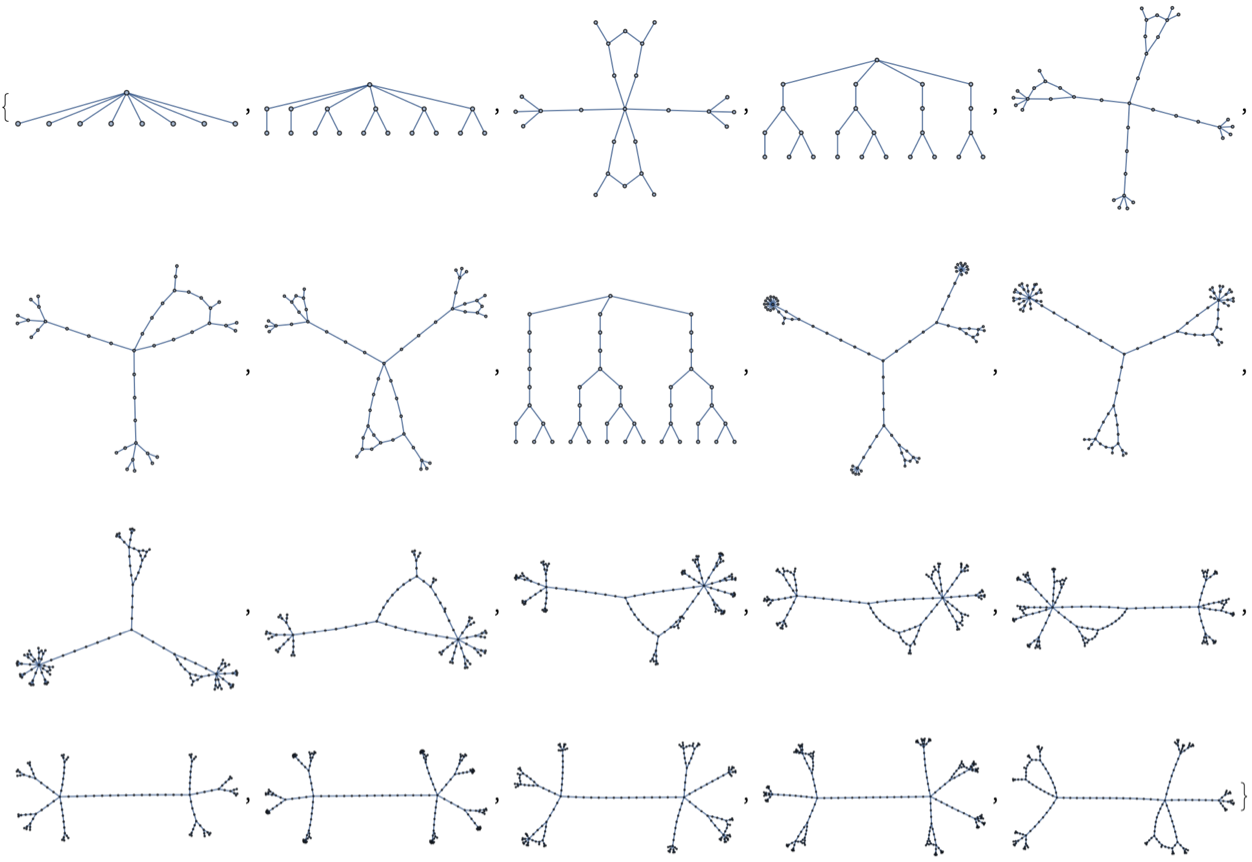
then we can estimate their automorphism group (GraphAutomorphismGroup) and finally determine the order of the group (GroupOrder)
In[]:=
gag=GraphAutomorphismGroup/@geodesicGraphs;
In[]:=
groupordert1=GroupOrder/@gag
Local and Global dimension
Local and Global dimension
1-D
1-D
Exploring the dimension of wm1268(or cactus universe).
In[]:=
cactus=UndirectedGraph[ResourceFunction["HypergraphToGraph"][ResourceFunction["WolframModel"][{{{1,1,2},{3,4,2}}{{4,4,2},{1,5,2},{1,5,3}}},{{1,1,1},{1,1,1}},600,"FinalState"]],VertexStyleResourceFunction["WolframPhysicsProjectStyleData"]["SpatialGraph","VertexStyle"],EdgeStyleResourceFunction["WolframPhysicsProjectStyleData"]["SpatialGraph","EdgeLineStyle"]]
Out[]=

Total vertex count.
In[]:=
totalnodescactus=VertexCount[cactus]
Out[]=
601
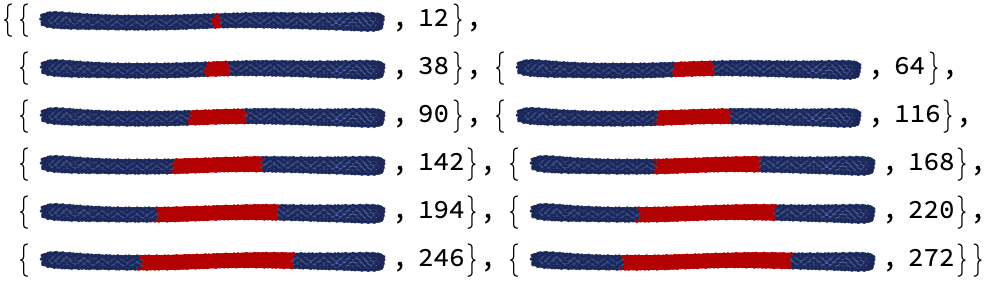
Evolution of the number of vertices from the center.
In[]:=
Table[{HighlightGraph[cactus,NeighborhoodGraph[cactus,GraphCenter[cactus],r]],VertexCount@NeighborhoodGraph[cactus,GraphCenter[cactus],r]},{r,0,10}]
Out[]=
In[]:=
nNodescactus=First[Values[ResourceFunction["GraphNeighborhoodVolumes"][cactus,GraphCenter[cactus]]]]
Out[]=
{1,7,19,37,61,91,127,153,179,205,231,257,283,309,335,361,387,413,439,465,491,517,543,569,589,601}
nNodescactus find the volumes of successively larger neighborhoods around nodes in a graph starting in this case from the center.
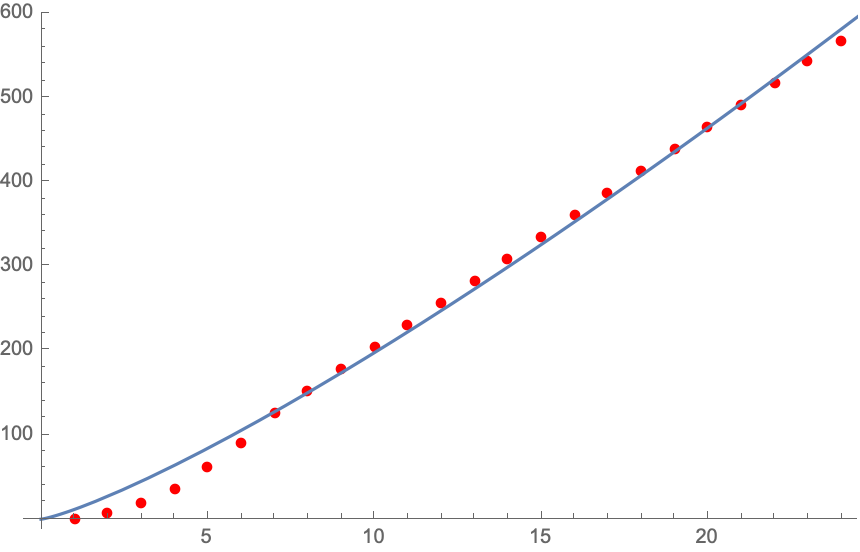
To fit the dimension we use a nonlinear model fit with 2 parameters a and d (dimension).
In[]:=
nlmcactus=NonlinearModelFit[nNodescactus[[1;;IntegerPart[GraphDiameter[cactus]/2]]],a*x^d,{a,d},x]
Out[]=
FittedModel
In[]:=

Out[]=
In[]:=
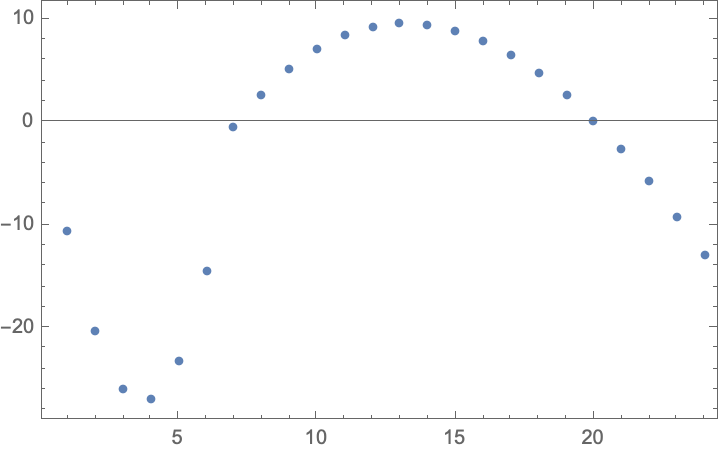
ListPlot[nlmcactus["FitResiduals"],FrameTrue,PlotRangeAll]
Out[]=
In[]:=

Out[]=

Another way to see the global dimension of the hypergraph is using NeighborhoodGraph and VertexCount.
In[]:=
Table[HighlightGraph[cactus,NeighborhoodGraph[cactus,1,k]],{k,10}]
Out[]=

In[]:=

Out[]=

In[]:=

Out[]=

To find the local dimension of the graph, we have to take account of the topology of the hypergraph, in this case we have to look to the radius of the cactus
2D Hypergraphs
2D Hypergraphs
3 D Hypergraphs
3 D Hypergraphs
If we estimate the dimension before reaching the height(10) of the octahedron
If we estimate the dimension globally.
Hypergraph automorphism groups and the relation with SO(n)
Hypergraph automorphism groups and the relation with SO(n)
Definition of SO(n)
Definition of SO(n)
Geodesics in hypergraphs
Geodesics in hypergraphs
In this section we investigate hypergraph automorphism groups that preserve the lengths of geodesics emanating from a single point, as the discrete analog of the SO(n) rotation group in n-dimensional space. We show the methodology used for one of the models.
10 generations of T1 Model
10 generations of T1 Model
We generate the hypergraph and then we transform it to a graph.
We define a function to find the geodesics.
Taking r20, with r the length of the geodesic.
We can explore the shape of the graphs formed from the geodesics.
We look for the automorphisms corresponding to these graphs and calculate the order of the group generated by them.
We make a table for the group order in a logarithm way the have better plots.
Dimension analysis of T1 Model
Dimension analysis of T1 Model
The group order and dimensions
The group order and dimensions
This section shows graphics of various models studied. In each column you can see the hypergraph corresponding to the model, in the middle row an estimate of the global dimension and in the last row the order of the group.
In the graphs corresponding to the group order we can find that the peaks in them are related to variations in the dimension, for the case that of hyperbolic spaces like the last two we can observe a continuous growth in the group order.
Conclusions
Conclusions
We were able to determine reasonably accurately the global and local dimension (when a significant change in local geometry was observed) of different hypergraphs.We built an algorithm to determine the geodesics to study graphs and hypergraphs that allowed us to search for their corresponding automorphisms and then determine the order of the group.
We find that in the case of very regular geometries that have a defined geometry as in the case of "wormhole universe" and "cactus universe" the order of the group decreases until it becomes constant as it does for grids.
We would expect the order of the group tending to infinity to identify the group of automorphisms with SO(n), even there are certain hypergraphs for which the order of the group becomes very large by increasing the length of the geodesic, this growth could be artificial and associated with the group of automorphisms generated by the star-type graph nodes. Therefore, it is necessary to study their automorphisms in a deeper way.
Future work:
We find that in the case of very regular geometries that have a defined geometry as in the case of "wormhole universe" and "cactus universe" the order of the group decreases until it becomes constant as it does for grids.
We would expect the order of the group tending to infinity to identify the group of automorphisms with SO(n), even there are certain hypergraphs for which the order of the group becomes very large by increasing the length of the geodesic, this growth could be artificial and associated with the group of automorphisms generated by the star-type graph nodes. Therefore, it is necessary to study their automorphisms in a deeper way.
Future work:
◼
Study in a more qualitative way the connection of hypergraphs with groups of symmetries and a possible relation with the gauge/gravity conjecture.
◼
Try to understand the meaning of SO(n), with n a non-integer number.
Keywords
Keywords
◼
Wolfram Model
◼
Physics
◼
Hypergraphs
◼
SO(n)
◼
Theoretical Physics
◼
Group Theory
◼
General Relativity
Acknowledgment
Acknowledgment
Mentor: Robert Nachbar
First of all I would like to thank Robert for all the support he has given me these past few weeks, without him this project could not have been completed.
I would also like to thank Stephen Wolfram and Jonathan Gorard for the interesting discussions and ideas for this project.
I would also like to thank Stephen Wolfram and Jonathan Gorard for the interesting discussions and ideas for this project.
References
References