Cracking of ammonia on a catalytic surface: 2 NH3 -> N2 + 3 H2
At one point in the reactor: P = 1 atm, T = 300 K, composition = 40 mol% NH3, 20 mol% N2, 40 mol% H2.
1) Estimate the diffusion coefficient of ammonia in the mixture.
2) Deduce the same coefficient at P = 3 atm.
MW (g/mol): NH3 = 17.03, N2 = 28.02, H2 = 2.016.
At one point in the reactor: P = 1 atm, T = 300 K, composition = 40 mol% NH3, 20 mol% N2, 40 mol% H2.
1) Estimate the diffusion coefficient of ammonia in the mixture.
2) Deduce the same coefficient at P = 3 atm.
MW (g/mol): NH3 = 17.03, N2 = 28.02, H2 = 2.016.
METHOD
METHOD
Step 1: use the Hirschfelder equation to get the BINARY diffusivity of NH3 in each of the other two gases separately (NH3-H2 and NH3-N2).=0.001858**P**with in cm2/s, T in K, P in atm, in Angstrom, M in g/mol.
D
AB
1.5
T
0.5
(1/+1/)
M
A
M
B
2
sigma
AB
OMEGA
D
D
AB
sigma
AB
Step 2: combine the two binary diffusivities with Wilke’s equation to get the diffusivity of NH3 in the multicomponent mixture.
The only non-trivial ingredient is, the collision integral, which is tabulated as a function of the dimensionless temperature T* = kT/. That table is entered below and interpolated.
The only non-trivial ingredient is
OMEGA
D
epsilon
AB
Given Lennard-Jones Constants:
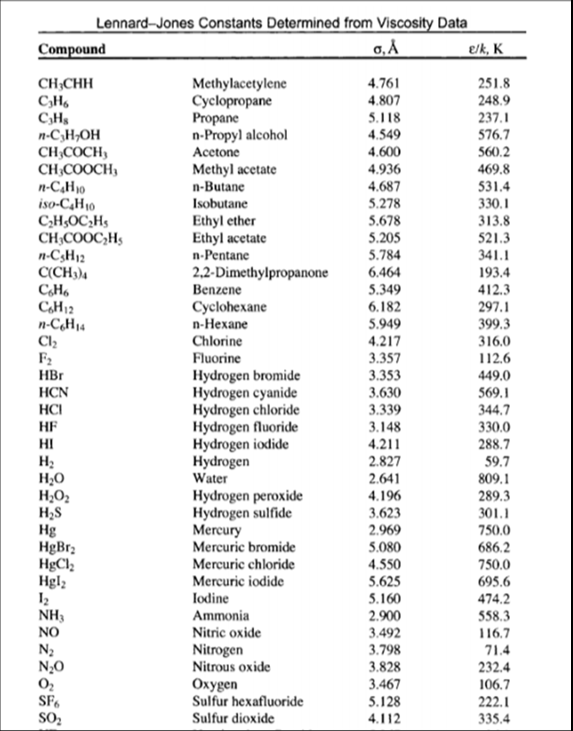
0 - Collision integral table
0 - Collision integral table
Tabulated collision integral for diffusion, taken from the Lennard-Jones tables in the appendix of the textbook.
Each pair is {T*, OMEGA_D} where T* = kT/epsilon_AB is the dimensionless temperature and OMEGA_D is the dimensionless collision integral.
T* runs from 0.3 up to 90
T* runs from 0.3 up to 90
DATA=;
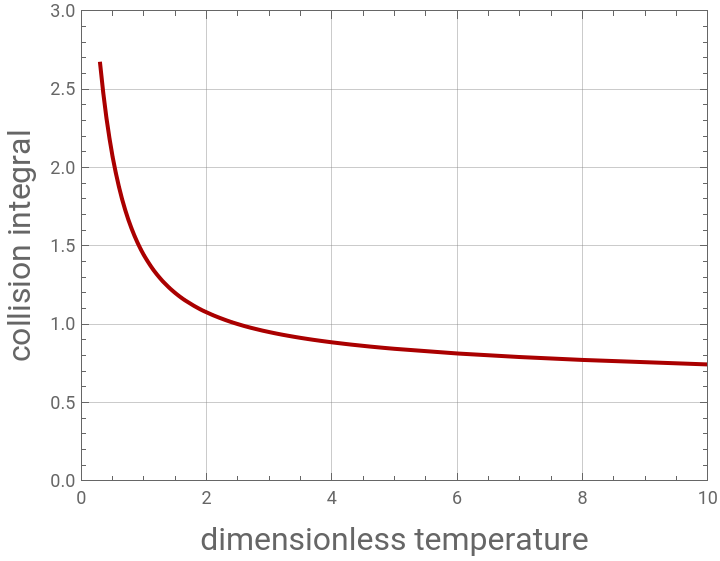
Quick visual check that the table was typed in correctly: OMEGA_D must decrease monotonically with T*, steeply at low T* then flattening out.
p1=ListPlotDATA,
Out[]=
1 - First binary pair: A = NH3, B = H2
1 - First binary pair: A = NH3, B = H2
Lennard-Jones energy parameters epsilon/kappa (in K), read from the table of Lennard-Jones constants given with the problem:
NH3 -> 558.3 K (species A)
H2 -> 59.7 K (species B)
The mixed pair value is obtained from the usual geometric-mean combining rule:
epsilon_AB/kappa =Sqrt[(epsilon_A/kappa)(epsilon_B/kappa)]
EPSILONsurKappaA=558.3;EPSILONsurKappaB=59.7;EPSILONsurKappaAB=Sqrt[EPSILONsurKappaAEPSILONsurKappaB];
Display the mixed energy parameter -> 182.57 K
EPSILONsurKappaAB
Out[]=
182.566
Lennard-Jones collision diameters sigma (in Angstrom), same table:
NH3 -> 2.900 A
H2 -> 2.827 A
For the mixed pair the combining rule is the ARITHMETIC mean: sigma_AB = (sigma_A + sigma_B)/2
sigmaA=2.900;sigmaB=2.827;sigmaAB=1/2(sigmaA+sigmaB);
Display the mixed collision diameter -> 2.8635 Angstrom
sigmaAB
Out[]=
2.8635
Operating conditions imposed by the problem statement.
T in kelvin, P in atmospheres - these units are the ones required by the numerical constant 0.001858 used further down.
T=300;P=1;
Turn the discrete table DATA into a continuous function of T*.
Interpolation[] fits a piecewise polynomial through the points, so that f[T*] returns OMEGA_D at any T* inside the domain 0.3 <= T* <= 90, which removes the need to read the table by hand and interpolate linearly between two rows.
f=Interpolation[DATA]
Out[]=
InterpolatingFunction


Dimensionless temperature for this pair: T* = kT/epsilon_AB = T/(epsilon_AB/kappa)
-> 300/182.57 = 1.6432
-> 300/182.57 = 1.6432
DIMENTIONLESStemperature=T/EPSILONsurKappaAB
Out[]=
1.64324
Read the collision integral off the interpolated curve at T* = 1.6432
-> OMEGA_D = 1.1548 (dimensionless)
-> OMEGA_D = 1.1548 (dimensionless)
OMEGAD=f[DIMENTIONLESStemperature]
Out[]=
1.15484
Molecular weights in g/mol: A = NH3, B = H2. (2.01 is used here for H2; the statement gives 2.016 - the difference is negligible on the final result.)
MWA=17.03;MWB=2.01;
Hirschfelder equation applied to the NH3-H2 pair:
D_AB = 0.001858 * T^1.5 * (1/M_A + 1/M_B)^0.5 / (P * sigma_AB^2 * OMEGA_D)
D_AB = 0.001858 * T^1.5 * (1/M_A + 1/M_B)^0.5 / (P * sigma_AB^2 * OMEGA_D)
Written in Mathematica as successive divisions by P, sigma_AB^2 and OMEGA_D.
Result -> D(NH3-H2) = 0.7604 cm2/s at 300 K and 1 atm.
Result -> D(NH3-H2) = 0.7604 cm2/s at 300 K and 1 atm.
Note how large it is: H2 is very light, so it diffuses fast.
DAH2=0.001858T^1.5/P/sigmaAB^2/OMEGAD(1/MWA+1/MWB)^0.5(*UNITiscm2/s*)
Out[]=
0.760399
2 - Second binary pair: A = NH3, B = N2
2 - Second binary pair: A = NH3, B = N2
Exactly the same sequence of steps, with the Lennard-Jones constants of N2 replacing those of H2. The variables are simply overwritten.
Lennard-Jones energy parameters, now for N2 (epsilon/kappa = 71.4 K), combined again with the geometric-mean rule.
EPSILONsurKappaA=558.3;EPSILONsurKappaB=71.4;EPSILONsurKappaAB=Sqrt[EPSILONsurKappaAEPSILONsurKappaB];
Display -> 199.66 K
EPSILONsurKappaAB
Out[]=
199.656
Collision diameters, now with sigma(N2) = 3.798 A, arithmetic-mean rule.
sigmaA=2.900;sigmaB=3.798;sigmaAB=1/2(sigmaA+sigmaB);
Display -> 3.349 Angstrom.
Bigger than for the NH3-H2 pair, which already tells us this diffusivity will be smaller (D varies as 1/sigma^2).
Bigger than for the NH3-H2 pair, which already tells us this diffusivity will be smaller (D varies as 1/sigma^2).
sigmaAB
Out[]=
3.349
Same operating conditions restated (harmless, but it makes this section self-contained if it is run on its own).
T=300;P=1;
Rebuild the interpolating function for OMEGA_D (unchanged - the table does not depend on the pair of gases, only T* does).
f=Interpolation[DATA]
Out[]=
InterpolatingFunction
T* for the NH3-N2 pair -> 300/199.66 = 1.5026
Collision integral at that T* -> OMEGA_D = 1.1971
Molecular weights: A = NH3, B = N2
Hirschfelder equation for the NH3-N2 pair.
Result -> D(NH3-N2) = 0.2209 cm2/s, about 3.4 times smaller than D(NH3-H2) because N2 is both heavier and larger than H2.
Result -> D(NH3-N2) = 0.2209 cm2/s, about 3.4 times smaller than D(NH3-H2) because N2 is both heavier and larger than H2.
3 - Diffusivity of NH3 in the mixture (Wilke's equation)
3 - Diffusivity of NH3 in the mixture (Wilke's equation)
For a species A diffusing through a stagnant multicomponent mixture, Wilke's equation gives
where the sum runs over all species other than A, and y_i’ is the mole fraction of species i on an A-free basis:
Mole fraction of N2 on an ammonia-free basis: 0.20/(1-0.40) -> 0.3333 (“2” refers to species 2 = N2, the “p” stands for prime)
Mole fraction of H2 on an ammonia-free basis: 0.40/(1-0.40) -> 0.6667 (“3” refers to species 3 = H2)
Wilke’s equation: harmonic-type average of the two binary diffusivities, weighted by the A-free mole fractions. As written here y2p is paired with DAN2 and y3p with DAH2 -> 0.4192 cm2/s.
4 - Effect of pressure
4 - Effect of pressure
Question 2: same mixture at P = 3 atm instead of 1 atm
D at 3 atm
D at 3 atm
D_A, mix is simply divided by 3 -> 0.1397 cm2/s
CITE THIS NOTEBOOK
CITE THIS NOTEBOOK
Diffusion coefficient of ammonia in a gas mixture
by Housam Binous
Wolfram Community, STAFF PICKS, September 16, 2026
https://community.wolfram.com/t/28033
by Housam Binous
Wolfram Community, STAFF PICKS, September 16, 2026
https://community.wolfram.com/t/28033