These days, new comet discoveries are found by automated surveys like PANSTARRS, ZTF, ATLAS, SWAN, and NEOWISE. Its getting harder and harder for motivated humans to discover a comet. But, on August 12, 2023 Hideo Nishimura used a 200mm telephoto lens. The comet was observed near the Sun in sky which is an area of avoidance for most automated surveys to avoid accidentally looking at the Sun and damaging the instrumentation. Media is already covering observations of this comet in the hopes it might become a visual spectacle.
3D Orbit and Motion
3D Orbit and Motion
Wolfram Language can be used to compute the position of the comet and its orbit.
In[]:=
comet=Entity["Comet","CometC2023P1Nishimura"];
In[]:=
start=DateObject[{2023,8,12,0,0,0},TimeZone->0];
In[]:=
end=start+Quantity[4,"Months"];
In[]:=
frames=Table[ResourceFunction["SolarSystemPlot3D"][{Cyan,EdgeForm[],Sphere[comet,.04],Opacity[.5],Cone[{1.5comet,comet},.02]},d,"OrbitStyle"->White,LabelStyle->White,LabelingFunction->Callout,"SunStyle"->{ColorData["BlackBodySpectrum"][5770],Lighting->{{"Ambient",GrayLevel[.3]},{"Directional",White,ImageScaled[{0,0,1}]}},Sphere[{0,0,0},.05]},ViewPoint->{2.61,-1.86,1.1},ViewVertical->{0.41,-0.15,0.9},Boxed->False,SphericalRegion->True,ViewAngle->Pi/300,ImageSize->400,Background->Black],{d,start,end,Quantity[1,"SiderealDays"]}];
In[]:=
SlideShowVideo[frames]
Out[]=
As seen in the results, the comet is moving along an eccentric orbit and is already in the inner solar system headed towards its closest approach to the Sun. The distance of the comet from both Earth and the Sun can be plotted as follows.
In[]:=
dr=DateRange[start,end];
In[]:=
DateListPlot[<|"distance from Earth"->Transpose[{dr,comet[Dated["DistanceFromEarth",#]&/@dr]}],"distance from Sun"->Transpose[{dr,comet[Dated["DistanceFromSun",#]&/@dr]}]|>,PlotTheme->"Detailed",FrameLabel->Automatic]
Out[]=
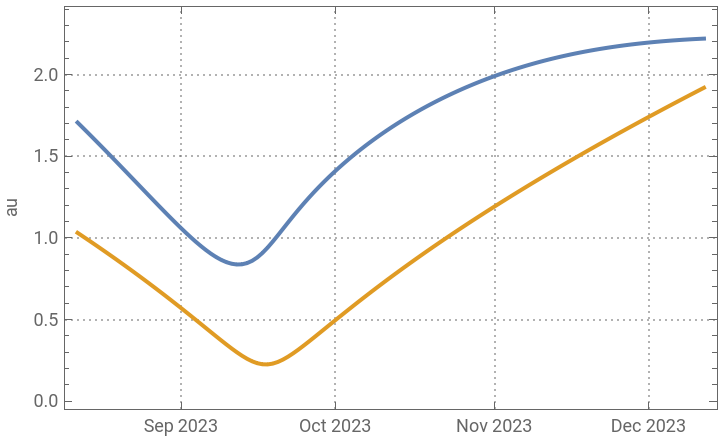


As shown in the plot, the comet will reach its nearest point to the Sun (perihelion) in mid September, only about a month after its discovery. The reason for its late discovery, as mentioned before, was its apparent proximity to the Sun in the sky. The angular separation between the comet and the Sun can be plotted with the following.
In[]:=
loc=;
In[]:=
DateListPlotTransposedr,AstroAngularSeparationAstroPosition[comet[{Dated["RightAscension",#],Dated["Declination",#]}],{"Equatorial",#,loc}],AstroPosition,{"Equatorial",#,loc}&/@dr,PlotTheme->"Detailed",FrameLabel->Automatic
Out[]=
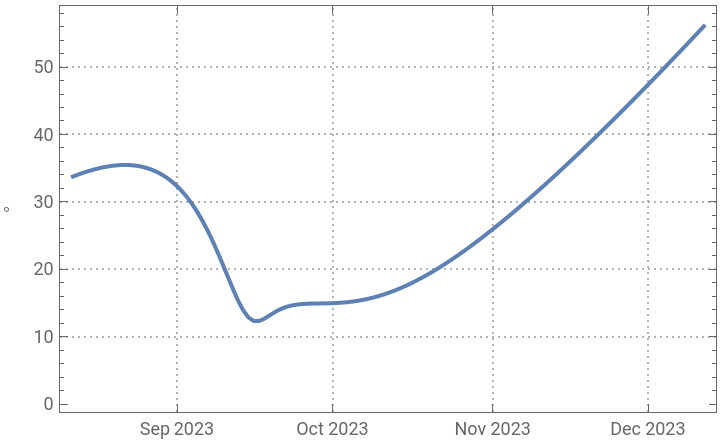
As shown above, the comet never gets more than about 35 degrees from the Sun until late November, well after its perihelion.
Early estimates predicted the comet could get as bright as 2nd or 3rd magnitude in mid-September, but history is full of over-hyped predictions of new comet brightness predictions. Using the latest estimates from the Jet Propulsion Laboratory shows the comet reaching peak magnitude in mid-September, but at a much fainter peak of about magnitude 6.5, barely visible to the naked eye in dark rural skies.
In[]:=
DateListPlot[Transpose[{dr,comet[Dated["ApparentMagnitude",#]&/@dr]}],ScalingFunctions->"Reverse",PlotTheme->"Detailed"]
Out[]=
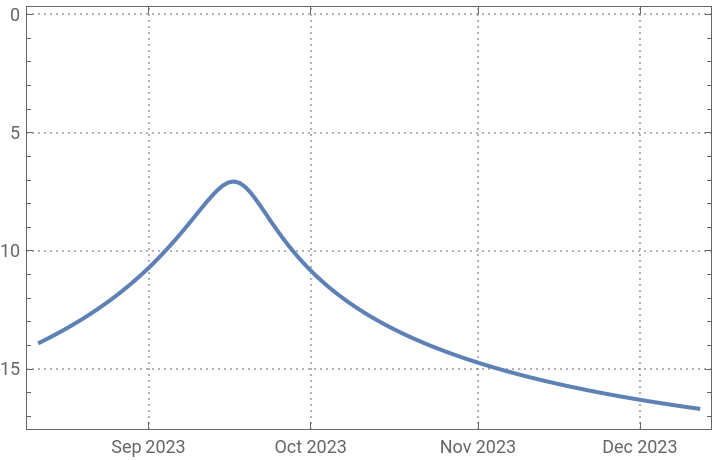
It should be noted that the simple algorithms used to predict comet brightness often fall short of actual observations. Will the comet outperform the computed predictions and become a comet bright enough to see with the naked eye? Regardless of the brightness of the comet, the fact that the comet stays 35° or less from the Sun means that the comet won’t be observed in the darkest skies, fighting the glow from dusk/dawn, at least until late November. Also staying relatively low on the horizon. By late November, the comet may start fading. Maybe we’ll get lucky and the comet will far exceed brightness predictions. Time will tell.
Northern Hemisphere
Northern Hemisphere
Observed Equatorial Sky Motion
Observed Equatorial Sky Motion
So where can the comet be observed? The following video plots the position of the comet over time, starting on Aug 12 and continuing over the next 4 months.
In[]:=
agf=Table[With[{frame={"Equatorial",d,loc}},AstroGraphics[{Cyan,Point[AstroPosition[comet[{Dated["RightAscension",d],Dated["Declination",d]}],frame]]},AstroRange->Quantity[30,"AngularDegrees"],AstroReferenceFrame->frame,ImageSize->{400,400},Background->Black]],{d,start,end,Quantity[1,"SiderealDays"]}];
In[]:=
SlideShowVideo[agf]
Out[]=
The comet starts out in the constellation of Gemini as it gets closer to the Sun and swings around it in its orbit.
Observed Horizon Sky Motion
Observed Horizon Sky Motion
Moving to an Earth-based observing position, the position of the comet relative to the horizon can be plotted. From a vantage point in Champaign, IL the comet starts out in Gemini low on the eastern horizon an hour before sunrise. The comet gets lower on the horizon as it approaches the Sun, disappearing from the morning skies by Sept 12 into brightening, pre-dawn light.
In[]:=
dr=DateRange[start,DateObject[{2023,9,12,0,0,0},TimeZone->"America/Chicago"],Quantity[1,"SiderealDays"]];
In[]:=
AstroGraphics[{Cyan,Point[AstroPosition[Most[#],{"Equatorial",Sunrise[loc,#[[3]]]-Quantity[1,"Hours"],loc}]]&/@Transpose[{comet[Dated["RightAscension",Sunrise[loc,#]-Quantity[1,"Hours"]]&/@dr],comet[Dated["Declination",Sunrise[loc,#]-Quantity[1,"Hours"]]&/@dr],dr}]},AstroReferenceFrame->{"Horizon",Sunrise[loc,dr[[1]]]-Quantity[1,"Hours"],loc},ImageSize->{400,400},AstroRange->Quantity[25,"AngularDegrees"],PlotLabel->Column[{"Position of C/2023 P1 (Nishimura) 1 hour before sunrise","between Aug, 12 and Sept 12, 2023 from Champaign, IL, USA"},Center]]
A more quantitative approach can be created using AstroPosition to extract the altitude of the comet in the pre-dawn skies as measured 1 hour before sunrise.
Sunset Apparent Motion
Sunset Apparent Motion
After September 17, the comet makes an appearance in the evening skies, though you’ll need to observe earlier and fight more light from evening dusk to see it. Here’s the appearance 30 minutes after sunset.
The comet doesn’t get as high as its morning appearance did, only getting about 7° above the horizon on September 25.
Southern Hemisphere
Southern Hemisphere
Does the southern hemisphere have a better view? Let’s find out by observing from South Africa.
Sunrise Apparent Motion
Sunrise Apparent Motion
As in the northern hemisphere, the view is similar for the morning appearance which ends around September 4th when it dives into the increasing dawn light. Interestingly, after the comet goes around the Sun, the comet makes another morning appearance starting around mid-October and climbs higher each day after as the comet gets further from the Sun.
Sunset Apparent Motion
Sunset Apparent Motion
As in the northern hemisphere, the comet makes a brief appearance in the evening skies between Sept 17 and Oct 12.
So it appears that the comet will be a challenging object to observe in the northern hemisphere since it will be near the Sun during its closest approach to the Sun. If it performs well and becomes very active, we may have a good view. The southern hemisphere will have a more extended window of viewing opportunity well after perihelion, but by then it will be further away so likely fainter at that time, though could still perform well if the comet becomes active post-perihelion. Remember that comet hunter David Levy once said, “Comets are like cats: they have tails and they do precisely what they want.”. So we’ll have to wait and see what this comet has in store for us.
CITE THIS NOTEBOOK
CITE THIS NOTEBOOK
New comet C/2023 P1 Nishimura: a rare amateur discovery beating automated surveys scanning the skies
by Jeff Bryant
Wolfram Community, STAFF PICKS, August 29, 2023
https://community.wolfram.com/groups/-/m/t/3001318
by Jeff Bryant
Wolfram Community, STAFF PICKS, August 29, 2023
https://community.wolfram.com/groups/-/m/t/3001318