Calculation 2 Gravitational RedShift (Gravitational Time Dilatation) between an atomic clock at a Ground-Station and an Atomic Clock in an ESA satllite in a Gallileo Orbit at an heigth of 23 222 [m]. The differences in the Calculated Gravitational RedShift with “General Relativity” and “Quantum Light Theory” are smaller than an amount of 15 digits beyond the decimal point.
3
10
The foundation for the Theory of General Relativity is the Riemannian Mathematics for curved 4-dimensional Manifolds. Based on this mathematics Einstein predicted correctly the deflection of light by the gravitational field of the sun, observed in the Eddington Experiment in 1919 during a total solar eclipse.But the theory of General Relativity correctly does not predict an increase or decrease of the speed of light within a gravitational field. Because within the (gravitational) curvature of space and time, the intervals for the space coordinates and time coordinate do not change. Only the direction of the beam of light has been changed, following the (by a gravitational field caused) curved space-time path. For this reason the Theory of General Relativity predicts a constant value for the frequency of the light following a curved space-time path. Because the time intervals and he space interval do not change within the curvature. A straight line being transformed into a circle does not get shorter or longer. Only the Lorentz time-dilation and the Lorentz space contraction have to be taken into account. The Lorentz contraction and time dilation can be neglected in the experiments for Gravitational Redshift. All publications related to the well observed effects of “Gravitational RedShift/ Blueshift” within a gravitational field explain this effect by the frequency shift due to the shift in potential energy within a gravitational field. The proportional relationship between (potential) energy and frequency is Planck’s law and has nothing to do with the theory of general relativity. The observed effects of Gravitational Redshift is in contradiction with the Theory of General Relativity. Because a curved space-time geometry does not change the time intervals and does not change the space intervals within a gravitational field. Only the direction of the beam of light will change and follow the curved 4-dimensional space-time geometry. A change of the magnitude of the speed of light has never been observed within gravitational fields. The only theory which predicts Gravitational Redshift correctly, with margins smaller than 15 digits beyond the decimal point, is the new theory presented in this article.The “Gravitational RedShift” [2, 5] between an observatory on Earth (Radius = 6 106 [m]) and a Satellite in a Galileo Orbit (Radius = 23222 103 [m]) according “Planck’s law” (incorrectly mentioned as “General Relativity” in the publications): The “Gravitational RedShift” [2, 5] between an observatory on Earth (Radius = 6 106 [m]) and a Satellite in a Galileo Orbit (Radius = 23222 103 [m]) according the “New Theory”:Both values are always within the measured Gravitational RedShift in all observations being published since the first observation of the gravitational redshift in the spectral lines from the White Dwarf which was the measurement of the shift of the star Sirius B, the white dwarf companion to the star Sirius, by W.S. Adams in 1925 at Mt. Wilson Observatory.KeywordsGravitational Redshift; Classical Field Theory, Gravitation and Electromagnetism, General Relativity, GEONs
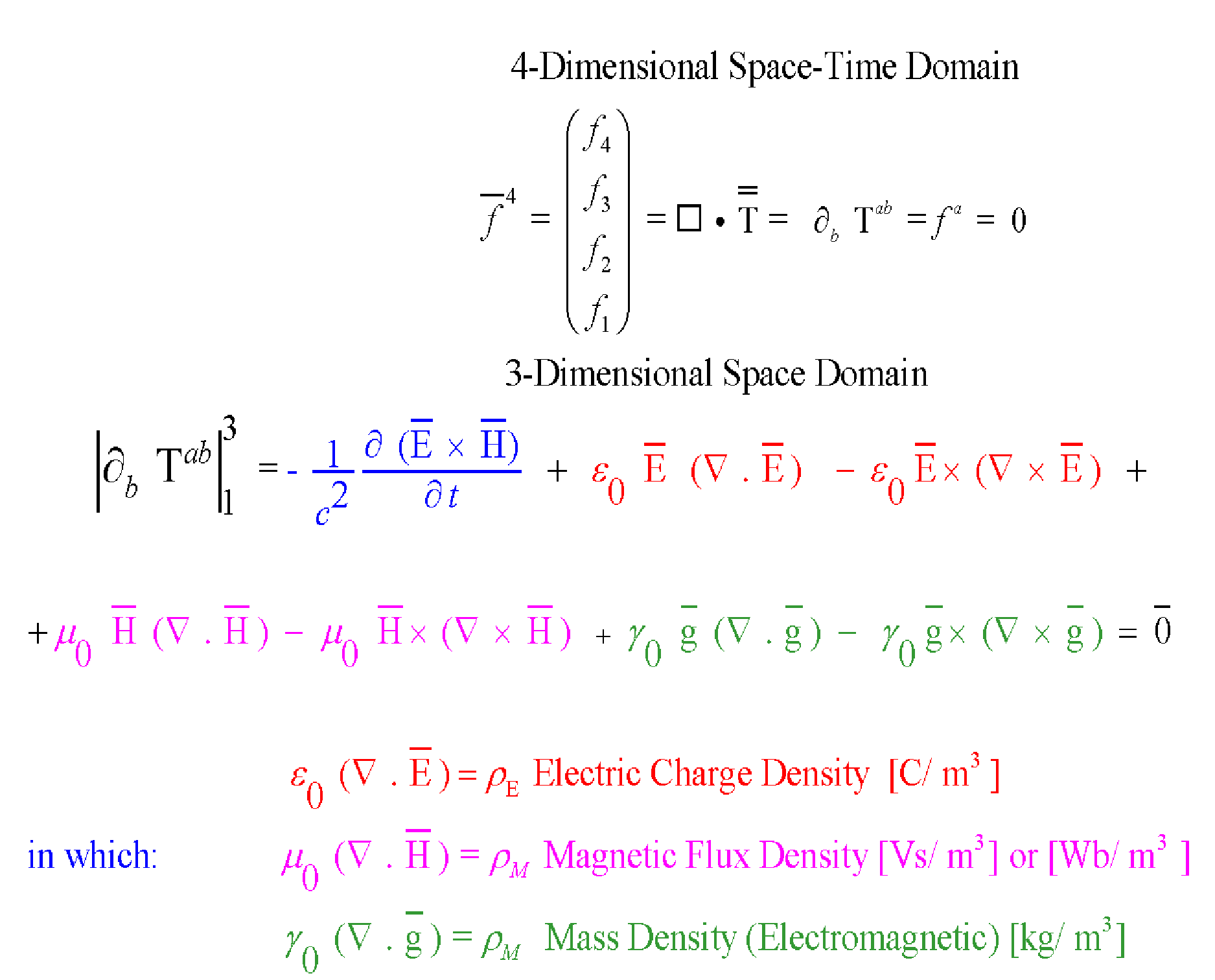
Book:,combinedwithanarbitrarydivisiong[x,y]inthe(x,y)plane,propagatinginthez-directionwiththespeedoflightc=.TheinputfortheElectricFieldIntensity{E(x,y,z,)=ev}andtheMagneticFieldIntensity{H(x,y,z,)=mv}hasbeensubstitutedintheFieldEquationfortheElectromagneticField(BookEquation19,page16).+∇. −×∇×+∇. −×∇× Equation(19)Whichcanbewrittenas:term1=-term2=(∇. )term3=−×(∇×)term4=∇. term5=−×∇×Equation(19)equals:term1+term2+term3+term4+term5=0
RisingoftheJamesWebbSpaceTelescopeanditsFundamentalBlindnes
:Page15,Equation(19)ExampleofaLASER-BEAMwithaGaussianIntensitydivison-K2+
2
x
2
y
1
ϵ0μ0
-
1
2
c
∂×
¯
E
¯
Η
∂t
ε
0
¯
E
¯
E
ε
0
¯
E
¯
E
μ
0
¯
Η
¯
Η
μ
0
¯
Η
¯
Η
= 0
1
2
c
∂×
¯
E
¯
Η
∂t
ε
0
¯
E
¯
E
ε
0
¯
E
¯
E
μ
0
¯
Η
¯
Η
μ
0
¯
Η
¯
Η
In[]:=
ϵ0=.
In[]:=
μ0=.
In[]:=
x=.
In[]:=
y=.
In[]:=
z=.
In[]:=
t=.
In[]:=
Get["VectorAnalysis`"]

In[]:=
Get["Calculus`DSolve`"]