ORIGINAL ARTICLE: Jarek Duda (2024), Phase space maximal entropy random walk: Langevin-like ensemble of physical trajectories, arXiv:2401.01239. https://doi.org/10.48550/arXiv.2401.01239
INTRODUCTION to MERW: https://community.wolfram.com/groups/-/m/t/2924355
INTRODUCTION to MERW: https://community.wolfram.com/groups/-/m/t/2924355
For situations with incomplete knowledge, the Jaynes principle of maximal entropy says the safest assumption are parameters maximizing entropy, as subset they describe grows the fastest. For example the number of length n sequences of 0/1 with p percentage of 1 is for Shannon entropy maximized for p = 1/2. With energy constraints it leads to Boltzmann ensembles, being at heart of statistical mechanics. However, trying to use it in a basic situation: random walk of a physical object, the question is if we should assume Boltzmann distribution of 1) single steps, or 2) diffusion-like paths, or maybe 3) of smooth paths? The problem is that they lead to different predictions - e.g. predicted stationary distributions in [0,1] range we will focus on: uniform distribution for 1) vs QM-like: for 2) vs for 3). While 1) leads to Boltzmann ensemble of positions in space, 2) leads to quantum ground state, novel 3) leads to ground state of phase space Schrödinger equation. There will be also discussed tunneling - with crossing probability depending not only on barrier width, but also initial velocity - as required, but neglected in standard diffusion-like paths.
binomial(n,pn)≈exp(nh(p))
h(p)-pln(p)-(1-p)ln(1-p)
ρ1
ρ∝
2
sin
ρ∝sin
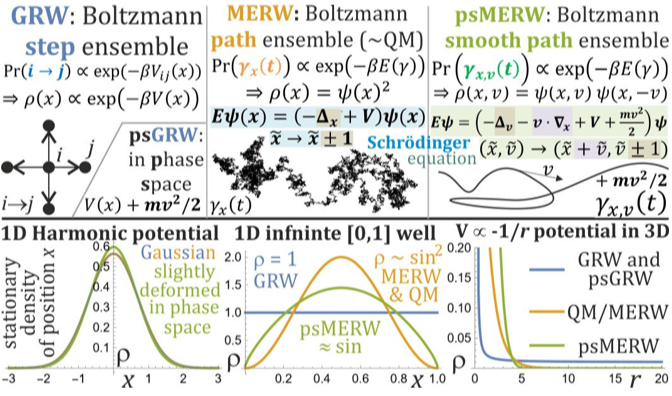
While the principle of maximal entropy, statistical physics show the safest assumption is Boltzmann distribution, there are various ways to apply it - leading to different predictions, and bringing open question we want to address: which one is the most appropriate for various settings? As in arXiv:2401.01239, we will analyze consequences of such 3 choices for motion of point-like objects. The main novelty is Boltzmann ensemble of smooth paths - in contrast to standard nowhere differentiable infinite kinetic energy used e.g. in diffusion derivation, or Feynman path ensembles. To get such ensemble of more physical paths, as in Langevin equation we go to (x,v) phase space including velocity controlling change in space. While Boltzmann ensemble of diffusion-like paths requires solving Schrödinger equation, here we will get phase space Schrödinger equation, earlier in 2017 considered in article by Jean-Philippe Bouchaud: https://journals.aps.org/pra/abstract/10.1103/PhysRevA.96.052116 . Here is summary of these 3 choices, and stationarity probability distributions for 3 types of potential (harmonic, infinite well, and Coulomb/Newton):
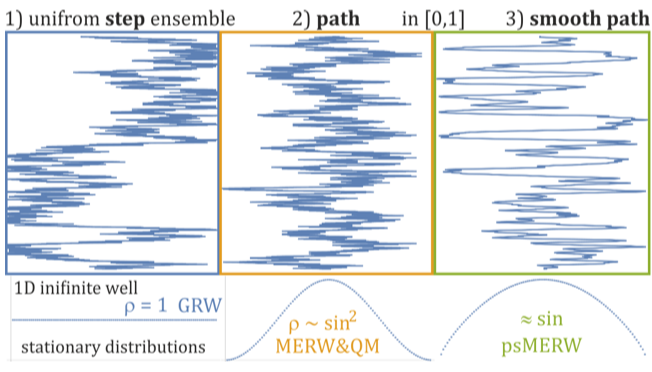
Below are random trajectories for 1D infinite [0,1] potential well case we will focus on, generated with further code. Potential is infinite outside [0,1], forbidding to leave the well. Inside potential is constant - making Boltzmann distribution become uniform distribution. In 1) case on the left, we can imagine “drunken sailor” making random steps chosen with uniform distribution among possible steps, referred as generic random walk (GRW), and being blocked by the left/right barrier. It leads to uniform stationary probability distribution inside this well. In central 2) we have assumed uniform distribution among entire paths in the well, as in “Wick rotated” quantum mechanics, or maximal entropy random walk (MERW) - we will see it leads to stationary probability distribution as quantum ground state, also in below random trajectory we can see stronger avoidance of the left/right barriers. Such quantum Anderson localization is crucial especially for electrons in semiconductor - preventing conductance, which incorrectly is allowed for GRW uniform distribution. Also for neutrons - experimentally getting quantum statistics: https://www.nature.com/articles/415297a. QM-like statistics was also experimentally observed for soliton-like walking droplets: https://journals.aps.org/pre/abstract/10.1103/PhysRevE.88.011001 Here is example of difference of evolution for defected lattice (like semiconductor) - nodes have edge to itself (self-loop) unless being a marked defect: Like in diffusion derivation, the paths in 2) continuous limit require temporal step spatial , what means infinite velocity/kinetic energy of such nowhere differentiable trajectories. As they seem nonphysical, it is natural to ask what if we repair it: use ensembles of more physical, smooth, finite velocity trajectories 3) - we can answer with MERW in phase space (psMERW). Below we see that thanks to randomly gaining velocity, it is much easier for them to reach the barrier than in 2), leading to approximately stationary distribution - and bringing interesting open question if we should/could find such sine-like barrier avoidance in nature?
ρ1
ρ∼
2
sin
∝
2
step
ρ∝sin
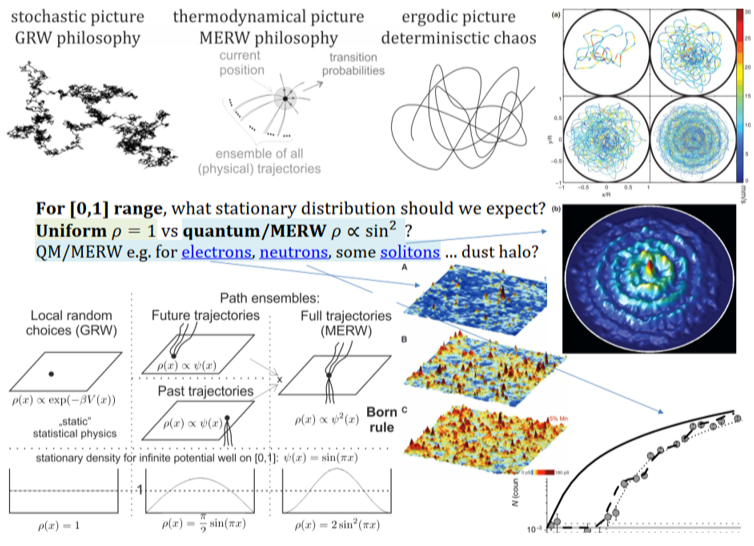
Here are some densities observed in experiments from the referred articles:
Discrete situation
Discrete situation
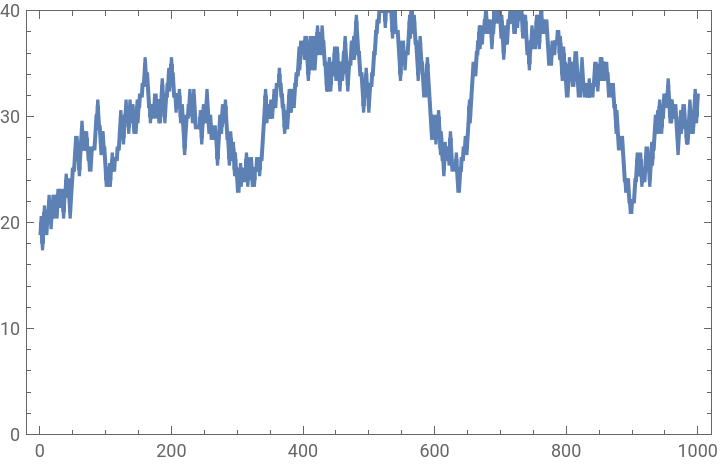
GRW: We will now start with code for lattice discretizing [0,1] potential well, later take infinitesimal limit for the continuous case. Here is a simple code generating random trajectory using uniform distribution among single steps in 1D infinite potential well:
xn=40;p=20;(*spatiallattice:1..xn*)traj=Table[p+=RandomInteger[{-1,1}];p=Max[Min[p,xn],1],{k,1000}];ListPlot[traj,Joined->True,PlotRange->xn,Frame->True]
Out[]=
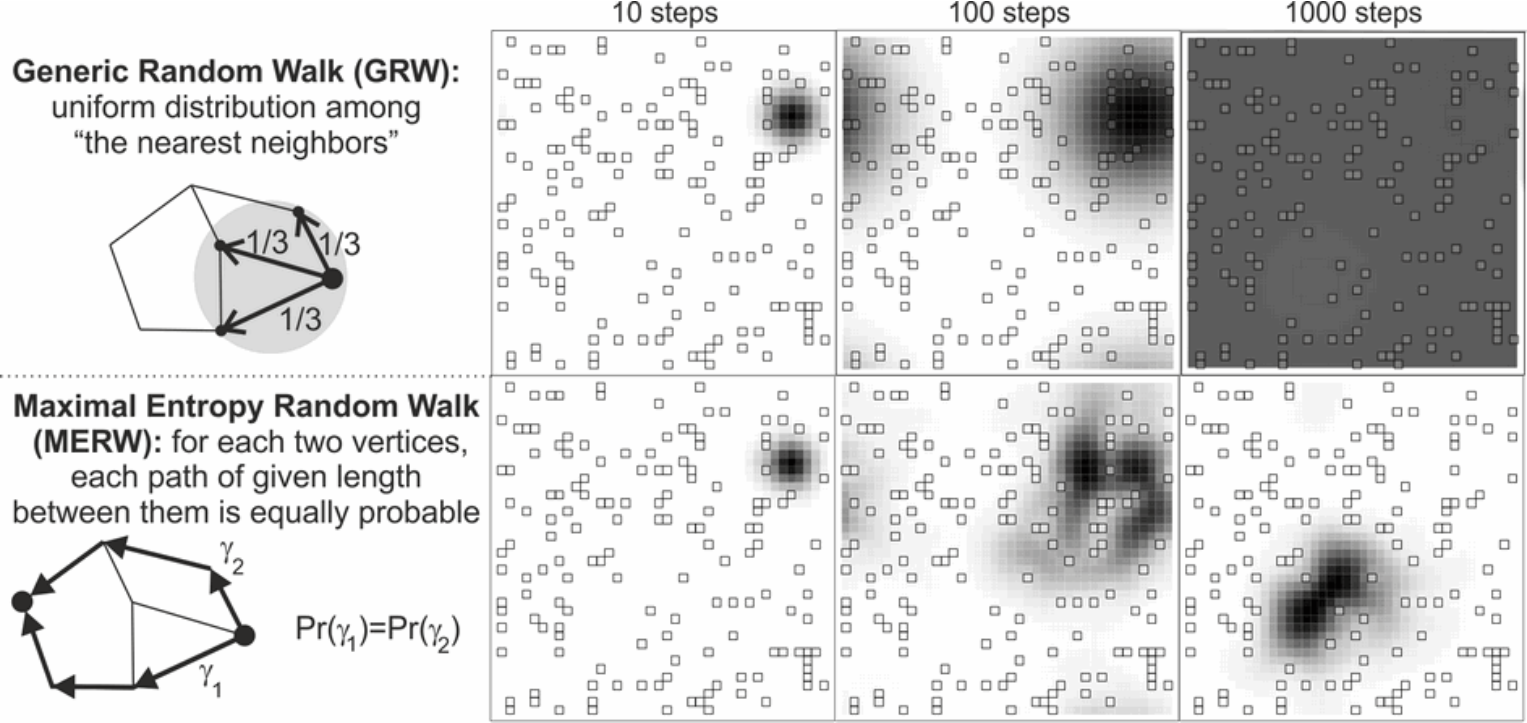
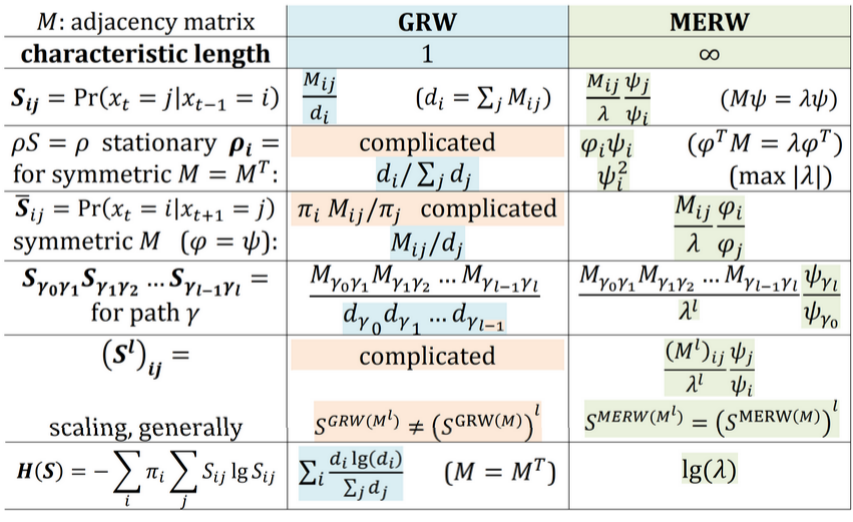
MERW:It is example of generic random walk (GRW) on a graph being a 1D lattice here - for adjacency matrix M of possible steps, we assume uniform probability distribution among possible single steps. For undirected graph (symmetric M) it leads to stationary probability distribution proportional to vertex degree. Adding vertex potential and replacing uniform distribution with Boltzmann: exp-β+2, in continuous limit it leads to Boltzmann distribution in space. In contrast uniform/Boltzmann distribution among paths on this graph, like random walk along Ising sequence, “Wick rotated” quantum mechanics, or maximal entropy random walk (MERW) lead to much stronger localization - mathematically exactly as ground state in quantum mechanics. Here is Wolfram notebook introducing to MERW: https://community.wolfram.com/groups/-/m/t/2924355 Below are gathered formulas for these two philosophies of random walk on the same graph given by adjacency matrix M, weighted e.g. exp-β+2 for Boltzmann distribution assuming vertex potential. For MERW we need to first find the dominant eigenvector of , which in continuous limit becomes stationary Schrödinger equation, then stationary probability distribution for symmetric M is ∝ as in Born rule, and stochastic matrix defining transition probabilities becomes :
V
i
M
ij
V
i
V
j
ρ(x)∝exp(-βV(x))
M
ij
V
i
V
j
V
i
Mψλψ
ρ
i
2
ψ
i
S
ij
M
ij
λ
ψ
j
ψ
i
Let us now find MERW stationary probability distribution in [0,1] range as a segment - first we find adjacency matrix M allowing jumps to neighbors unless reaching a barrier, then calculate its dominant eigenvector (maximizing λ which corresponds to minus energy), then squares of coordinates give quantum ground state stationary probability distribution:
xx±1
Mψλψ
ρ(x)∝ψ(x)
2
(x)
2
sin
Tunneling probability (width, velocity)
Tunneling probability (width, velocity)
Continuous limit to Schrödinger equations
Continuous limit to Schrödinger equations
It leads to Gaussian-like stationary distribution of velocities (left), and sin-like of positions (right):
CITE THIS NOTEBOOK
CITE THIS NOTEBOOK
Boltzmann ensembles of steps, paths and smooth paths with phase space Schrödinger equation
by Jarek Duda
Wolfram Community, STAFF PICKS, February 16, 2024
https://community.wolfram.com/groups/-/m/t/3124320
by Jarek Duda
Wolfram Community, STAFF PICKS, February 16, 2024
https://community.wolfram.com/groups/-/m/t/3124320