ABSTRACT (original article): Exploratory missions have found that regolith on interplanetary bodies can be loosely packed and freely flowing—a state that strongly affects mission plans and that may also influence the large-scale shapes of these bodies. We investigate here whether notable circumferential ridges seen on Saturn’s moons may be a byproduct of free flow of loosely packed regolith. Such ridges and other features likely record the history of the moons, and we find that if surface grains are freely flowing, then the combined gravity of Saturn itself and its tenuous ring generate similar circumferential features. Moreover, analysis of these features reveals the possibility of previously unreported morphologies, for example, a stationary torus around a non-rotating satellite. Some of these features persist even for a very low density and distant disk, which raises the prospect that nonlinear analysis of interactions from disks to moons and back again may lead to new insights. CITATION (original article): Shinbrot T (2023), Gravitational influence of Saturn’s rings on its moons: a case for free granular flow. Front. Astron. Space Sci. 10:1146705. https://doi.org/10.3389/fspas.2023.1146705
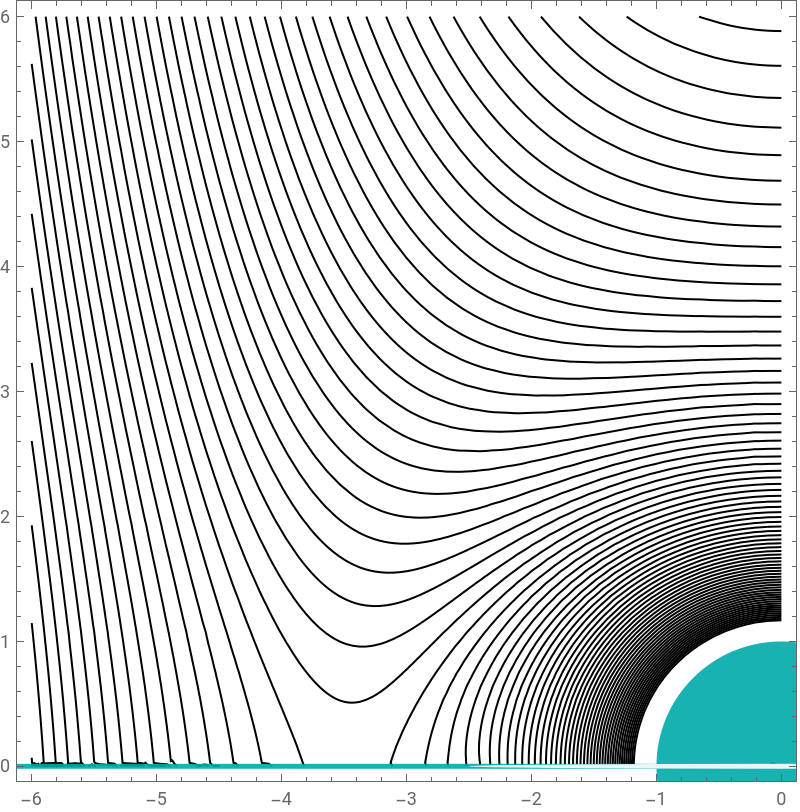
The gravitational potential surrounding a rotating moon has been known since 1840¹. By combining this potential with the potential of a uniform ring, we approximate equipotentials of Saturn’s moons, many of which have a peculiar flattened, pancake-like, appearance. These equipotentials also exhibit pancake-like shapes, as well as newly predicted shapes - such as a stable torus surrounding the moon².
Wolfram code
Wolfram code
Ellipsoidal gravity definitions:
Ellipsoidal gravity definitions:
GM is a magnitude for the gravitational force, where M the mass interior to the ellipsoid,
a the equatorial radius,
b the polar semi-axis,
ee is measure of eccentricity:=−,
ω the rotation rate about the polar axis,
u is the ‘distance’ of the equipotential line from the origin,
β is the parametric latitude,
RR is cylindrical radius,
ZZ is cylindrical z-coord.
a the equatorial radius,
b the polar semi-axis,
ee is measure of eccentricity:
2
ee
2
a
2
b
ω the rotation rate about the polar axis,
u is the ‘distance’ of the equipotential line from the origin,
β is the parametric latitude,
RR is cylindrical radius,
ZZ is cylindrical z-coord.
Cylindrical coordinates RR and ZZ are obtained from ellipsoidal coordinates u and β using:
Cylindrical coordinates RR and ZZ are obtained from ellipsoidal coordinates u and β using:
RR=+Cos[β];ZZ=uSin[β];z=
2
u
2
ee
ee
u
Conversion from cylindrical into ellipsoidal coordinates:
Conversion from cylindrical into ellipsoidal coordinates:
This is not needed for calculations here, but the solution is used to produce the functions beta[ ] and uu[ ] below. Note that there are 16 solutions accounting for all symmetries and antisymmetries; only 1 is needed.
In[]:=
ClearAll["Global‘*"]thetsfm=QuietSolveR1==+Cos[β],Z1uSin[β],{u,β};
2
u
2
ee
Helper functions used in final solution:
Helper functions used in final solution:
In[]:=
beta[RR_,ZZ_,EE_]=ArcCos++-+++2+2-2;uu[RR_,ZZ_,EE_]=;Quad[z_]=1+ArcTan[z]-;(*functionusedforquadrupole*)Um[u_,a_,b_,GM_]=-ArcTan-;(*massterm*)Uq[u_,β_,ω_,a_,b_]=-;(*quadrupoleterm*)Ur[u_,β_,a_,b_,ω_]=(+-);(*=:centrifugalterm*)Utotal[u_,β_,GM_,a_,b_,ω_]=Um[u,a,b,GM]+Uq[u,β,ω,a,b]+Ur[u,β,a,b,ω];
2
EE
2
RR
2
ZZ
4
EE
4
RR
4
ZZ
2
EE
2
ZZ
2
RR
2
ZZ
2
EE
2
RR
2
2
EE
ZZ
Sin[beta[RR,ZZ,EE]]
1
2
3
z
3
2
z
3
z
GM
2
a
2
b
2
a
2
b
u
2
ω
2
2
a
3
b
3
u
Quad-
2
a
2
b
u
Quad-
2
a
2
b
b
2
Sin[β]
1
3
2
ω
2
2
u
2
a
2
b
2
Cos[β]
2
ω
2
2
R
Equipotentials for central ellipsoid combined with plane as described in Shinbrot “Gravitational influence of Saturn’s rings on its moons”
Equipotentials for central ellipsoid combined with plane as described in Shinbrot “Gravitational influence of Saturn’s rings on its moons”
Only one quadrant is plotted: this is associated with a choice of symmetric, antisymmetric solutions mentioned above. Other quadrants can easily be provided, but doing so is computationally redundant.
In[]:=
SetOptions[Manipulator,Appearance->"Labeled"];(*optional*)MaxOuterDisk=100;(*outerradiusofplane,*)gravfactor=1/3;(*factorbywhichdensityofplane<densityofmoon*)(*followingisusedbyMathematicatoallowchangesinparameterswithsliders*)Manipulatetheee=-;(*followingisplotofplanarmass:*)p00=Graphics[{Darker[Cyan],Opacity[0.9],{Disk[{0,0},{themajor,theminor}],Disk[{0,0},{MaxOuterDisk,diskthickness}]},White,Disk[{0,0},{negratio,diskthickness}]},PlotRange{{-plotmin-plotradius,-plotmin},{0,plotradius}}];(*followingisdefinitionofsumofnetmass,quadrupolemassandcentrifugalacceleration:*)SumFun[XX_,ZZ_,theGMFlat_,negratio_,themajor_,theminor_,theee_,theGM_,theomega_]=Utotaluu+,ZZ,-,beta+,ZZ,-,theGMFlat,MaxOuterDisk,diskthickness,0-Utotaluu+,ZZ,-,beta+,ZZ,-,theGMFlat,negratiothemajor,diskthickness,0+Utotaluu+,ZZ,theee,beta+,ZZ,theee,theGM,themajor,theminor,theomega;(*followingisplotofequipotentialscalculatedabove:*)p01=ContourPlot[SumFun[XX,ZZ,theGMFlat,negratio,themajor,theminor,theee,theGM,theomega],{XX,-plotmin-plotradius,-plotmin},{ZZ,0,plotradius},ContoursRange[mincontour,maxcontour,numcontours],ContourShadingNone];(*followingdisplaysbothequipotentialsandsurroundingplane:*)Show[p01,p00,ImageSize->400],(*followingareparametersthatcanbechangedusingsliders:*){{theGM,10000,"Moon Gravity"},0,50000},theGMFlat,gravfactortheGMdiskthicknessthemajor,Style["Disk Gravity (default is 1/2 moon)",{Blue,11,Bold}],0,10000000,Style" same density = ",{Blue,Italic},{{diskthickness,0.02,"Disk thickness"},0.02,1},{{theminor,0.999,"Minor axis of spheroid (must be <1)"},0,0.999},{{themajor,1,"Major axis of spheroid"},theminor,2},{{negratio,2.5,Style["Ratio of excised radius to spheroid radius",{Bold,Darker[Red]}]},1,100},{{theomega,15,Style["Rotation Rate, ω",{Bold,Darker[Red]}]},0,60},Delimiter,{{plotmin,0,"Minimum radius plotted"},0,100},{{plotradius,6,"Range of radii plotted"},0.4,100},{{mincontour,33,"Minimum contour plotted"},0,10000},{{numcontours,100,Style["Separation between contours",Bold]},1,1500},{{maxcontour,50000,"Maximum contour plotted"},10000,250000},SaveDefinitions->True,ControlPlacementTop
R
plane
2
themajor
2
theminor
2
XX
2
0
2
MaxOuterDisk
2
diskthickness
2
XX
2
0
2
MaxOuterDisk
2
diskthickness
2
XX
2
0
2
(negratiothemajor)
2
diskthickness
2
XX
2
0
2
(negratiothemajor)
2
diskthickness
2
MaxOuterDisk
2
(negratiothemajor)
2
XX
2
0
2
XX
2
0
2
(MaxOuterDisk/theminor)
M
disk
diskthickness
themajor
MaxOuterDisk
theminor
2
)
M
moon
Out[]=


References
References
[1] Chasles, M. (1840). “Solution nouvelle du problème de l’attraction d’un ellipsoïde hétérogène sur un point exterieur,” Jour. Liouville 5, 465–488.
[2] Shinbrot, T. (2023). “Gravitational influence of Saturn’s rings on its moons: a case for free granular flow,” Frontiers in Astronomy and Space Sciences, 10, 1146705.
CITE THIS NOTEBOOK
CITE THIS NOTEBOOK
Gravitational influence of Saturn's rings on its moons: a case for free granular flow
by Troy Shinbrot
Wolfram Community, STAFF PICKS, May 29, 2025
https://community.wolfram.com/groups/-/m/t/3469873
by Troy Shinbrot
Wolfram Community, STAFF PICKS, May 29, 2025
https://community.wolfram.com/groups/-/m/t/3469873