In the early morning of August 5th, 2026 Central time, a SpaceX Falcon 9 rocket booster was expected to impact the Moon. The expected impact point should have been close to the following position.
In[]:=
impactdate=DateObject[{2026,8,5,1,35,0},TimeZone->"America/Chicago"];
In[]:=
loc=GeoPosition{19.461,-93.293},;
This is near a crater named after Einstein which is nearly on the “edge” of the Moon as seen from Earth.
In[]:=
crater=;
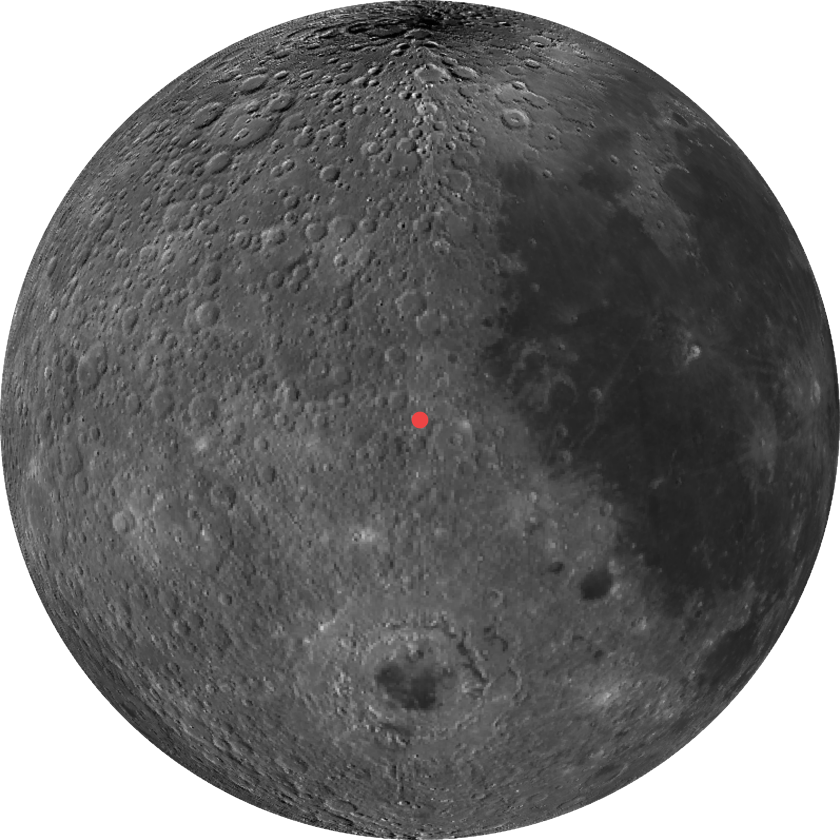
Here’s a view of the “side” of the Moon, with the Earth-facing side on the right. The impact point is shown in red.
In[]:=
GeoGraphics[{StandardRed,PointSize[.02],Point[loc]},GeoProjection->"Orthographic",GeoRange->All]
Out[]=
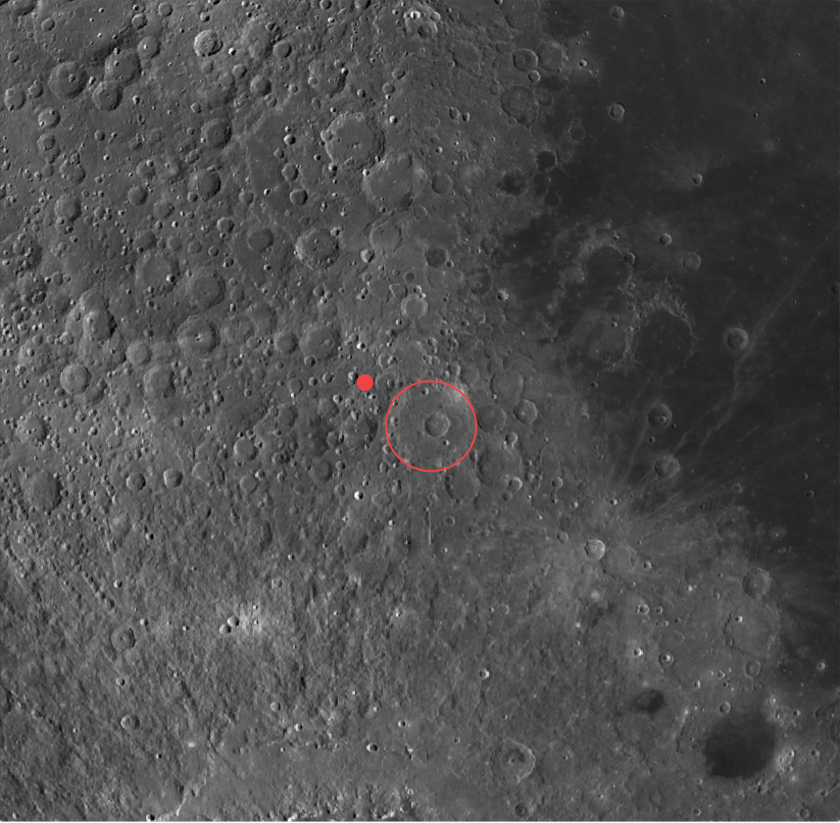
Zooming in, we can highlight the Einstein crater as a red circle and the expected impact point as before.
In[]:=
GeoGraphics[{StandardRed,PointSize[.02],Point[loc],GeoCircle[crater,crater["Size"]/2]},GeoRange->Quantity[500,"Miles"]]
Out[]=
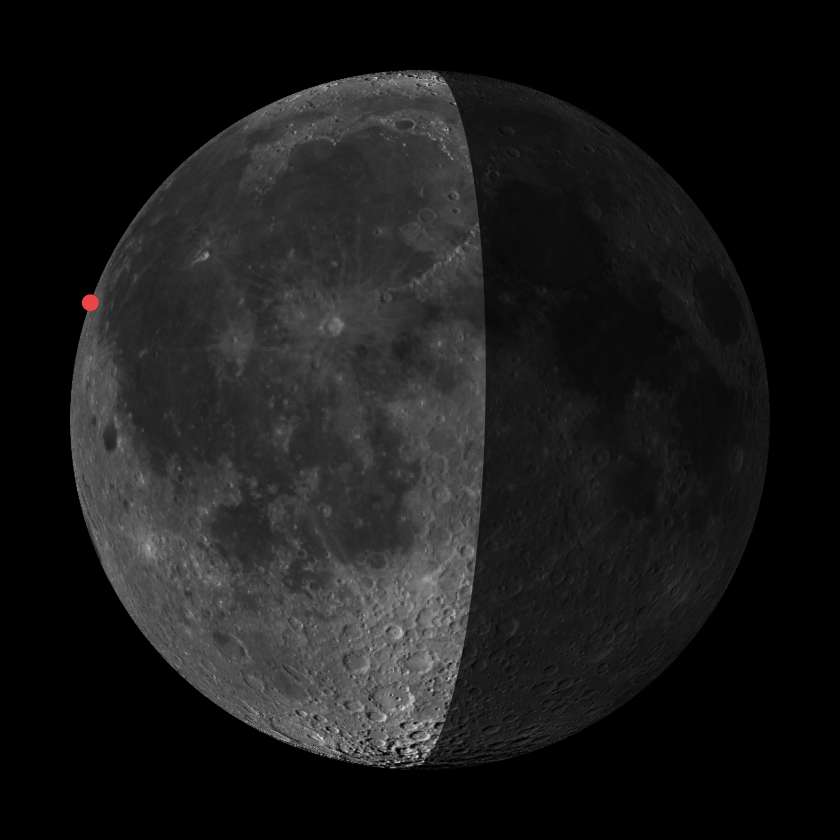
There are a couple ways to simulate the view from Earth. The first is to use GeoGraphics. The view here shows the north pole of the Moon as up.
GeoGraphics{GeoStyling[Opacity[.7]],NightHemisphere[impactdate],StandardRed,PointSize[.02],Point[loc]},
Out[]=
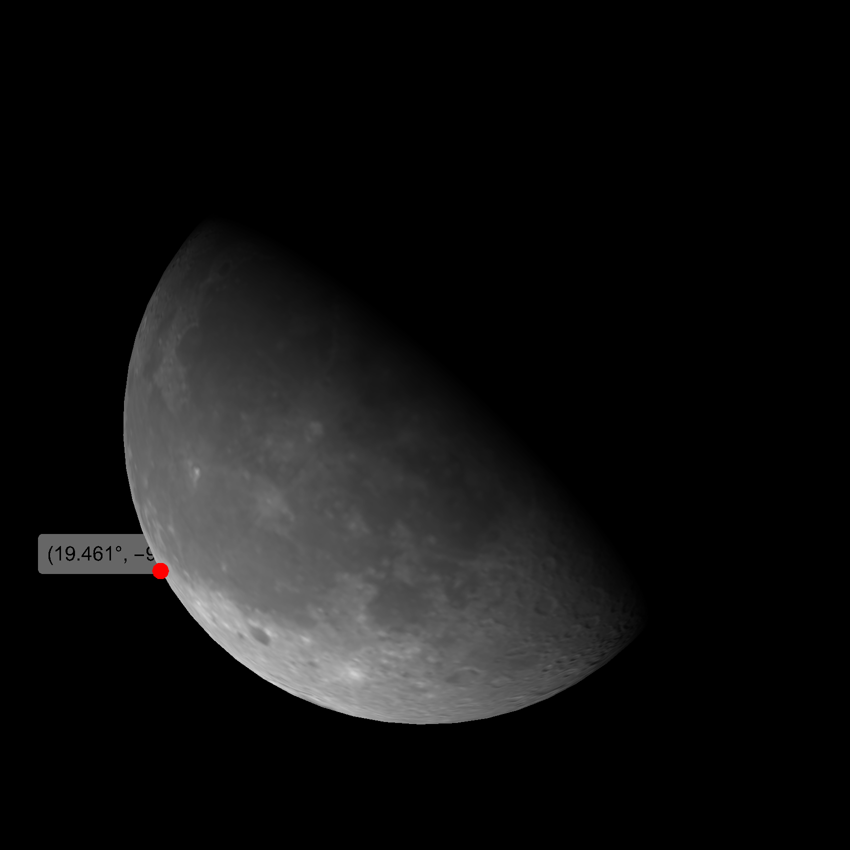
From an observation point on Earth, the actual view is rotated depending on your observation location do to observing with respect to your local horizontal plane.
Out[]=
Calculating the trajectory can be tricky. Here, we make use of JPL Horizons to get the latest ephemeris for the rocket booster. Orbital elements are retrieved for 2 hours prior to impact.
In[]:=
horizons=Values["OrbitalElements",{"@-162719",<|"Center"->"@399","Frame"->"EclipticJ2000","Dates"->impactdate-Quantity[2,"Hours"]|>},All,"Association"][[1]]
Out[]=
PeriapsisDate,Eccentricity0.835471,PeriapsisDistance,Inclination,AscendingNodeLongitude,PerifocusArgument,MeanMotion,MeanAnomaly,TrueAnomaly,SemiMajorAxis,ApoapsisDistance,OrbitalPeriod
In[]:=
orbits=OrbitalElements[horizons,"OrbitLine"];
In[]:=
moonPos[date_]:=AstroPosition["Moon",{"EclipticICRS",date,"Earth"},"Cartesian"]["Data"]
In[]:=
sunPos[date_]:=AstroPosition["Sun",{"EclipticICRS",date,"Earth"},"Cartesian"]["Data"]
In[]:=
morb=Line[Table[moonPos[impactdate+Quantity[s,"SynodicMonths"]],{s,-.5,.5,.005}]];
In[]:=
earth={StandardBlue,Sphere[{0,0,0},QuantityMagnitude[Entity["Planet","Earth"]["Radius"],"AstronomicalUnit"]]};
In[]:=
mrad=QuantityMagnitude["Radius"],"AstronomicalUnit";
The following shows the satellite getting very close to the Moon:
In[]:=
ManipulateGraphics3D{earth,White,morb,orbits,Specularity[White,1],Sphere[moonPos[impactdate+Quantity[h,"Hours"]],mrad],Red,PointSize[Large],Point[OrbitalElements[horizons,"PositionVector",impactdate+Quantity[h,"Hours"],UnitSystem->None]]},,{h,-4,4},SaveDefinitions->True
Out[]=
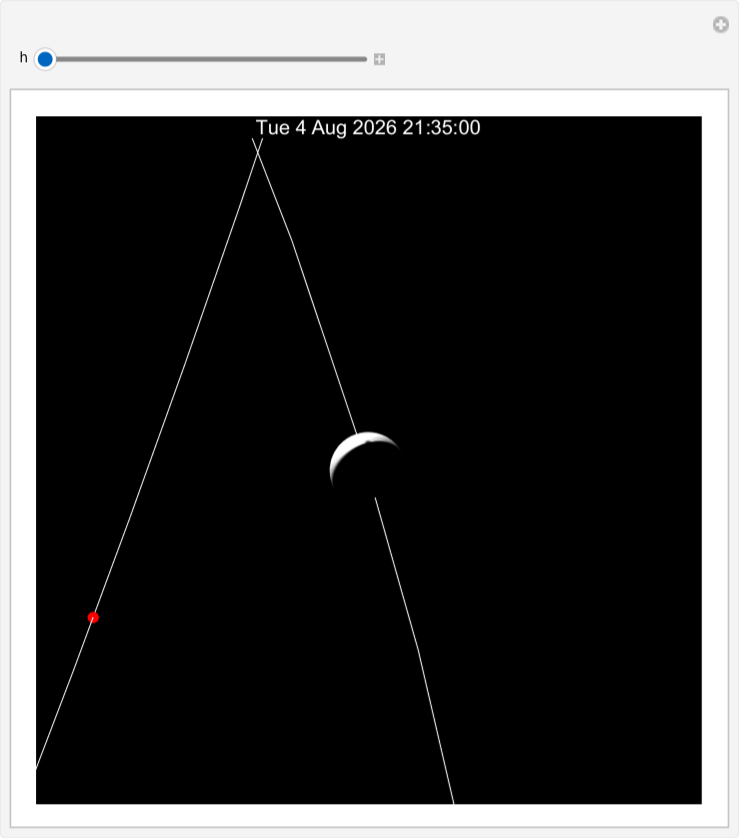
The reason this approach doesn’t simulate an actual impact is because this method treats the Moon and the rocket booster as two separate 2-body systems. Basically, just the Earth with the individual bodies. In order to be more realistic, you would need to factor in the gravitational influence that the Moon has on the rocket body as it gets closer. Without this, the rocket appears to fly right by the Moon without impacting. That’s a much more involved exploration.
As of this post, there have been no reports of anyone observing either an impact flash or a dust cloud lifted off the surface. Confirmation may have to come from lunar orbiters imaging the surface and looking for new craters.
CITE THIS NOTEBOOK
CITE THIS NOTEBOOK
SpaceX rocket booster impacting the Moon
by Jeffrey Bryant
Wolfram Community, STAFF PICKS, August 5, 2026
https://community.wolfram.com/groups/-/m/t/3774686
by Jeffrey Bryant
Wolfram Community, STAFF PICKS, August 5, 2026
https://community.wolfram.com/groups/-/m/t/3774686