Al Rihla's polyhedron: truncated rhombicdodecahedron type 2
By Philip Kuchel
School of Life and Environmental Sciences,
University of Sydney,
NSW 2006, Australia
By Philip Kuchel
School of Life and Environmental Sciences,
University of Sydney,
NSW 2006, Australia
Inspection of the seam-and-node structure of the football with its 12 kite-shaped faces led me to the RhombicDodecahedron, which is in the PolyhedronData collection of Mathematica; but then it was clear that there must be a twist in the analysis to account for the 8 triangles. Here is the story of the designation of its formal name.
Geometrical dissection of the Al Rihla football
Geometrical dissection of the Al Rihla football
Aim
Aim
Al Rihla is Adidas’ name for their football released for the 2022 FIFA World Cup (in Qatar) [1]. It has a pattern of shaped panels, and intersecting grooves that are distinctly different from its 13 predecessors [1]. The aim here is to assign a formal geometrical name to the polyhedron that is formed if straight lines connect the points of intersection of the grooves in the skin of the ball [2-6].
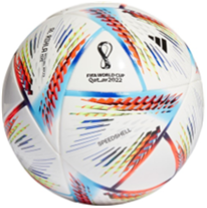
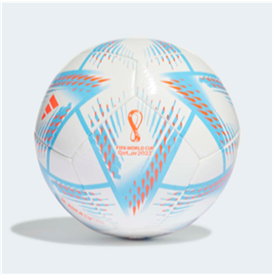
A B FIGURE 1. Adidas' Al Rihla footballs. A, The Match Ball; and B, the Club or Practice Ball.
Direct analytic proof
Direct analytic proof
As for previous releases, the cheaper Club Ball variant that has stitched seams on panels that are of different shape from those of the Match Ball; the Match Ball having mostly molded seams. Nevertheless, the printed patterns (decals) are the same on both types, consequently straight lines on the Club Ball cross the stitched seams; whereas on the Match Ball they are coincident with the seams.
By simple inspection, it is evident that the Club Ball (Figure 1B) has 12 congruent faces that are isosceles pentagons. Four sides of each pentagon are of equal length and longer than the fifth side that is shorter by a factor of more that 2. Such a polyhedron is therefore a dodecahedron that can be simply morphed into the regular dodecahedron. In other words Al Rihla’s polyhedron is isomorphic with the regular dodecahedron.
Counting the number of faces on the Match Ball is quite difficult to do but it is readily seen to contain 8 equilateral triangles. The intervening trapeziums (‘kites’) are seen to be arranged in pairs, with the obtuse angled ‘heads’ meeting in such a way that four seams converge on a Ball-vertex; while the acute-angled ‘tails’ meet with four seams converging on another Ball-vertex.
The triangles each lie on an adjacent long side of a kite.
If we focus on one triangle, we can see that there are three bands of kites (one on each side) that span around the ball in rings that are made up of two head-to-head-and-tail-to-tail rings. Consequently, there are 12 kites.
In a converse view to that given above, relating to the triangles, the kites have 4 straight sides, and they are joined on each long side by a triangle; therefore they are formally hexagons (six points of intersection of grooves/seams). Hence, the Match Ball has 20 faces, made up of 8 equilateral triangles and 12 hexagons.
Insight
Insight
This is where some knowledge of the sets of polyhedra is useful, in particular which ones have 12 congruent hexagonal faces or 4-sided faces that could be readily made into hexagons by judicious cutting. Well! The rhombic dodecahedron is composed of 12 congruent rhombi with sides of equal length, that subtend alternate angles of arccos[1/3] = and arccos[-1/3] = [6-9]; see Figure 2 for the image of a real physical model (made to provide insights for a previous scientific project [9]).
o
70.529
o
109.471
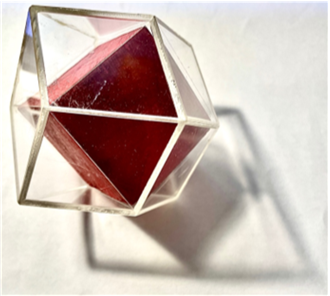
In Figure 2, note how the vertices of the rhombi that have an obtuse angle, meet in threes at the eight corners of the in-cube; while the vertices with the acute angle meet in fours, above each of the six faces of the in-cube. In other words there are 8, order-3 vertices, and 6 order-4 vertices.
Finally, to generate triangular faces, consider slicing off triangular pyramids from the 8 order-3 vertices. This would mean that each rhombus now becomes a hexagon as mooted above. Such a truncated rhombic dodecahedron will have 8 triangular- and 12 hexagonal faces, as required for consistency with Al Rihla’s polyhedron.
Finally, to generate triangular faces, consider slicing off triangular pyramids from the 8 order-3 vertices. This would mean that each rhombus now becomes a hexagon as mooted above. Such a truncated rhombic dodecahedron will have 8 triangular- and 12 hexagonal faces, as required for consistency with Al Rihla’s polyhedron.
Less direct ‘synthetic’ analysis
Less direct ‘synthetic’ analysis
An analysis that does not rely on as much prior knowledge of polyhedra (as used above) is to construct a Schlegel diagram [7] of the polyhedron: We imagine the projection of each vertex from a point that is symmetrically located above one of the faces, onto the plane on which the opposite face of the polyhedron sits. While such a projection can be performed analytically (knowing the coordinates of the various points), for the present analysis it is only necessary to preserve the connectivity of the vertices and sides in this 3-dimensional to 2-dimensional spatial mapping. With some thought the outcome is shown to be something like Figure 3.
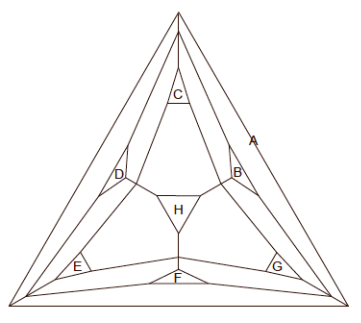
This Schlegel diagram is quite tricky to construct. The natural tendency is to choose a triangular face (being symmetrical) as the central polygon, as opposed to one of the asymmetric hexagons. Inspection of the football, with one triangle at the top pole, shows that the bottom triangle is rotated relative to it (I call this Rule 1). It is judicious to begin the diagram by first drawing the outside triangle and then the inside one with its rotation. Another key constraint (I call this Rule 2) is that there are always two edges (with an intervening node or vertex) between each corner of adjacent triangles. We can now proceed to draw edges, plus the six extra triangles through two arcades, using Rule 2, and we soon arrive at Figure 3.
o
180
o
180
A smarter way
A smarter way
Mathematica has a function, PlanarGraph which generates a graph (net) that is isomorphic with the Schlegel diagram of a fully connected graph. What we do is hold a real ball in our hands and begin numbering each point of intersection of its grooves/seams, using a felt-tip pen. I labelled each of the 8 triangles on the football, A to H in the alphabet, and the results were entered into a List in Mathematica, where the comments (*A*) etc. indicate the labels on the respective triangles:
In[]:=
AlRihlaLinks={(*A*)1->2,2->3,3->1,(*B*)4->6,6->5,5->4,(*C*)7->9,9->8,8->7,(*D*)10->11,11->12,12->10,(*E*)13->14,14->15,15->13,(*F*)16->17,17->18,18->16,(*G*)19->20,20->21,21->19,(*H*)22->23,23->24,24->22,(*A1*)1->25,2->26,3->27,(*B4*)4->27,5->28,6->25,(*C7*)7->25,8->28,9->29,(*D10*)10->29,11->25,12->26,(*E13*)13->26,14->30,15->29,(*F16*)16->26,17->27,18->30,(*G19*)19->30,20->27,21->28,(*H22*)22->29,23->30,24->28};graphAlRihla=Graph[AlRihlaLinks,VertexLabelsAll,VertexStyleGreen,EdgeStyleBlue]
Out[]=
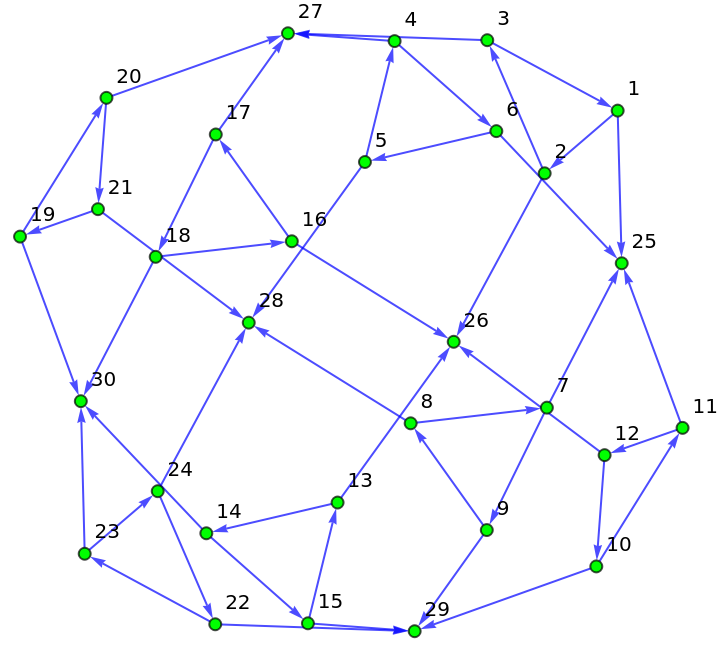
FIGURE 4. Graph of the grooves/seams of Al Rihla Match ball drawn by using the input connectivities and the function Graph.
This particular graph can only be interpreted with some intellectual effort; but a breakthrough comes from the simple next step that yields the 2-dimensional Schlegel diagram ‘in one key stroke’!
This particular graph can only be interpreted with some intellectual effort; but a breakthrough comes from the simple next step that yields the 2-dimensional Schlegel diagram ‘in one key stroke’!
In[]:=
graphSchlegel=PlanarGraph[AlRihlaLinks,VertexStyleBlack,EdgeStyleBlack,VertexSize->0.11,DirectedEdgesFalse]
Out[]=
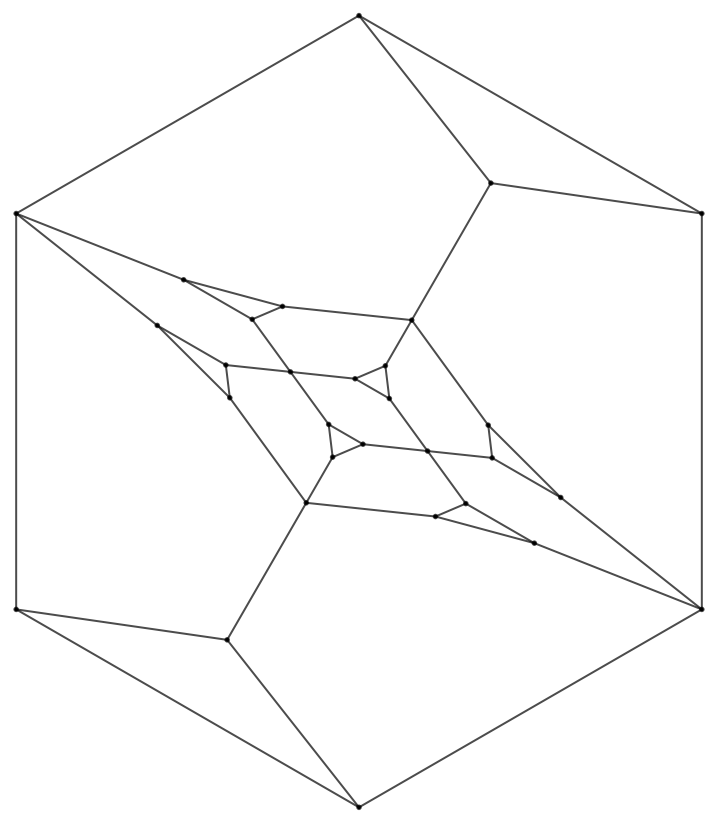
FIGURE 5. Graph of the grooves/seams of the Al Rihla Match Ball drawn by using the input connectivities and the function PlanarGraph that generates one of its two Schlegel diagrams.
Note how in this version of the Schlegel diagram, the central and outer polygons are hexagons, as opposed to the triangles of Figure 3.
Note how in this version of the Schlegel diagram, the central and outer polygons are hexagons, as opposed to the triangles of Figure 3.
Parent body
Parent body
What does Mathematica make of the Schlegel diagram of the rhombicdodecahedron that is alluded to under the heading “Insight”? This can be readily generated as follows [10, 11]:
skeleton=PolyhedronData["RhombicDodecahedron","Skeleton","Name"]GraphData[skeleton,"Graph","Planar"]
Out[]=
RhombicDodecahedralGraph
Out[]=
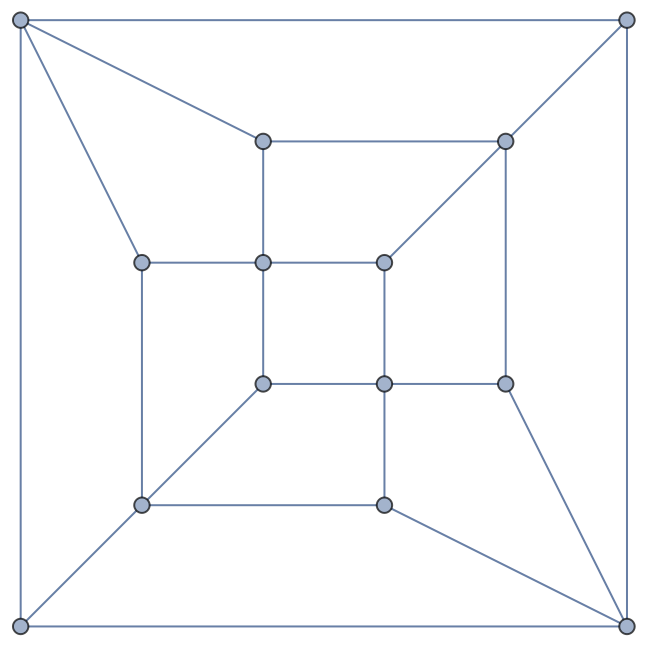
FIGURE 6. PlanarGraph of the rhombicdodecahedron from the PolyhedronData database.
Note how in this version the central and outer polygons are squares whereas in the native rhombicdodecahderon the polygons are rhombi.
FIGURE 6. PlanarGraph of the rhombicdodecahedron from the PolyhedronData database.
Note how in this version the central and outer polygons are squares whereas in the native rhombicdodecahderon the polygons are rhombi.
Note how in this version the central and outer polygons are squares whereas in the native rhombicdodecahderon the polygons are rhombi.
Closure
Closure
Conclusion
Conclusion
The Club Ball is based on a 12-panel dodecahedron with irregular pentagons for which one of the edges is 0.46 of the length of the other four. However, the Match Ball has a symmetrical pattern of 8 triangles and 12 kites (trapezoids) that are in fact hexagons, based on two extra intersections on each of their longer sides. Thus, it has 20 faces (F), making this an icosahedron, or more formally an ‘irregular icosahedron’. There are 30 vertices (V) and 48 edges (E). This latter number turns up in the Length of the List of connections that was used to draw the polyhedron using Graph in Figure 5. Overall, E = V + F -2 (48 = 20 + 30 -2), as required by Euler!
Adidas have produced 14 original football designs, for successive World Cups [1]. The first 9 had different printed patterns on them but the underlying seam structure was simply that of the classical design of a soccer ball, namely a truncated icosahedron, with 32 faces that includes 12 pentagons. Then came the next five with major variations: (1) Teamgeist, a truncated octahedron [2]; (2) Jabulani, a truncated, truncated tetrahedron [3]; (3) Brazuca, a cube [4] and (4) Conext21, a cube [5, 6].
The truncation that has been implemented in the Al Rihla Match Ball is across the 8, order-3 vertices of the rhombicdodecahedron. This can be readily visualized in Figures 2 and 3. However, another truncation can be made across the 6, order-4 vertices, which leaves the order-3 vertices untouched. Such slicing is described in [12]. Since this type of truncation of a rhombicdodecahedron has drawn attention on the Internet (while the that in Al Rihla has not), I refer to it as ‘Type 1 truncation’. Therefore, that leaves the truncation in the Al Rihla polyhedron to be referred to as Type 2 truncation, as is used in the title above.
Finally, I have shown that a neat way of generating a Schlegel diagram [7] for any completely connected polyhedron is by using PlanarGraph in Mathematica. As the explorer of shapes you now have a powerful tool to lead you to the assignment of the systematic name of any new football polyhedron. I can therefore bow out of this football-polyhedron odyssey and leave it to you!
A Schlegel diagram is the key to identifying the polyhedron that underlies and football. It makes very clear what are the numbers of each type of polygon in the panels (faces) of a football and their connectivity. Coupling this information with the comprehensive data base of in Mathematica’s PolyhedronData should make it possible to assign the name of any future football polyhedron. This may involve visualizing symmetrical truncation of vertices of a listed polyhedron as was needed with understanding Al Rihla’s polyhedron, or even symmetrical chamfering of edges of known polyhedra.
It could be argued that analysis such as shown here adds further value (was that even considered possible!?) to what is already the World’s most popular game!
References
References
1. Football Balls Data Base, FootBall-Balls.com
2. P. W. Kuchel, Can you 'bend' a truncated octahedron? Math. Gaz. 91 (November 2007) pp. 533-536.
3. P. W. Kuchel, Can you 'bend' a truncated truncated tetrahedron? Math. Gaz. 96 (July 2012) pp. 317-323.
4. P. W. Kuchel, Kicking a cube. Math. Gaz. 99 (July 2015) pp. 346-347.
5. Conext 21 Authentic: https://www.adidas.com.au/conext-21-pro-ball/GK3488.html
6. Conext 21 Replica: https://www.adidas.com.au/conext-21-league-ball/GK3489.html
7. H. S. M. Coxeter, Introduction to Geometry (2nd edn.), John Wiley & Sons (1969).
8. H. M. Cundy and A. P. Rollett, Mathematical Models, Oxford University press (1972), Chap III.
9. Z. H. Endre and P. W. Kuchel, Viscosity of concentrated solutions and of human erythrocyte cytoplasm determined from NMR measurement of molecular correlation times: The dependence of viscosity on cell volume. Biophys. Chem. 24 (1986) pp. 337-356.
10. S. Wolfram, Mathematica (Version 12.0), Wolfram Research, Inc., (2019).
11. S. Wolfram, An Elementary Introduction to the Wolfram Language (2nd edn.), Wolfram Media, Inc. (2017).
12. Robertlovespi.net/2014/06/09/a-truncated-form-of-the-rhombic-dodecahedron/