Which one—wave-like, particle-like, or something in between? Why and how?
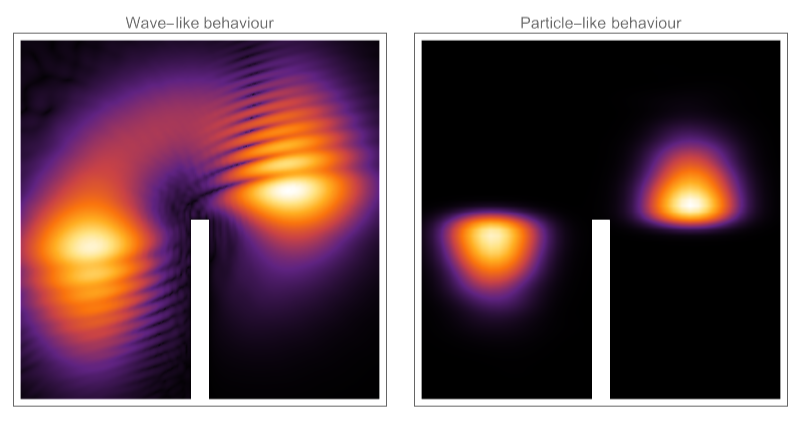
The ability of quantum objects to exhibit wave-like features (e.g., interference patterns) while also being detected at precise positions, suggesting particle-like behavior, has fueled over a century of debate on the true nature of quantum theory. This debate, known as wave-particle duality, persists despite broad agreement on how to compute using quantum mechanics, even with its mathematical peculiarities (e.g., in quantum field theory). However, consensus on what quantum reality actually looks like remains elusive, even among close colleagues.
Consider a quantum object such as a large molecule called 5,10,15,20-tetrakis(2,3,4,5,6-pentafluorophenyl)-21,23-dihydroporphyrin:

Although a complete description of this molecule requires sophisticated quantum mechanical computations, it serves as a compelling example of what we define as a “particle.” Comprising 78 atoms bound within a few nanometers, it has a mass of approximately 1 kg per Avogadro’s number of molecules—roughly a thousand times the mass of a proton. In essence, it is a nanoparticle that can be observed with a high-resolution microscope. Let us position this molecule somewhere within the shaded red region in the image below, representing a region with a central barrier.
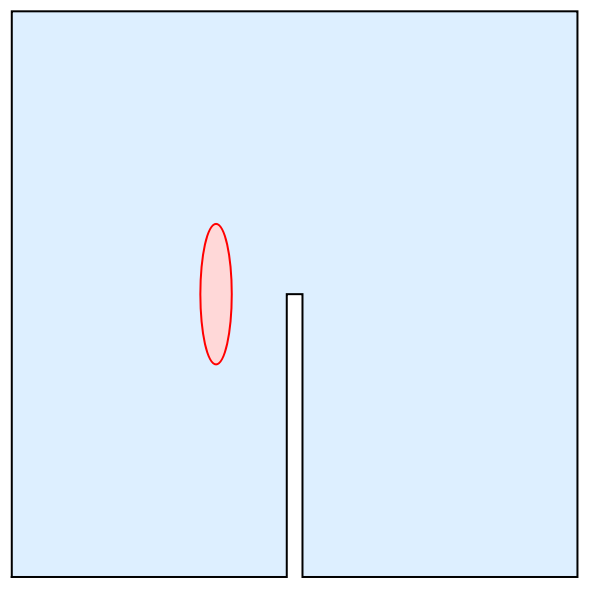
We propel the molecule to the right, analogous to a bullet, with a specific velocity. This velocity is not fixed but is instead drawn from a distribution. We can consider distributions of positions and velocities to be Gaussian distributions.
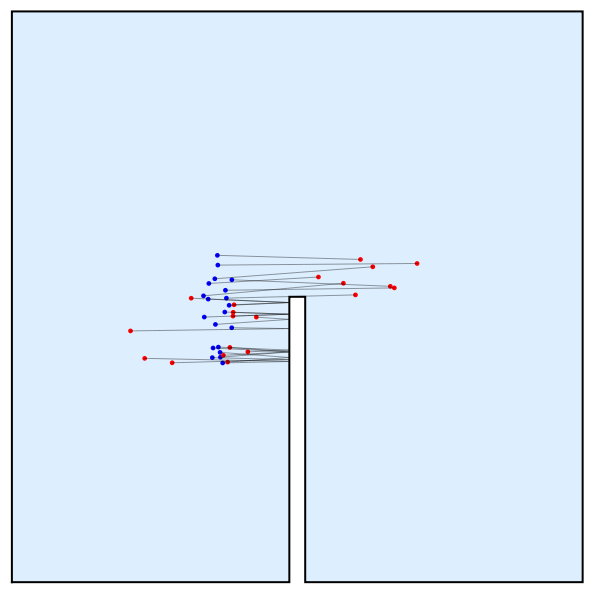
It is important to note that the molecules are introduced one at a time, ensuring that, at any given moment within the apparatus, only a single molecule is present. In a particle-like scenario, for each experimental run, we track the trajectory of the particle. As an illustrative example, after 20 repetitions of the experiment, we can generate a visual representation where the initial positions are marked in blue, and the corresponding final positions are indicated in red, and the black solid lines are corresponding trajectories..
It is important to note that the molecules are introduced one at a time, ensuring that, at any given moment within the apparatus, only a single molecule is present. In a particle-like scenario, for each experimental run, we track the trajectory of the particle. As an illustrative example, after 20 repetitions of the experiment, we can generate a visual representation where the initial positions are marked in blue, and the corresponding final positions are indicated in red, and the black solid lines are corresponding trajectories..
After repeating the experiment enough times, one can obtain the distribution of particles’ final positions.
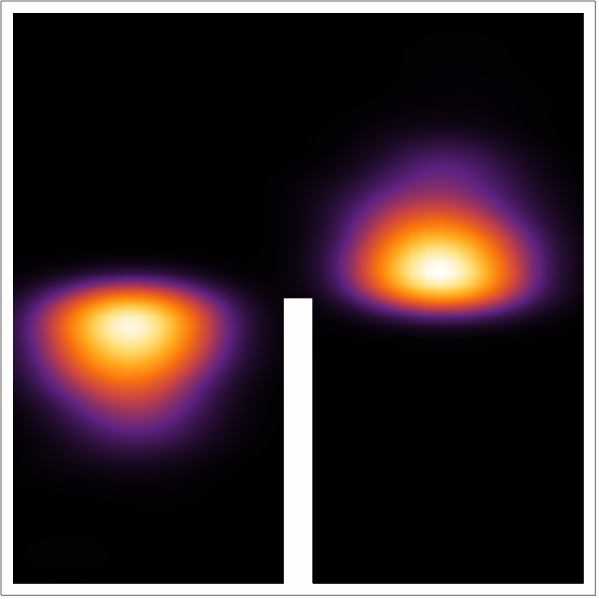
Alternatively, one can analyze the time evolution of this distribution.
Out[]=
To convey the experimental procedure to an experimentalist, particularly one well-versed in quantum, we need to describe the initial preparation of the molecule in precise quantum terms. In this case, preparing the molecule with the specified initial distribution corresponds to initializing the quantum object with a well-defined wave function—here, a Gaussian wave packet. The details of this quantum formulation, governed by the Schrödinger equation, will be discussed separately in another post as part of our “quantum cookbook.”
Given the experimentalist’s expertise, they are likely to pose an important question regarding the execution of individual measurements:
“For each run of the experiment, should I track and monitor the molecule’s trajectory?”
This question is critical because the choice of whether to monitor the trajectory—either partially, with limited precision, or not at all—will fundamentally influence the final observed pattern. The experiment’s outcome depends on how much information is gathered during the measurement process, directly engaging with the core principles of wave-particle duality.
How to respond? Well, one smart choice could be this: try both, one set of data without looking at molecules’ trajectory, and another set of data by tracking them.
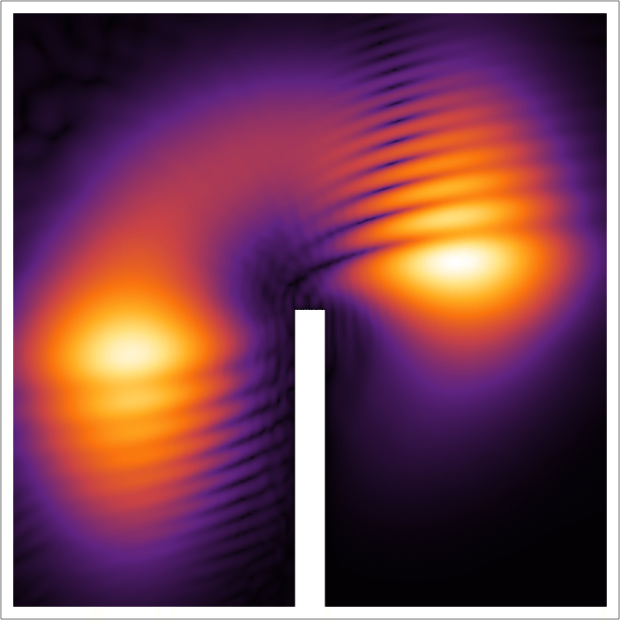
In the scenario where the experimentalist sets the initial state but only observes the molecular position at the final time, the experimental data follows the following wave-like pattern:
And here is the time evolution of this case:
Out[]=
In the scenario where the experimentalist establishes the initial state and simultaneously monitors the molecular trajectory, the experimental data exhibits the following particle-like pattern:
Out[]=
And indeed, these two patterns appear strikingly different. In one case, we observe only two distinct blobs—one corresponding to molecules that collide with the barrier and reflect, and another representing those that pass through unimpeded. This corresponds to a particle-like behavior. In contrast, the other case reveals two intricate wavy patterns, which are unmistakable signatures of interference, a hallmark of wave-like behavior.
The experimental setup can be made even more complex. For instance, one could partially monitor the position, use a measurement device with limited precision, or even store position data without actively detecting it—for example, by coupling the system to another quantum object. In all such cases, the final observed pattern lies somewhere between the purely particle-like and the purely wave-like cases. Crucially, it appears impossible to observe both behaviors simultaneously with complete knowledge—that is, to precisely track individual trajectories while still witnessing clear wave-like interference.
This is the essence of wave-particle duality. The behavior of a quantum object is not rigidly fixed as either a wave or a particle but instead depends on the specifics of the experimental conditions. The system can exhibit behavior spanning the entire spectrum, from entirely particle-like to entirely wave-like.
Yet, we are certain that the molecule—our quantum object—is indeed a particle. Every individual measurement yields a single, localized detection event, manifesting as a discrete dot on the detector plate. When we say that a molecule behaves like a wave, what do we actually mean? Does this imply that the molecule exists partially in different locations simultaneously? If so, why do we always detect a single, well-defined position upon measurement? These are profound questions that we will explore further in our next discussion on quantum mechanics.
Last but not least, quantum diffraction patterns can be very beautiful, almost the same like all classical wave phenomena:
Out[]=
CITE THIS NOTEBOOK
CITE THIS NOTEBOOK
Wave-particle duality: Observation methods reveal quantum object wave-like & particle-like behavior
by Mohammad Bahrami
Wolfram Community, STAFF PICKS, February 13, 2025
https://community.wolfram.com/groups/-/m/t/3393461
by Mohammad Bahrami
Wolfram Community, STAFF PICKS, February 13, 2025
https://community.wolfram.com/groups/-/m/t/3393461