CITE THIS NOTEBOOK: Mathematical Games: Fun with Fractions by Ed Pegg. Wolfram Community FEB 24 2023.
This is part of live presentation series called Mathematical Games in which we explore a variety of games and puzzles using Wolfram Language. In this episode, we feature games and puzzles using fractions.
Wolfram Demonstrations Project
Wolfram Demonstrations Project
Some of the Mathematics related demos I added on the Wolfram Demonstrations Project
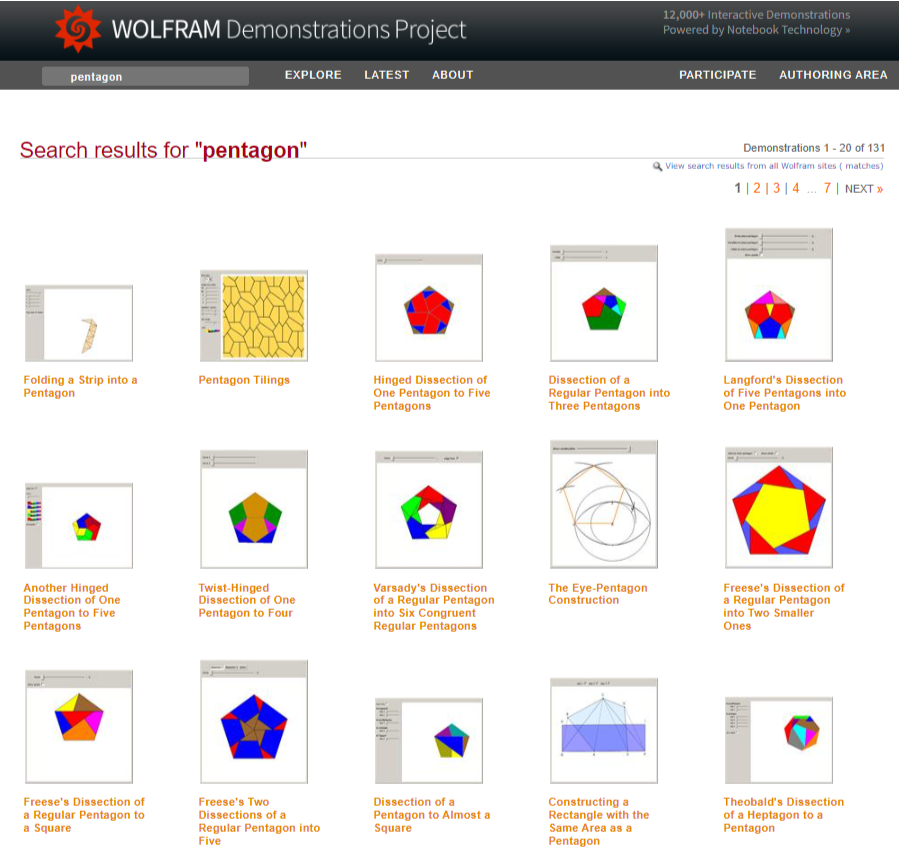
Marjorie Rice’s Pentagon Tilings (100 years)
Marjorie Rice’s Pentagon Tilings (100 years)
Out[]=
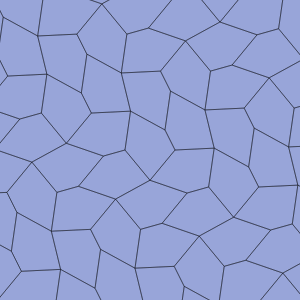

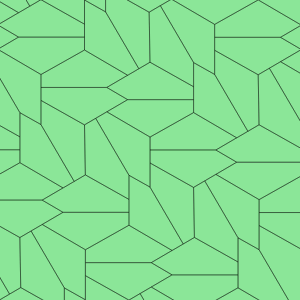
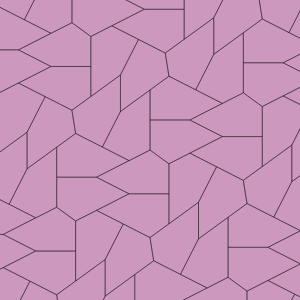
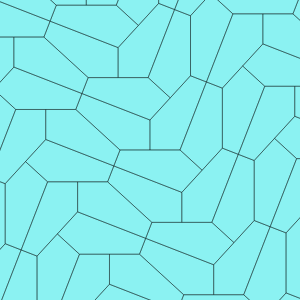
“I thought, my, that must be wonderful that someone could discover these things which no one had seen before, these beautiful patterns.” -- Marjorie Rice.
In[]:=
offset[type_,AA_,BB_,b_,c_,e_]:=;motif[type_,AA_,BB_,b_,c_,e_]:=;PentagonTiling[type_,{AA_,BB_,b_,c_,e_},{v1_,v2_},color_,range_,size_]:=Module[{pentset,off,pents},pentset=motif[type,AA,BB,b,c,e];off=offset[type,AA,BB,b,c,e];pents=Flatten[Table[pentset+Table[xoff[[1]]+yoff[[2]],{Length[pentset]},{5}],{x,-v1,v1},{y,-v2,v2}],2];Graphics[{EdgeForm[Thin],color,Polygon/@pents},PlotRange{{-range,range},{-range,range}},ImageSize{size,size}]];
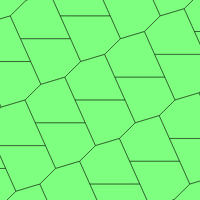
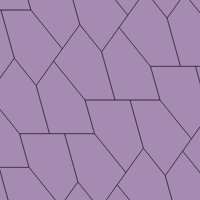
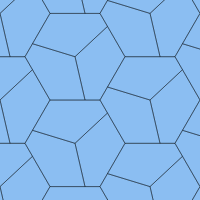
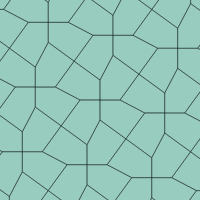
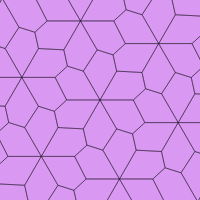
What was in that column? First, there were pentagons of types 1 to 5, found by Karl Reinhardt, though most of these were well known, for example the Cairo tiling. Karl finished up his enumeration with this statement: “Furthermore, there is a certain probability that other pentagon types, apart from those mentioned it Theorem 2, will not occur.”
With that, we can show the five types catalogued by Karl Reinhardt:
Out[]=
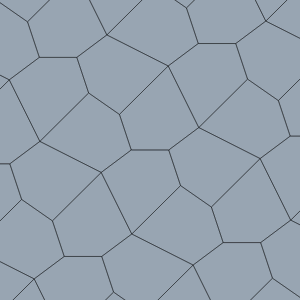
In the next part of the column, Martin introduced three relatively new results by Richard Kershner, who wrote “The author has recently succeeded in carrying through a complete determination in the special case of convex polygons. This paper contains a few critical proofs and a complete statement of the results, but not a complete proof for the excellent reason that a complete proof would require a rather large book.”
Out[]=
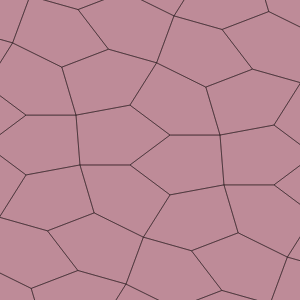
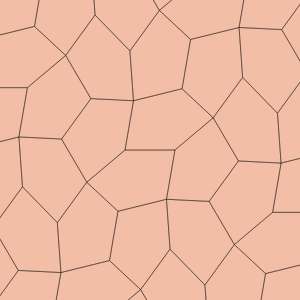
Marjorie Rice: “I became fascinated by the subject and wanted to understand what made each type unique. Lacking a mathematical background, I developed my own notation system and in a few months discovered a new type which I sent to Martin Gardner. He sent it on to Doris Schattschneider to determine if it truly was a new type, and indeed it was. It was because of her interest and encouragement and the information which she sent me that I continued on in the search that eventually led to the discovery (over a two-year period) of three other new types.”
Fraction Bars
Fraction Bars
horizontal bar: virgule, oblique or slash: 1/4diagonal or solidus: 1⁄4unicode (in some cases): ¼
1
4
1
4
Often called vulgar fractions or common fractions.
The “vulgar” here means commonplace.
Fraction Formulas
Fraction Formulas
Addition: a/b + c/d = (ad+bc)/(bd)
Addition: a/b + c/d = (ad+bc)/(bd)
In[]:=
1/3+1/5
Out[]=
8
15
Subtraction: a/b - c/d = (ad-bc)/(bd)
Subtraction: a/b - c/d = (ad-bc)/(bd)
In[]:=
1/3-1/5
Out[]=
2
15
Multiplication: a/b × c/d = (ac)/(bd)
Multiplication: a/b × c/d = (ac)/(bd)
In[]:=
1/3*1/5
Out[]=
1
15
Division: a/b ÷ c/d = (ad)/(bc)
Division: a/b ÷ c/d = (ad)/(bc)
In[]:=
(1/3)÷(1/5)
Out[]=
5
3
Mediant: a/b mediant c/d = (a+c)/(b+d)
Mediant: a/b mediant c/d = (a+c)/(b+d)
In[]:=
Mediant[x_,y_]:=;
(Numerator[x]+Numerator[y])
(Denominator[x]+Denominator[y])
Farey sequence
Farey sequence
Farey sequence is the common fractions up to a given denominator:
n
In[]:=
f6=FareySequence[6]
Out[]=
0,,,,,,,,,,,,1
1
6
1
5
1
4
1
3
2
5
1
2
3
5
2
3
3
4
4
5
5
6
In[]:=
m6=Mediant@@#&/@Partition[f6,2,1]
Out[]=
,,,,,,,,,,,
1
7
2
11
2
9
2
7
3
8
3
7
4
7
5
8
5
7
7
9
9
11
6
7
The repeated mediant of the Farey sequence is the Farey sequence:
In[]:=
Mediant@@#&/@Partition[m6,2,1]
Out[]=
,,,,,,,,,,
1
6
1
5
1
4
1
3
2
5
1
2
3
5
2
3
3
4
4
5
5
6
Greatest Common Denominator
Greatest Common Denominator
So that’s Euclid. What else happened thousands of years ago?
Egyptian Fractions
Egyptian Fractions
In ancient Egypt, only fractions with a 1 on top were allowed. Other numbers were sums of these fractions.
How many fractions are needed?
Egyptian Fractions
Egyptian Fractions
A routine for dividing up a fraction is well-known, though.
Fraction Decomposition
Fraction Decomposition
From Partial Fractions in the Set of Rationals.
We mentioned the Farey sequence earlier.
Farey sequence and Ford Circles
Farey sequence and Ford Circles
The circles are tangent to their mediants:
Fractions are so useful for the radius of a circle that a circle with radius 1/3 is said to have a Bend of 3.
Mod 12, what are the possible bends for Ford circles?
Descartes Circle Theorem and Bends
Descartes Circle Theorem and Bends
Enumerating the Rationals 1
Enumerating the Rationals 1
But that repeats things
Fraction Trees
Fraction Trees
In Stern-Brocot, fractions are based on mediants:
Enumerating the Rationals 2 & 3
Enumerating the Rationals 2 & 3
Fractions are good in geometry as well.
Areal / Barycentric coordinates
Areal / Barycentric coordinates
If a point is outside, signed areas are needed.
18 lines of five points.
Every point is a color
Every point is a color
Every point is a color, 3D
Every point is a color, 3D
Lines of 5 in 3D
Lines of 5 in 3D
18 lines of five points.
Point = Line, in Areal Coordinates
Point = Line, in Areal Coordinates
27 points and 27 lines.
A Barycentric Self-dual 4-Configuration
A Barycentric Self-dual 4-Configuration
Every line is a point. Every point is a line.
So how else can we represent a fraction?
Repeating Decimals
Repeating Decimals
Continued Fractions
Continued Fractions
All rational mixtures with a single square root terms have a periodic continued fraction:
Any real number can be approximated with continued fractions:
The series of approximants give the convergents
The geometric mean of the terms of the continued fraction of most numbers goes to the Khinchin constant.
Some numbers have “large” values early on in their continued fraction
?
?
The Minkowski ? function is based on continued fractions:
A “large” term in the continued fraction results in a ? function value with a lot of repeated 9’s or 0’s.
Bad Fraction Simplification
Bad Fraction Simplification
With all that, we can simplify fractions badly. For almost any fraction, we can build a larger fraction that has a bad but valid simplification. But the numbers crossed out are always a repeating decimal for
Melvyn Knight’s Problem
Melvyn Knight’s Problem
Elliptic Curves
Elliptic Curves
A property of elliptic curves: If two points on the curve are rational, so is the third point.
Sylvester’s Four Point Problem
Sylvester’s Four Point Problem
Odds of all points on convex hull boundary?
Rational Triangles
Rational Triangles
A positive integer is called a congruent number if it is the area of a right triangle with rational sides.
Rational Distance Problem
Rational Distance Problem
Is there a point at rational distances from the vertices of a unit square?
A few thousand solutions with 3 rational distances.
No-one knows if 4 rational distances are possible!
A few thousand solutions with 3 rational distances.
No-one knows if 4 rational distances are possible!
Heilbronn Problem
Heilbronn Problem