Consider a ternary mixture composed of 20 mole% benzene, 60 mole% toluene and 20 mole% -xylene. This mixture can be separated by the usual direct or indirect sequences using two distillation columns. A more efficient method is to use the dividing wall column [1, 2] (DWC) or the Petlyuk column [3]. Both methods are thermodynamically equivalent. DWC allows up to 30% saving in capital investment and energy cost. Here, we feed the DWC, operating at atmospheric pressure, with the ternary mixture. The feed, a saturated liquid, has a flow rate equal to 100 kmol/hr and a temperature equal to 104.87 °C. Here, we compute the composition profiles in both the main column and the fractionator.
p
The steady-state compositions of benzene, toluene, and -xylene are indicated in red, blue, and green, respectively. You can change the values of the reflux and reboil ratios, the liquid and vapor split ratios, and the sidestream draw rate. Here, we use: Reflux Ratio = 10.25; liquid and vapor splits equal to 0.02 and 0.15; sidestream draw rate = 61.0 kmol/hr and distillate rate equal to 19.1 kmol/hr.Both the Petlyuk column and DWC setups are shown below:
p
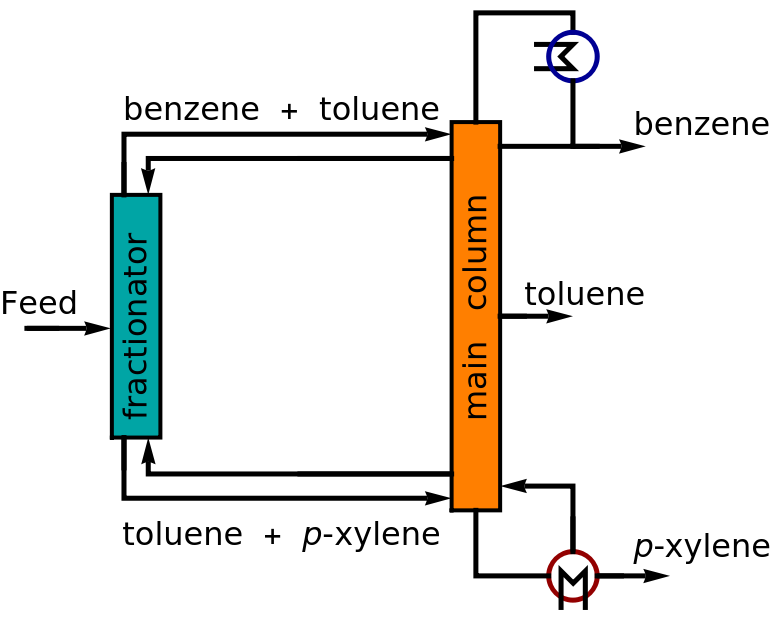
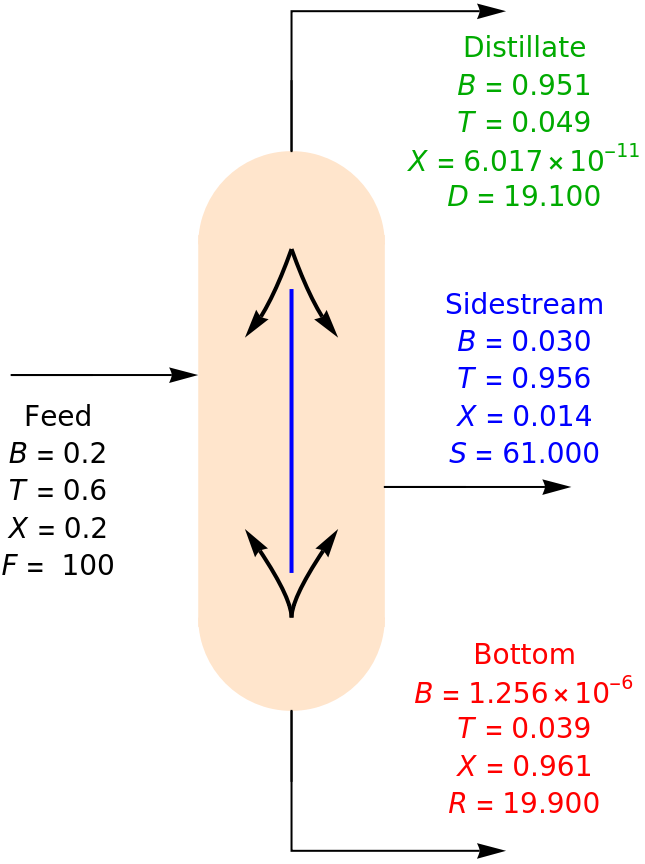
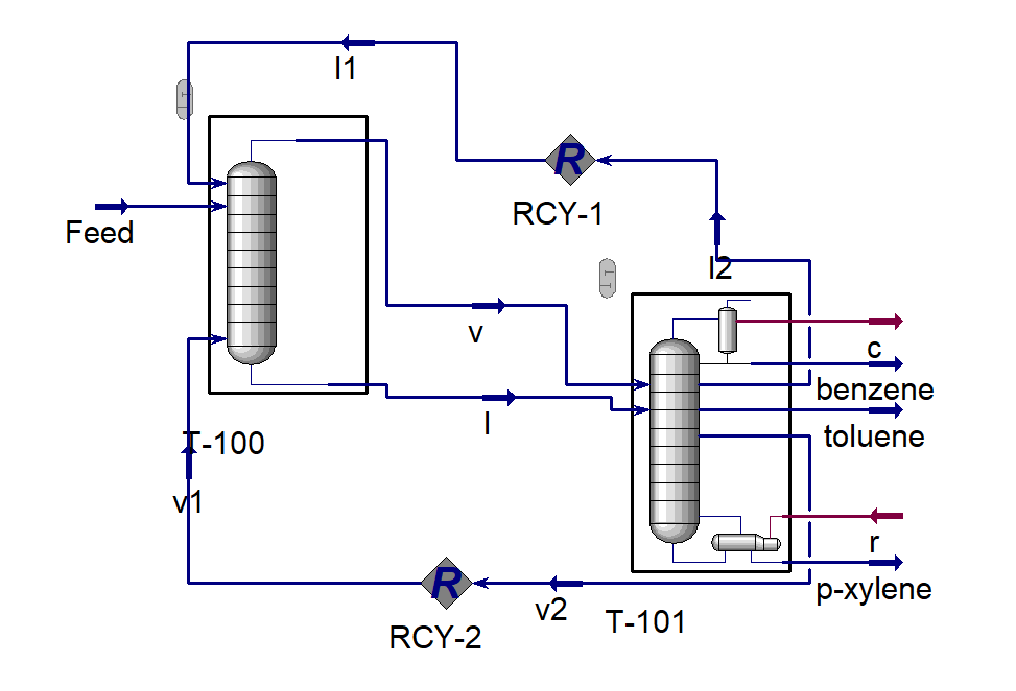
The DWC simulation indicates that it is possible to separate the pure benzene, pure toluene, and pure -xylene that exit as distillate, intermediate, and bottom products, respectively. Expressions for pure component molar vapor and liquid enthalpies as well as the vapor pressures were adapted from Aspen HYSYS. The mixture is assumed to obey Raoult’s law since it is composed of only aromatic compounds with Antoine constants taken from Aspen HYSYS.
p
In[]:=
RR=10.25;alpha1=0.02;alpha2=0.15;SS=9.5;sidestreamrate=61.0;
(*BothmodifiedAntoineequations+purecomponentvaporandliquidenthalpiesareobtainedfromHYSYS*)A1=169.65;B1=-10314.8;C1=0.;D1=-23.5895;E1=;F1=2.;A2=76.4511;B2=-6995.;C2=0.;D2=-9.1635;E2=;F2=2.;A3=91.2505;B3=-8121.25;C3=0.;D3=-11.3188;E3=;F3=2.;a1=0.;b1=129.44;c1=-;d1=;e1=-;h1=e1+d1+c1+b1T+a1/.TTF;hl1=e1+d1+c1+b1T+a1-h1;a2=0.;b2=140.1399;c2=-;d2=;e2=-;h2=e2+d2+c2+b2T+a2/.TTF;hl2=e2+d2+c2+b2T+a2-h2;a3=0.;b3=-35.49996;c3=0.6435998;d3=-;e3=;h3=e3+d3+c3+b3T+a3/.TTF;hl3=e3+d3+c3+b3T+a3-h3;a1v=45880.06;b1v=114.7825;c1v=-0.2426732;d1v=;e1v=-;Hv1=e1v+d1v+c1v+b1vT+a1v-h1;a2v=48522.49;b2v=132.693;c2v=-0.2388932;d2v=;e2v=-;Hv2=e2v+d2v+c2v+b2vT+a2v-h2;a3v=11653.17;b3v=383.7983;c3v=-1.17436;d3v=;e3v=-;Hv3=e3v+d3v+c3v+b3vT+a3v-h3;PSat[1][i_][t_]:=Exp[A1+B1/(C1+T)+D1Log[T]+E1T^F1]/.TT[i][t];PSat[2][i_][t_]:=Exp[A2+B2/(C2+T)+D2Log[T]+E2T^F2]/.TT[i][t];PSat[3][i_][t_]:=Exp[A3+B3/(C3+T)+D3Log[T]+E3T^F3]/.TT[i][t];
2.09442
5
10
6.225
6
10
7.30555
6
10
8.475001
2
10
2.159366
4
10
2.089645
14
10
4
T
3
T
2
T
4
T
3
T
2
T
7.615016
2
10
2.31667
4
10
2.769433
14
10
4
T
3
T
2
T
4
T
3
T
2
T
8.66333
4
10
6.064997
7
10
4
T
3
T
2
T
4
T
3
T
2
T
5.663124
4
10
3.654795
7
10
4
T
3
T
2
T
5.907287
4
10
3.913967
7
10
4
T
3
T
2
T
2.308164
3
10
1.543837
6
10
4
T
3
T
2
T
zF[1]=0.2;zF[2]=0.6;zF[3]=0.2;TF=104.872573239450+273.15;(*feedcompositionandtemperatureinKelvin*)P=101.325;(*totalpressureinkPa*)
mixture liquid and vapor enthalpies in main column:
H[i_][t_]:=(y[1][i][t]Hv1+y[2][i][t]Hv2+y[3][i][t]Hv3)/.TT[i][t];h[i_][t_]:=(x[1][i][t]hl1+x[2][i][t]hl2+x[3][i][t]hl3)/.TT[i][t];
enthalpy of feed stream in kJ/kmol:
hF=zF[1]hl1+zF[2]hl2+zF[3]hl3/.TTF;
summation rules:
x[3][i_][t_]:=1-x[1][i][t]-x[2][i][t];y[3][i_][t_]:=1-y[1][i][t]-y[2][i][t];
vapor pressures in fractionator column:
PSatf[1][i_][t_]:=Exp[A1+B1/(C1+T)+D1Log[T]+E1T^F1]/.TTf[i][t];PSatf[2][i_][t_]:=Exp[A2+B2/(C2+T)+D2Log[T]+E2T^F2]/.TTf[i][t];PSatf[3][i_][t_]:=Exp[A3+B3/(C3+T)+D3Log[T]+E3T^F3]/.TTf[i][t];
mixture liquid and vapor enthalpies in fractionator column:
Hf[i_][t_]:=(yf[1][i][t]Hv1+yf[2][i][t]Hv2+yf[3][i][t]Hv3)/.TTf[i][t];hf[i_][t_]:=(xf[1][i][t]hl1+xf[2][i][t]hl2+xf[3][i][t]hl3)/.TTf[i][t];
summation rules:
xf[3][i_][t_]:=1-xf[1][i][t]-xf[2][i][t];yf[3][i_][t_]:=1-yf[1][i][t]-yf[2][i][t];
F=100;(*feedflowrate*)
MESH equations in main column:
eq1=Di[t]+L[0][t]V[1][t];eq2=Di[t]h[0][t]+L[0][t]h[0][t]V[1][t]H[1][t]+Qc[t];eq3[i_]:=V[i][t]+L[i][t]-If[i20,Vf[1][t],0]-If[i52,Lf[30][t],0]+If[i20,l2[t],0]+If[i34,S[t],0]+If[i56,v2[t],0]V[i+1][t]+L[i-1][t];eq4[i_]:=Table[V[i][t]y[j][i][t]+L[i][t]x[j][i][t]-If[i20,Vf[1][t]yf[j][1][t],0]-If[i52,Lf[30][t]xf[j][30][t],0]+If[i20,l2[t]x[j][i][t],0]+If[i34,S[t]x[j][i][t],0]+If[i56,v2[t]y[j][i][t],0]V[i+1][t]y[j][i+1][t]+L[i-1][t]x[j][i-1][t],{j,1,2}];eq5[i_]:=Table[y[j][i][t]Px[j][i][t]PSat[j][i][t],{j,1,3}];eq6[i_]:=V[i][t]H[i][t]+L[i][t]h[i][t]-If[i20,Vf[1][t]Hf[1][t],0]-If[i52,Lf[30][t]hf[30][t],0]+If[i20,l2[t]h[i][t],0]+If[i34,S[t]h[i][t],0]+If[i56,v2[t]H[i][t],0]V[i+1][t]H[i+1][t]+L[i-1][t]h[i-1][t];eq15=V[61][t]+B[t]L[60][t];eq16=Table[V[61][t]y[i][61][t]+B[t]x[i][61][t]L[60][t]x[i][60][t],{i,1,2}];eq17=Table[Py[i][61][t]x[i][61][t]PSat[i][61][t],{i,1,3}];eq18=V[61][t]H[61][t]+B[t]h[61][t]L[60][t]h[60][t]+Qr[t];eq19=L[0][t]/Di[t]RR;eq20=V[61][t]/B[t]SS;eq21=l2[t]alpha1L[19][t];eq21b=v2[t]alpha2V[57][t];eq21c=S[t]sidestreamrate;eq22=Table[x[i][0][t]y[i][1][t],{i,1,2}];eq25=Table[Py[i][0][t]x[i][0][t]PSat[i][0][t],{i,1,3}];EQU=Flatten[{eq1,eq2,eq25,eq22,eq20,eq19,eq18,eq17,eq16,eq15,Table[{eq3[i],eq4[i],eq5[i],eq6[i]},{i,1,60}],eq21,eq21b,eq21c}];
MESH equations in fractionator column:
eq3f[i_]:=Vf[i][t]+Lf[i][t]-If[i8,F,0]-If[i1,l2[t],0]-If[i30,v2[t],0]If[i30,0,Vf[i+1][t]]+If[i1,0,Lf[i-1][t]];eq4f[i_]:=Table[Vf[i][t]yf[j][i][t]+Lf[i][t]xf[j][i][t]-If[i8,FzF[j],0]-If[i1,l2[t]x[j][20][t],0]-If[i30,v2[t]y[j][56][t],0]If[i30,0,Vf[i+1][t]yf[j][i+1][t]]+If[i1,0,Lf[i-1][t]xf[j][i-1][t]],{j,1,2}];eq5f[i_]:=Table[yf[j][i][t]Pxf[j][i][t]PSatf[j][i][t],{j,1,3}];eq6f[i_]:=Vf[i][t]Hf[i][t]+Lf[i][t]hf[i][t]-If[i8,FhF,0]-If[i1,l2[t]h[20][t],0]-If[i30,v2[t]H[56][t],0]If[i30,0,Vf[i+1][t]Hf[i+1][t]]+If[i1,0,Lf[i-1][t]hf[i-1][t]];EQUf=Flatten[{Table[{eq3f[i],eq4f[i],eq5f[i],eq6f[i]},{i,1,30}]}];
governing equations for the DWC
Graphical representations of liquid and vapor compositions, temperature profiles, liquid and vapor flow rates (for the main + fractionator columns)
Graphical representations of liquid and vapor compositions, temperature profiles, liquid and vapor flow rates (for the main + fractionator columns)
liquid composition in main column
liquid composition in main column
liquid composition in fractionator column
liquid composition in fractionator column
vapor composition in main column
vapor composition in main column
vapor composition in fractionator column
vapor composition in fractionator column
temperature profile in main column
temperature profile in main column
temperature profile in fractionator column
temperature profile in fractionator column
liquid and vapor flow rates in main column
liquid and vapor flow rates in main column
liquid and vapor flow rates in fractionator column
liquid and vapor flow rates in fractionator column
In order to reproduce our results with HYSYS, one needs to provide HYSYS with the following specifications:
Comparison between our calculations (colored squares) and results obtained using HYSYS (colored lines).
The various variables, indicated by pic, are snapshots from HYSYS.
The various variables, indicated by pic, are snapshots from HYSYS.
vapor composition in main column
vapor composition in main column
liquid composition in main column
liquid composition in main column
liquid composition in fractionator column
liquid composition in fractionator column
vapor composition in fractionator column
vapor composition in fractionator column
temperature profile in main column
temperature profile in main column
temperature profile in fractionator column
temperature profile in fractionator column
liquid and vapor flow rates in main column
liquid and vapor flow rates in main column
liquid and vapor flow rates in fractionator column
liquid and vapor flow rates in fractionator column
Graphical representations of DWC and Petlyuk column
Graphical representations of DWC and Petlyuk column
References
References
◼
[1] R. O. Wright, Fractionation Apparatus, US Patent 2,471,134, filed July 17, 1946, and issued May 24, 1949. www.google.com/patents/US2471134.
◼
[2] M. A. Schultz , D. G. Stewart, J. M. Harris, S. P. Rosenblum, M. S. Shakur, and D. E. O’Brien, “Reduce Costs with Dividing-Wall Columns,” Chemical Engineering Progress, May 2002, pp. 64–71.
◼
[3] F. B. Petlyuk, V. M. Platonov, and D. M. Slavinskii, “Thermodynamically Optimal Method for Separating Multicomponent Mixtures,” International Journal of Chemical Engineering, 5(3), 1965 pp. 555–561.
CITE THIS NOTEBOOK
CITE THIS NOTEBOOK
Operation of a dividing wall column and a Petlyuk column
by Housam Binous and Ahmed Bellagi
Wolfram Community, STAFF PICKS, March 25, 2024
https://community.wolfram.com/groups/-/m/t/3146882
by Housam Binous and Ahmed Bellagi
Wolfram Community, STAFF PICKS, March 25, 2024
https://community.wolfram.com/groups/-/m/t/3146882