ABSTRACT (original article): This paper investigates the sensitivity of heat transfer and fluid flow to geometric uncertainties caused by roughness in microchannels. The study considers laminar, fully developed slip flow and temperature jump conditions in the momentum and energy equations, controlled by velocity slip λ and temperature jump parameters, under traditional H1 and H2 heating conditions. Microchannels with nominally circular geometries are analyzed, incorporating random boundary variations defined by a roughness parameter, . These variations generate unique geometries for each , grouped into samples for numerical simulation and statistical analysis. The analysis shows that for every configuration, a normal distribution of Poiseuille and Nusselt numbers values is obtained for each . An examination of the median and standard deviation of each sample reveals that increasing leads to higher Poiseuille numbers and lower Nusselt numbers, indicating greater pressure drop and reduced heat transfer, respectively. The influence of slip length and temperature jump parameters was also assessed, revealing that while higher λ values reduce the friction factor, these cases are more impacted by roughness. Conversely, although an increase in significantly reduces the Nusselt number due to added thermal resistance, cases with lower are more sensitive to roughness effects. CITATION (original article): Sphaier, L. A., A. Barletta, M. Celli, P. V. Brandão, and E. Ghedini. “Laminar Forced Convection in Circular Microchannels with Slip-Flow: Analysis of Randomly Distributed Roughness.” International Communications in Heat and Mass Transfer 162 (March 1, 2025): 108615. https://doi.org/10.1016/j.icheatmasstransfer.2025.108615
λ
T
*
δr
max
*
δr
max
*
δr
max
*
δr
max
λ
T
λ
T
Version 0.20 - January 2025
Introduction
Introduction
This notebook is focused on the solution of fully-developed slip-flow laminar forced convection in circular micro-channels with a randomly-generated roughness distribution at the channel wall. two wall heating conditions, namely the H1 and H2 conditions, as illustrated below, are considered.
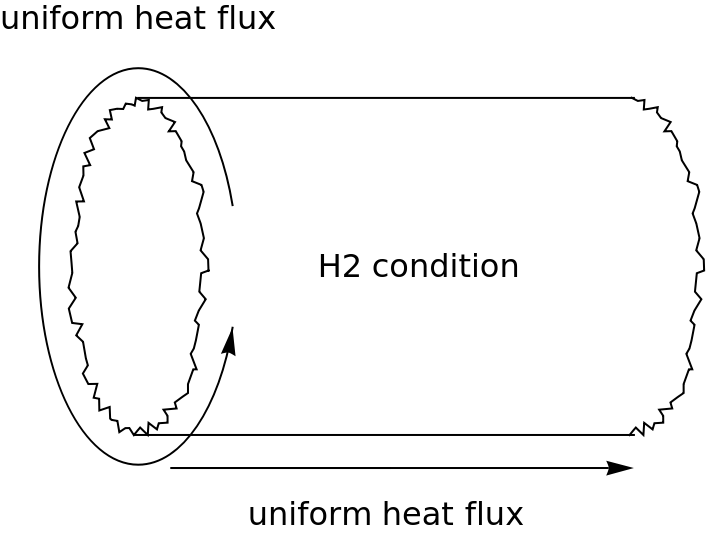
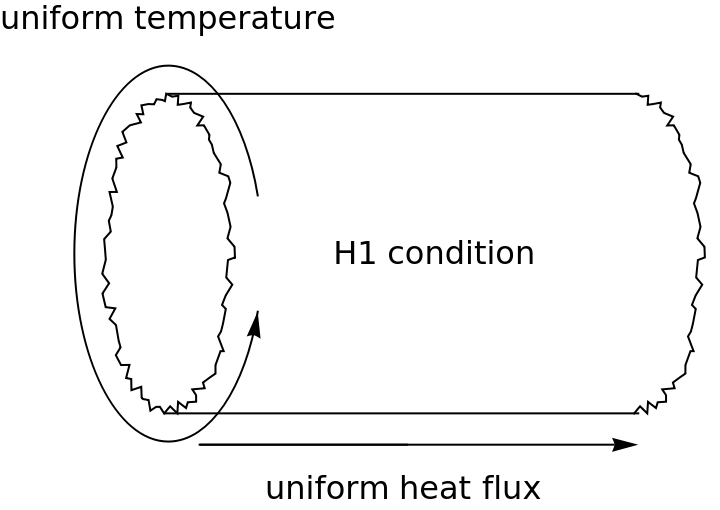
The governing equation for fluid flow, written in terms of the dimensionless velocity, is given by:
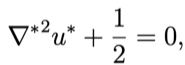
Subjected to the boundary condition

And the Poiseuille number (friction factor) is evaluated from:
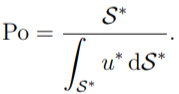
The governing equation for heat transfer is, written in terms of the dimensionless temperature, is given by:
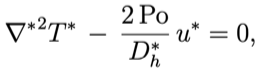
Subjected to the boundary condition

The Nusselt number is calculated from:
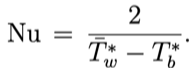
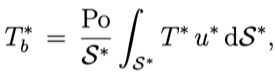
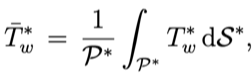
Where the bulk temperature and wall temperature are evaluated from integrals within the dimensionless area and dimensionless perimeter, respectively:
In this notebook, the slip flow parameters are the dimensionless slip length and temperature jump parameter:
In[]:=
{λs,λsT}
Out[]=
{,}
*
λ
*
λ
T
More details regarding the problem formulation can be found in the reference below:
Sphaier, L. A., A. Barletta, M. Celli, P. V. Brandão, and E. Ghedini. “Laminar Forced Convection in Circular Microchannels with Slip-Flow: Analysis of Randomly Distributed Roughness.” International Communications in Heat and Mass Transfer 162 (March 1, 2025): 108615. https://doi.org/10.1016/j.icheatmasstransfer.2025.108615.
Initialization
Initialization
Function definition
Function definition
Numerical
Numerical
Region generation
Region generation
Generation of circular region with random roughness (the parameters δrsmax and npts control random variations in the geometry boundary).
In[]:=
r=1;δrsmax=.1;npts=100;(*SeedRandom[1];*){pts,vecs}=RandomRegionPointsCircle[r,npts,δrsmax,False];
In[]:=
g1=Graphics[{GrayLevel[.9],Circle[{0,0},r],GrayLevel[.8],FaceForm[],{EdgeForm[{Dashed,Blue}],Polygon[pts]},{Red,PointSize[.01],Point[pts]}},Axes->True]
Out[]=
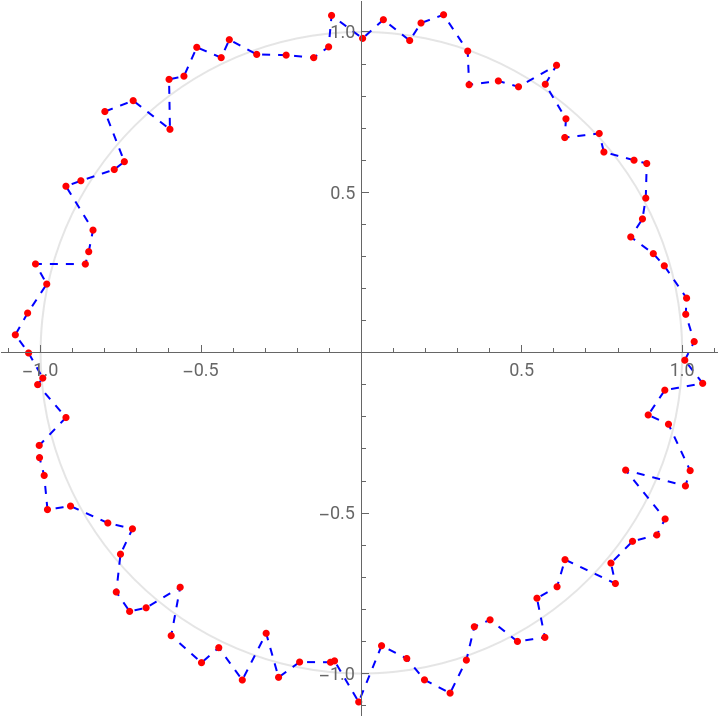
Definition of problem domain:
In[]:=
region=Region[Polygon[pts]]
Out[]=

Solution of transport equations
Solution of transport equations
Definition of slip-length parameters:
The solution output is organized as an Association with the following keys:
The calculated perimeter, area ad hydraulic diameter, in dimensionless form gives:
The Fanning friction factor (Poiseuille number) and its nominal value for a smooth circular channel gives:
The Nusselt number number for the H1 and H2 boundary conditions and its nominal value for a smooth circular channel gives:
Ultimately, the full solution gives:
The dimensionless velocity field is plotted below:
The dimensionless temperature field for the H1 condition is plotted below:
The dimensionless temperature field for the H2 condition is plotted below:
Other recommended work:
Other recommended work:
Shape uncertainty analysis of laminar forced convection in a round microchannel with viscous dissipation
by Antonio Barletta, Michele Celli, Leandro Alcoforado Sphaier, Pedro Vayssiere Brandão, Stefano Lazzari & Emanuele Ghedini
Wolfram Community, STAFF PICKS, October 25, 2024
https://community.wolfram.com/groups/-/m/t/3308119
by Antonio Barletta, Michele Celli, Leandro Alcoforado Sphaier, Pedro Vayssiere Brandão, Stefano Lazzari & Emanuele Ghedini
Wolfram Community, STAFF PICKS, October 25, 2024
https://community.wolfram.com/groups/-/m/t/3308119
Original Article: Barletta, A., M. Celli, L. A. Sphaier, P. V. Brandão, S. Lazzari, and E. Ghedini. “Shape Uncertainty Analysis of Laminar Forced Convection in a Round Microchannel with Viscous Dissipation.” Applied Thermal Engineering 265 (April 15, 2025): 125536. https://doi.org/10.1016/j.applthermaleng.2025.125536.
CITE THIS NOTEBOOK
CITE THIS NOTEBOOK
Laminar forced convection in circular micro-channels with slip-flow and random roughness
by Leandro A. Sphaier, Antonio Barletta, Michele Celli & Pedro V. Brandão, Emanuele Ghedini
Wolfram Community, STAFF PICKS, February 14, 2025
https://community.wolfram.com/groups/-/m/t/3394409
by Leandro A. Sphaier, Antonio Barletta, Michele Celli & Pedro V. Brandão, Emanuele Ghedini
Wolfram Community, STAFF PICKS, February 14, 2025
https://community.wolfram.com/groups/-/m/t/3394409