Alpha-Type Stirling Engine
Alpha-Type Stirling Engine


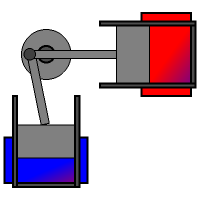
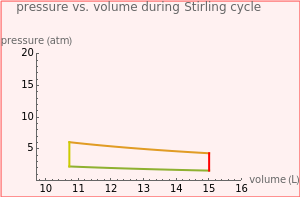


A Stirling engine takes advantage of the thermodynamic properties of compression and expansion of gases to produce work. This Demonstration tracks the changes in pressure (atm) and volume (L) of the working fluid during a reversible Stirling cycle as it cycles through the four characteristic thermodynamic steps:
1. isothermal expansion
2. isochoric cooling
3. isothermal compression
4. isochoric heating.
Accompanying this is an animation of the alpha-type engine, as well as work produced per cycle (J) and Carnot efficiency of the engine. The alpha-type Stirling engine is functionally equivalent to other Stirling engines, but has two pistons in separate cylinders, one with a heater (red), the other with a cooler (blue), that are connected by a heat regenerator (not shown in the animation).
Details
Details
Submission from the Compute-to-Learn course at the University of Michigan.
References
References
[1] R. Chang, Physical Chemistry for the Biosciences, Sansalito, CA: University Science, 2005.
External Links
External Links
Permanent Citation
Permanent Citation
David Niemann, Katherine Sanchez, Katherine Bunnell
"Alpha-Type Stirling Engine"
http://demonstrations.wolfram.com/AlphaTypeStirlingEngine/
Wolfram Demonstrations Project
Published: November 29, 2018