ABSTRACT (original article): In Ref. arXiv:2502.08816, Hawking radiation was analyzed through a statistical mechanics framework, revealing a structured microstate description of black hole horizons and information transfer into the radiation background. This study extends that approach by formulating Hawking radiation and black hole evaporation in the language of stochastic mechanics, employing an analytical Langevin framework and a numerical Euler iteration scheme. Both methods confirm that small black holes behave as thermal systems with Gaussian noise, while larger black holes develop a structured noise spectrum that aligns with the gradual contraction of the horizon. This suggests an alternative interpretation of Hawking radiation as an effective surface fuzziness, encoding horizon-scale fluctuations. The appendix provides a Wolfram Mathematica blueprint for numerical simulations, open to heuristic modifications for further exploration of black hole noise spectra. CITATION (original article): N. M. MacKay (2025), The Stochastic Mechanics of Hawking Radiation, arXiv:2503.18086. https://doi.org/10.48550/arXiv.2503.18086
Introduction
Introduction
In typical thermodynamic systems, particles in a thermal gas undergo stochastic mechanics by means of Brownian motion brought up by collisions with nearest neighbors. For a black hole, which has a temperature relation of T=ℏ /(8 π GM ), (super-)massive black holes are quite cold to track any meaningful noise spectrum. Since Hawking radiation is a quantum phenomenon, Heisenberg uncertainty gives us stochastic motion in the form of zero-point energy for cryogenic systems. With that said, can Hawking radiation on the surface be measured as a noise signal?
3
c
k
B
Euler Scheme Set-up
Euler Scheme Set-up
While the article has the complete layout on the analytical side (e.g., Langevin Equation, discretization into Euler Scheme, choice of potential energy profile, parameters) as well as scaling choices to avoid numerical divergences, the numerical results are generated by this code. Original figures are kept and shown below, but this code can be generated to produce new spectra.
The code:
In[]:=
Clear["`*"]
◼
Hawking radiation is Johnson (thermal) noise, so despite having forces much less than the kick amplitude (st. dev), noise is normal.
(*Wegeneratethekicks*)(*"length"isthenumberoftimesteps*)n=(*insertwholeintegervalue*);(*nisthemassscaleM/mP,mP=2.178*10^(-8)kg*)(*Masslimitis10^(54)kg,orn=10^(62)*)length=10^3*Ceiling[Log[E,n]](*"length"dependsonthemassscale;largerblackholeshavealongertimescaletoevaporate.*);dt=1/length;data=RandomVariate[NormalDistribution[0,1],length];kicks=Table[(data[[i]]/(dt^(1/2))),{i,length}];AbsForce=1;(*Thisiskeptasunitybecausethisdeterminestheevaporationtime*)Amplitude=n/(8*Sqrt[20Pi])(*TotalnumberofHawkingparticlestimesAmplitudeof1Hawkingparticle*);Force[u_]:=If[u>0,-AbsForce,0](*Westartveryclosetozero*)x[1]=0.0000001;Do[dx=(Force[x[i]]+Amplitude*kicks[[i]])dt*(10^6/n);(*c=1,effectively,orabsorbedbydt*)If[x[i]x[1]&&(Amplitude)kicks[[i]]≤Force[[i]],dx=0];x[i+1]=x[i]+dx;If[x[i+1]<0,x[i+1]=0],{i,1,length}]PosTabel=Table[x[j],{j,length}];f=Interpolation[PosTabel];Plot[{f[y]},{y,1,length},FrameTrue,PlotStyle->{Hue[0.05,0.8,0.9]},FrameStyle->Directive[Black],PlotRange{All},FrameLabel->{{"Spectrum Peak",None},{"Timesteps",None}}]g=Fit[PosTabel,{y},y];Plot[{f[y],y/Pi,g[y]},{y,1,length},FrameTrue,PlotStyle->{Hue[0.05,0.8,0.9],Blue,{Hue[0.29,0.77,0.58],Opacity[0.6]}},FrameStyle->Directive[Black],PlotRange{All},FrameLabel->{{"Spectrum Peak",None},{"Timesteps",None}}](*Regeneratesnoisespectrumwithatheoreticalexpectationandalinearfit--applicableforlargermasses*)(*Torefreshthecode,activatetheGlobalClearbeforerunningthecode*)(*CodewillactweirdlybecauseoftheCeilingcommandin"length",Aborttheprocessbeforeprimingthecode*)(*PressShft+Entratleasttwicetoprimethecode*)
Results
Results
The results of the above code produced these figures, which are in the original article:
◼
Plots
◼
n=8
Equivalent to a black hole as massive as 8 Planck masses.
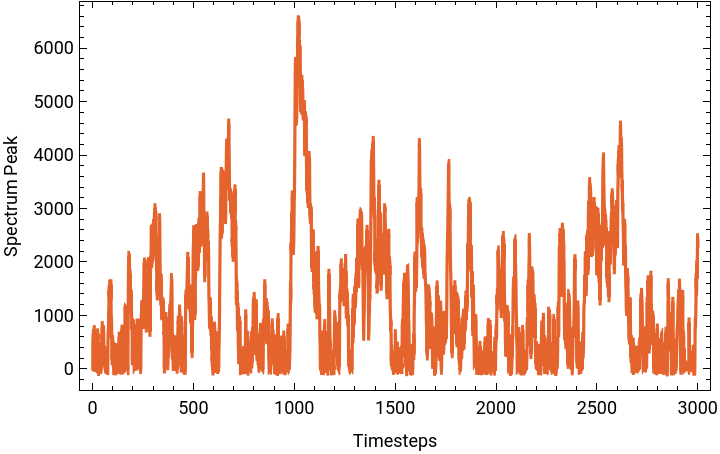
Due to T∝1/M, a small mass leads to a hot, thermal noise-inducing system.
◼
n=10^(38) -- stellar BH
Equivalent to a black hole as massive as Planck masses, nearly as massive as the Sun.
38
10
◼
fit=0.322271 x
Below, the light green line is the linear fit; the blue solid line is y=x/π .
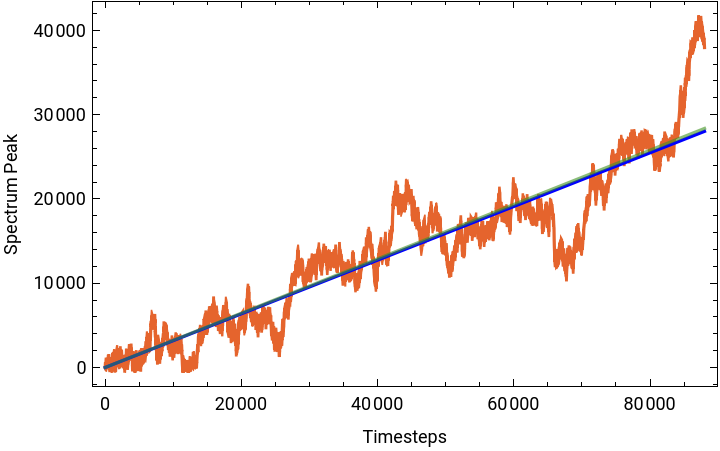
Due to the inverse-mass scaling, the iterations here are not thermal but due to the zero-point quantum noise. Rather impressively, the generated noise signal shows a linear trend with a linear fit that closely overlies with the theoretical expectation of horizon-scale linear decrease if read from right to left (i.e., Hawking radiation). From the code, this is sourced by If command If[x[i]x[1]&&(Amplitude)kicks[[i]]≤Force[[i]],dx=0]. This is to filter out extreme deviations that otherwise appear as blips from the linear line.
◼
n=10^(38+6) -- Supermassive BH
Equivalently a supermassive black hole of solar masses (e.g., Sag. A*)
6
10
◼
fit=0.304165 x
Below, light green line is the linear fit; the solid blue line is y=x/π.
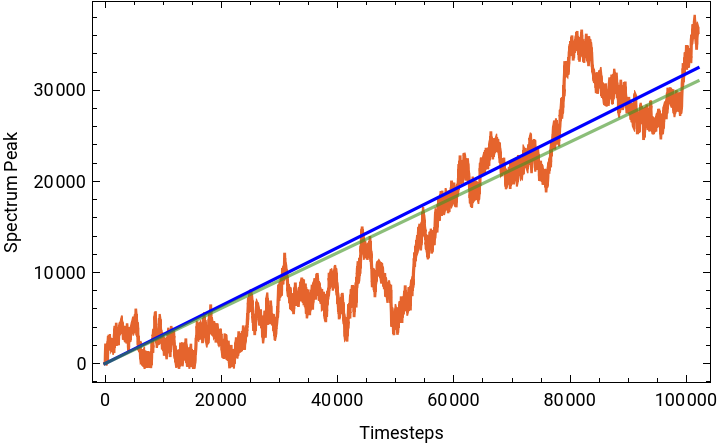
The larger BH noise spectrum tells the same phenomenological story as the previous “1-Solar-Mass” BH spectrum. This noise is indeed quantum mechanical, here visualized for the astronomical scale.
Discussion and Conclusion
Discussion and Conclusion
This notebook is (in the American vernacular) “short and sweet,” but it is not without faults (e.g., activate the Global Clear before running the code, press Shift+Enter at least twice to prime the code, etc.). Because this work is more of a proof-of-concept, refinement of the current code to override the faults is welcomed with comments. For what it currently produces, as readily offered in the original article, the code enables an insight of what a Hawking radiation spectrum -- and with it black hole evaporation -- would look like.
CITE THIS NOTEBOOK
CITE THIS NOTEBOOK
The stochastic mechanics of Hawking radiation
by Noah MacKay
Wolfram Community, STAFF PICKS, April 3, 2025
https://community.wolfram.com/groups/-/m/t/3438819
by Noah MacKay
Wolfram Community, STAFF PICKS, April 3, 2025
https://community.wolfram.com/groups/-/m/t/3438819