ABSTRACT (original article): Prevalence of mentholated products for consumption has brought great importance to studies on menthol’s metabolic pathways to ensure safety, design more potent derivatives, and identify therapeutic benefits. Proposed pathways of (-)-menthol metabolism based on metabolites found experimentally in previous works by Yamaguchi, Caldwell & Farmer, Madyastha & Srivatsan and Hiki et al. were not in agreement. This in silico approach is based on the three in vivo studies and aims to resolve the discrepancies. Reactions in the pathways are conjugation with glucuronic acid/sulfate, oxidation to alcohol, aldehyde & carboxylic acid, and formation of a four-membered/five-membered ring. Gas-phase structures, standard Gibbs energies and SMD solvation energies at B3LYP/6-311++G(d,p) level were obtained for 102 compounds in the pathways. This study provides a more complete picture of menthol metabolism by combining information from three experimental studies and filling missing links in previously published pathways. CITATION (original article): Taweetham Limpanuparb, Wanutcha Lorpaiboon, Kridtin Chinsukserm (2019), An in silico investigation of menthol metabolism. PLOS ONE 14(9): e0216577. https://doi.org/10.1371/journal.pone.0216577
Introduction
Introduction
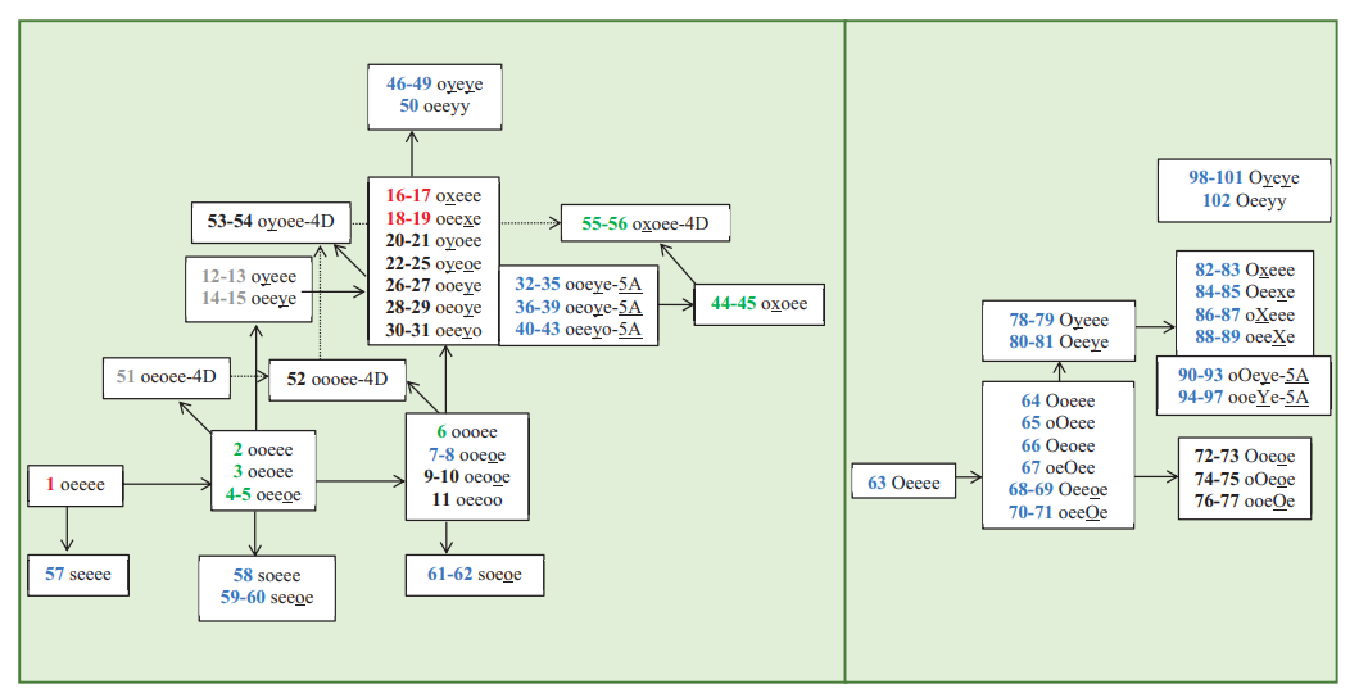
There are numerous mentholated products sold in the market leading to the interests to study menthol's metabolic pathways. Available pathways from the three in vivo studies by Yamaguchi, Caldwell & Farmer (1994); Madyastha & Srivatsan (1988); Hiki et al. (2011) were in discrepancy. To tackle this problem, the in silico approach is designed by combining data from all three studies and filling in the missing links between them. The figure below shows the resulting complete pathway from this in silico approach. Note that the naming system is based on their five substitutable positions which are positions 3, 7, 8, 9 and 10.Figure 1. Metabolic pathway of menthol in rats and human. Red, Green, and Blue numbers indicate that menthol metabolites were found in both rats and human, only in rats, and only in human respectively. Gray and Black numbers indicate menthol metabolites proposed by previous experiments and by this paper respectively. Arrows to the right and arrows upward indicate oxidation reactions +1/2 and - respectively. Downward arrows indicate conjugation with sulfate. Dashed arrows indicate reactions of four-membered ring metabolites. Diagonal arrows toward top left indicate dehydration reaction. Main pathways are shown on the left and pathways containing glucuronide metabolites with similar possible connections are shown on the right.
O
2
H
2
1. Input preparation
1. Input preparation
The gas-phase structures were calculated at the B3LYP/6-311++G(d,p) level of theory (confirmed to be at minimum energy on the electronic potential energy surfaces by frequency calculations). The solvation energies in water of the gas-phase structures were calculated with the SMD model through single-point energy calculations. All quantum chemical calculations are done in Q-CHEM. The script for processing along with the output files for each structure can be found in supporting information of the paper itself.
2. Construction of thermodynamics table
2. Construction of thermodynamics table
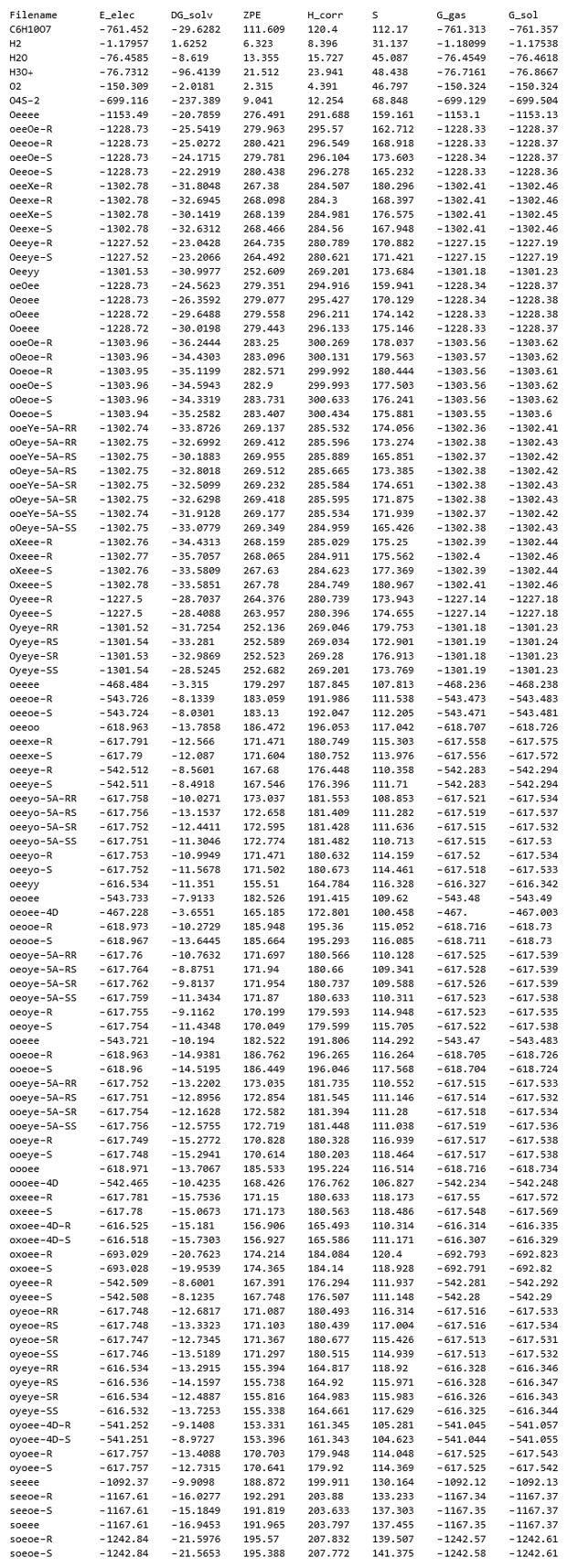
The data on final energy, solvation energy, zero point, enthalpy and entropy for each chemical structure (menthol derivatives) are compiled into one big table.
In[]:=
Hartree=627.50947415;T=298.15;Faraday=96485.3328959;cal=4.184;RSI=8.314459848;Rlatm=0.08205733847;CWater=0.997048*1000/18.0152833;dG=RSI/cal*T*Log[Rlatm*T]/1000/HartreedGWater=RSI/cal*T*Log[CWater]/1000/Hartreeprefix=NotebookDirectory[]<>""PATH={prefix<>"common/",prefix<>"g-series/",prefix<>"o-series/",prefix<>"s-series/"};EnergyTab={};For[i=1,i≤Length[PATH],i++,filelist=Import[PATH〚i〛<>"0_file_list.txt","List"];finalenergy=Import[PATH〚i〛<>"1_final_energy.csv","CSV"];solvation=Import[PATH〚i〛<>"2_solvation.csv","CSV"];zeropoint=Import[PATH〚i〛<>"3_zero_point.csv","CSV"];enthalpy=Import[PATH〚i〛<>"4_enthalpy.csv","CSV"];entropy=Import[PATH〚i〛<>"5_entropy.csv","CSV"];tab=Table[{StringReplace[t=filelist〚j〛,{".out"""}],E0=If[(k=Position[finalenergy,t])≠{},finalenergy〚k〚1〛〚1〛〛〚2〛,0],Esolv=If[(k=Position[solvation,t])≠{},solvation〚k〚1〛〚1〛〛〚2〛,0],ZPE=If[(k=Position[zeropoint,t])≠{},zeropoint〚k〚1〛〚1〛〛〚2〛,0],H=If[(k=Position[enthalpy,t])≠{},enthalpy〚k〚1〛〚1〛〛〚2〛,0],S=If[(k=Position[entropy,t])≠{},entropy〚k〚1〛〚1〛〛〚2〛,0],Ggas=E0+H/Hartree-T*S/1000/Hartree,Gsol=Ggas+Esolv/Hartree+If[t≠"H2O.out",dG,dG+dGWater]},{j,1,Length[filelist]}];EnergyTab=Join[EnergyTab,tab];]FindC[compound_,table_]:=If[(x=Position[table,compound])≠{},{1,x〚1〛〚1〛},If[(x=Position[table,StringDrop[compound,1]])≠{},{ToExpression[StringTake[compound,1]],x〚1〛〚1〛},If[(x=Position[table,StringDrop[compound,2]])≠{},{ToExpression[StringTake[compound,2]],x〚1〛〚1〛},If[(x=Position[table,StringDrop[compound,3]])≠{},{ToExpression[StringTake[compound,3]],x〚1〛〚1〛},{compound<>"NF",1}]]]]FindGg[compound_,table_]:=(x=FindC[compound,table];x〚1〛*EnergyTab〚x〚2〛〛〚7〛)FindGs[compound_,table_]:=(x=FindC[compound,table];x〚1〛*EnergyTab〚x〚2〛〛〚8〛)EnergyTab=Join[{{"Filename","E_elec","DG_solv","ZPE","H_corr","S","G_gas","G_sol"}},EnergyTab];EnergyTab//TableFormExport[NotebookDirectory[]<>"../tables and figures/"<>"6_cmpdtab.csv",EnergyTab,"CSV"]EnergyTab=EnergyTab/.{"O4S-2""SO4-2"};
Out[]=
0.0030188
Out[]=
0.00378956
3. Reaction energy calculations
3. Reaction energy calculations
The Gibbs energies for each reaction (from the text file "list-reactions.txt") are calculated (with the correction for the standard state of liquid water ~ 55 mol/L) and associated with type, position and step of reaction in the pathway. The possible reactions are conjugation with glucuronic acid/sulfate, oxidation to alcohol, aldehyde & carboxylic acid, and formation of a four/five-membered ring. The positions can be 3,7,8,9, or 10 of the parent compound.
Other applications
Other applications
References
References
Yamaguchi T, Caldwell J, Farmer PB. Metabolic fate of [3H]-l-menthol in the rat. Drug Metabolism and Disposition. 1994; 22(4):616–24.
Madyastha KM, Srivatsan V. Studies on the metabolism of l-menthol in rats. Drug Metabolism and Disposition. 1988; 16(5):765–72.
Hiki N, Kaminishi M, Hasunuma T, Nakamura M, Nomura S, Yahagi N, et al. A phase I study evaluating tolerability, pharmacokinetics, and preliminary efficacy of L-menthol in upper gastrointestinal endoscopy. Clinical Pharmacology & Therapeutics. 2011; 90(2):221–8. https://doi.org/10.1038/clpt.2011.110
Limpanuparb T, Roongruangsree P, Areekul C. A DFT investigation of the blue bottle experiment: E° half-cell analysis of autoxidation catalysed by redox indicators. Royal Society Open Science. 2017; 4(11):170708. https://doi.org/10.1098/rsos.170708
Limpanuparb T, Noorat R, Tantirungrotechai Y. In silico investigation of mitragynine and 7-hydroxymitragynine metabolism. BMC Res Notes. 2019;12:451. https://doi.org/10.1186/s13104-019-4461-3
Datta S, Limpanuaparb T. Quantum Chemical Investigation of Polychlorinated Dibenzodioxins, Dibenzofurans and Biphenyls: Relative Stability and Planarity Analysis. Molecules. 2020;25:5697. https://doi.org/10.3390/molecules25235697
CITE THIS NOTEBOOK
CITE THIS NOTEBOOK
An in silico investigation of menthol metabolism
by Piyathida Tawornparcha, Taweetham Limpanuparb, Wanutcha Lorpaiboon, Kridtin Chinsukserm
Wolfram Community, STAFF PICKS, October 22, 2021
https://community.wolfram.com/groups/-/m/t/2390643
by Piyathida Tawornparcha, Taweetham Limpanuparb, Wanutcha Lorpaiboon, Kridtin Chinsukserm
Wolfram Community, STAFF PICKS, October 22, 2021
https://community.wolfram.com/groups/-/m/t/2390643