QuantumToMultiwaySystem to explore quantum Entanglement
by Mark Merner
InterSolar GK; researcher in Japan
by Mark Merner
InterSolar GK; researcher in Japan
The four proposed phases of an entanglement life cycle: Completion, Propagation, Collapse OR Transfer
The four proposed phases of an entanglement life cycle: Completion, Propagation, Collapse OR Transfer
Simulations of quantum entanglement experiments using the QuantumToMultiwaySystem tool has indicated that photon polarization coincidence measurements between four or more detector pairs indicate several distinct stages of the quantum entanglement evolution and completion. This indicates that physical experiments could be designed, and eventually be conducted, to reveal not only these general distinct stages, but also the subtle ways in which entanglement changes within each distinct stage of the life cycle of an entangled system.. Instead of being able to obtain only a probability value for each set of the angle pairs, experiments of quantitative measurements of the manner in which entanglement evolves within each general stage of entanglement growth will be able to be suggested. The analog of this with single photon multiple slit experiments would be the capability of measuring not just single photon interference values at specific positions, but the general behavior of the interference curve envelope. (Recent double slit Neutron spin measurements indicate that such deeper entanglement explorations are possible.) Another characteristic that could be studies would be how each entanglement also goes through a persistence ‘propagation’ phase, before it concludes in either a collapse, or a transfer phase, each with distinctive behavior corresponding to each phase.In addition to using the QuantumToMultiwaySystem tool to simulate the life cycle of photon entanglement, simulations were performed on some new generation Sigma 5 level type inequality experiments known as the Wigner’s Friends experiments. Initial simulations of 6 pair coincidence simulations where one of the entanglement pairs involve an AND-NOT quantum operator and wave function are shown as an example of the simulation capability of the QuantumToMultiwaySystem tool. The above two simulation examples indicate that the QuantumToMultiwaySystem tool is an excellent tool for exploring the frontiers of quantum entanglement. The hope is that there might be a possibility of measuring Multiway diagram physical correlates in a real experiments where the structure, not just the value, of quantum probability would be directly measured.
Section 1: Using QuantumToMultiwaySystem to simulate yet to be measured Quantum Entanglement correlates
Section 1: Using QuantumToMultiwaySystem to simulate yet to be measured Quantum Entanglement correlates
Our Procedure: 1st: we choose the measurement value with respect to a Bell (or QM) equations of our choice; 2nd: we generate angle sets we will use in our experiment
Our Procedure: 1st: we choose the measurement value with respect to a Bell (or QM) equations of our choice; 2nd: we generate angle sets we will use in our experiment
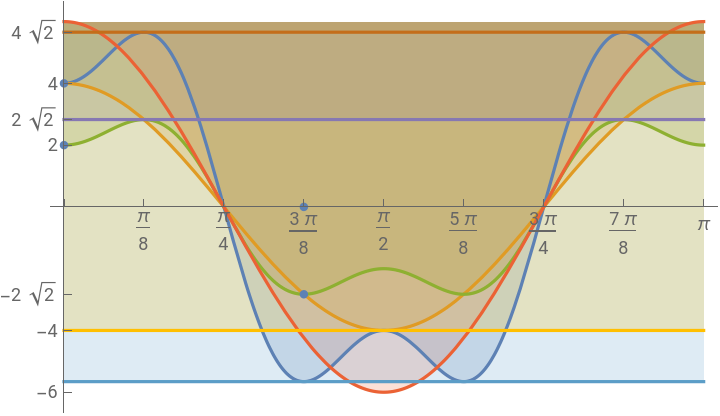
The graph below shows 2 Bell equations with W shaped curves, and 2 ‘straight’ Quantum Mechanical equations with V shaped curves. All are just different quantum statistics.Others can created to suit the situation, along with an appropriate normalization values and wave plates, attenuators, and beam splitters.The Experiment and Narrative: The main point is that doing a correlation measurement with any 4 angles will only give a probability value (positive or negative) somewhere on one of the four curves in the Bell equation graph below showing total entanglement probability. In contrast, QuantumToMultiwaySystem will typically generate a completion series of 4 or 5 (but even beyond 8) detailed, 3D evolution diagrams with vertexes, weights, arrows, and self-referent loops which grow in complexity and symmetry with each iteration value. In traditional quantum parlance, this measurement is called the collapse of the wave function. In this researcher’s opinion, based on examining the rich diversity, complexity, and symmetry of the diagrams that were created for each value on (but not limited to) any of the four quantum mechanical curves shown below, the term collapse is a misplaced misnomer. A more appropriate term would be completion. And more importantly, this indicates that this is only one third of the full story of of a quantum entanglement life cycle. The suggested full story would be Completion, Propagation, and only at the end, Collapse or Transfer. It is further suggested that this story can be told with Multiway diagrams in the following manner: 1. The Completion diagrams generated using the EvolutionEventsGraphStucture and the EvolutionCausalGraphStructure options, show the constructive increase of structure, symmetry, and complexity, generated up to the iteration value t (usually between 3 or 5 but not always), after which no further change is seen. 2. The Propagation diagrams, using the CausalGraphStructure option, actually comes into play before the completion value t, but continues adding entanglement related structural loops with each increase of t. In the Completion process, the creation of a loop in structure and number is associated with the increase of entanglement. Thus adding more loops in the Propagation process is an indication that entanglement is at least being maintained. Even after the photons go through the polarizers, as long as they are still moving towards their destination, they have not collapsed. If a wave fractional wave plate is placed in the beam, the entanglement would change but not collapse. When and where these wave plates are placed makes a difference to the entanglement, but to to it’s existence as a live and kicking entangled state. 3. The yet to be developed Collapse or Transfer diagram option would show the steps of dissolution, or the Transfer of structure and orderliness if it occurs. The word collapse indicates a situation where all the entanglement is immediately lost and all structure disappears immediately in some kind of heat entropy. However, another example would be a ‘slow’ collapse where each aspect of entanglement would be lost in a step by step process, similar to the way in which it was created. So experimentally, it is quite unlikely that the entanglement would be lost in such a gentle manner (a reverse of when it was created) unless extreme experimental effort is made. However, Transfer would occur when the photon entanglement would be transferred in atomic or molecular electron excitation in a stepwise fashion as in a laser. Then the excited electrons would complete their entanglement in a Multiway diagram with a Bell equation with k = 0 to for electrons rather than k = 0 to π for photons. The Multiway diagrams for such a Completion process might only look qualitatively similar to those used for photon entanglement completion. But it would still be Completion. One original classical case of Transfer was when Clauser of CHSH fame, used excited calcium atoms to generate entangled photons. In this case, the photons were not emitted in opposite directions, and had different wavelengths. Clauser used stacked, stressed glass plates to carefully measure polarization. Completion Multiway diagrams for electrons for (k = 0 to ) will be created in a separate exercise, where diagrams of the decay of the photon entanglement will be shown in parallel with electron entanglement completion diagrams. The ultimate hope is to be able to measure the physical correlates of multiway diagrams experimentally. These are real in the sense that the at position {0 , -2}, a Bell equation peak, when the absolute value is taken to generate a Bell inequality graph. The positions corresponding to the measurement we will make are at } of Bell’s equation which correspond in this case, to the negative probability of -2. The four angles which created this probability are shown in the green chart below. This case also corresponds to the ‘straight’ quantum mechanical case of } in the Bell graph below shows that at k = , the .
π
2
π
2
structure
of quantum probability is real. The vertexes or nodes of the Multiway diagrams with the edge structures which are generated correspond to ALL histories. They include all physical states and evolutions in not only physical space but also branchial space which are more general than ordinary physical space-time. They are more general than any classical entanglement description. In this manner, they describe entanglement in a more general manner.The Experiment: We select a curve and a k value on the Bell graph, and then generate the measurement angles. In practice, this is not always so simple, and degenerate cases can exist.To simulate a quantum measurement, first the position on Bell’s equation below
must be specified. For our example, we choose k = 3π
8
2
,-2
3π
8
2
2
4Cos[2k].
The dot at ,-2
3π
8
2
3π
8
green 3Cos[2k] -Cos[(3)2k] Bell
graph
and the orange 4Cos[2k]
intersect at - 22
In[]:=
data={0,2},{0,4},,0,,-2
3π
8
3π
8
2
Out[]=
{0,2},{0,4},,0,,-2
3π
8
3π
8
2
In[]:=
Show[Plot[2(3Cos[2k]-Cos[(3)2k]),4Cos[2k], "}],ListPlot[data],Ticks->{0.001Pi,Pi/8,Pi/4,3Pi/8,Pi/2,5Pi/8,6Pi/8,7Pi/8,Pi},4
3Cos[2k]
-
Cos[(3)2k]
,6
Cos[2k]
,
2
2
,4
2
,-42
,-4,{k,0,π},Filling->Top,PlotLegends->{"2
X
Bell
:
3
Cos
[
2
k
]
+
Cos
[
(
3
)
2
k
]
","4
Cos
[
2
k
]
"," Bell
:
(
3
Cos
[
2
k
]
-
Cos
[
(
3
)
2
k
]
)
","6
Cos
[
2
k
]
;
from
-
6
to
6
2
,2,4,22
,-22
,-4,-6]Out[]=


Next we establish the angle pairs which we will use, indicated in the table and the pie chart below:
Next we establish the angle pairs which we will use, indicated in the table and the pie chart below:
With the angle pairs, we run the QuantumToMultiwawySystem tool to generate diagrams and to measure causal invariance.
With the angle pairs, we run the QuantumToMultiwawySystem tool to generate diagrams and to measure causal invariance.
Below is a very simple Propagation example. After the diagrams complete, the loops keep increasing maintaining and confirming the structure, but not changing it’s fundamental nature.
The loops increase by one as entanglement is completed and maintained.
After entanglement completes at t = 4, the structure itself doesn’t change; however, for every increase in the t value, the number of SR loops increases by one at each loop location.
Section 2: Using QuantumToMultiwaySystem to simulate recent 5 Sigma Wigner Friend Experiments
Section 2: Using QuantumToMultiwaySystem to simulate recent 5 Sigma Wigner Friend Experiments
As another example of using the QuantumToMultiwaySystem, we do a 11D simplified version of the 5 Sigma Wigner Experiment which has been done by the Proietti (ref) group in Europe, as well as
the Bong group (ref) in Australia. Both of these are recently (2019) completed state of the art 5 Sigma experiments. Using the EvolutionCausalGraphStructure option with t = 4 in a simplified 11D simulation,
we execute 6 entanglement simulations of which 4 blues lines correspond to a Bell test, and 2 lines correspond to communications with Wigner’s friends. All the red zeros in the 4 RHS terms of the operator
correspond to the required AND-NOT operator. Entanglements with Wigner’s friends can be turned off by putting zeros into the pink line.
Inserting and running the “CausalInvariantQ” option in the code above results in the following Causal Invariants*
With the pink 6th line in the middle of this 11D simulation, we can turn entanglement off between Wigner and friends by changing {0,1,0,0,1,0,1,0,1,0,1} to {0,0,0,0,0,0,0,0,0,0,0}; then we have 2 sets of diagrams, one for the very clean Bell test on the bottom line with 4 diagrams, and one on the top line with only 2 diagrams for the 8th and 11th lines having to do with the AND-NOT operator and another set of entanglement angles bringing the total number of pairs up to 6.
Two entanglement steps occurring between Wigner’s Friends due to the green 8th and 11th operator lines.
Four Entanglement Bell equation steps occurring with the first four blue operator lines on Wigner’s side, when entanglement with the friends is turned off putting zeros in the 6th pink operator lines.
Conclusions and Future Directions
Conclusions and Future Directions
The ultimate hope is to be able to suggest and engage in experiments which discover and measure the physical correlates of quantum multiway diagrams in nature.
Keywords
Keywords
◼
Entanglement
◼
QuantumToMultiwaySystem
◼
Bell equation
◼
Wigner’s Friend
Acknowledgments
Acknowledgments
Hatem Elshatlawy and Xerxes Arsiwalla, my mentors who have supported me during the last year.
Jonathan Gorard, who created the QuantumToMultiway infrastructure, and supported my research efforts
Sortiris Michos and Michael Trott who have encouraged me to study Wigner’s Friends experiments more deeply
Danielle and Emily who kept Summer School operational
Takashi Yoneyama who encouraged me to study physics seriously again.
Stephen Wolfram, Kaiso (開創) (Founder of this new knowledge which will last and evolve over generations)
References
References
◼
Neutron double slit article article: 10.1103/PhysRevResearch.4.023075
◼
The Naive View of an Experimentalist, Alain Aspect: https/arxiv.org/pdf/quant-ph/0402001.pdf
◼
Fundamentals of Quantum Entanglement, F J Duarte, IOP Expanding Physics (Kindle vers.)
◼
Clauser, M. Horne, A. Shimony, and R. Holt, Phys.Rev. Lett. 23, 880 (1969).
◼
Marissa Giustina: Significant loophole-free test of Bell’s theorem with entangled photons: https://www.youtube.com/watch?v=tgoWM4Jcl-s
◼
Proietti, M. et al. Experimental test of local observer independence. Sci. Adv. 5, eaaw9832 (2019).
◼
Bong et al., https://doi.org/10.1038/s41567-020-0990-x
Below is the code created by Hatem Elshatlawy and Max Pisnov. to be able to utilize continuous angles into QuantumToMultiwaySystem.
(This code should be activated as code by “choosing“ code in the selection box on the upper left of Mathematica v. 13.1;
doing this will put a gray background underneath the code.)
(This code should be activated as code by “choosing“ code in the selection box on the upper left of Mathematica v. 13.1;
doing this will put a gray background underneath the code.)