CITE THIS NOTEBOOK: Mathematical Games: Algebraic number magic by Ed Pegg. Wolfram Community MAR 16 2023.
This is part of live presentation series called Mathematical Games in which we explore a variety of games and puzzles using Wolfram Language. In this episode, we features games and puzzles focusing on algebraic number magic.
What is an algebraic number?
What is an algebraic number?
It’s a solution for an algebraic equation.
In[]:=
Solve[x^2==x+1]
Out[]=
x(1-(1+
1
2
5
),x1
2
5
)If the highest exponent is 2, then it’s geometrically constructible with compass and ruler.
A few higher order polynomials lead to geometric constructions, such as the 17-gon.
In[]:=
InputForm[RootReduce[Cos[2Pi/17]]]
Out[]//InputForm=
Root[1 - 8*#1 - 40*#1^2 + 80*#1^3 + 240*#1^4 - 192*#1^5 - 448*#1^6 + 128*#1^7 + 256*#1^8 & , 8, 0]
Other polynomials, cubics and above, are not constructible with ruler and straightedge. However, cubics are constructible in origami.
In[]:=
Solve[x^3==x+1]
Out[]=
x,x,x

In[]:=
ToRadicals
Out[]=
1
3
1/3
27
2
3
69
2
1/3
(9+
1
2
69
)2/3
3
In[]:=
Solve[x^3==x^2+1]
Out[]=
x,x,x
In[]:=
ToRadicals
Out[]=
1
3
1/3
29
2
3
93
2
1/3
1
2
93
)Number Field Discriminant
Number Field Discriminant
NumberFieldDiscriminant[Sqrt[5]]
Out[]=
5
The discriminant of a quadratic is either the root number or 4 times the root number.
In[]:=
Grid[Partition[Table[{k,NumberFieldDiscriminant[Sqrt[k]]},{k,1,60,2}],4]]
Out[]=
{1,1} | {3,12} | {5,5} | {7,28} |
{9,1} | {11,44} | {13,13} | {15,60} |
{17,17} | {19,76} | {21,21} | {23,92} |
{25,1} | {27,12} | {29,29} | {31,124} |
{33,33} | {35,140} | {37,37} | {39,156} |
{41,41} | {43,172} | {45,5} | {47,188} |
{49,1} | {51,204} | {53,53} | {55,220} |
In[]:=
Solve[a+bx+c==0,x]
2
x
Out[]=
x,x
-b--4ac
2
b
2a
-b+-4ac
2
b
2a
The discriminant of is -4ac. Remember the quadratic formula?
Funny story, I’ve been working with discriminants for years, but I looked it up for this talk. I should have known that first sentence.
a+bx+c
2
x
2
b
Funny story, I’ve been working with discriminants for years, but I looked it up for this talk. I should have known that first sentence.
The discriminate of is
-4(d+a)+18abcd-27
a+b+cx+d
3
x
2
x
2
b
2
c
3
b
3
c
2
a
2
d
In[]:=
Last[x/.Solve[a+b+cx+d==0,x][[1]]]
3
x
2
x
Out[]=
1/3
-2+9abc-27d+
3
b
2
a
4+
3
(-+3ac)
2
b
2
(-2+9abc-27d)
3
b
2
a
3a
1/3
2
In[]:=
ExpandExpand[4+](-27a^2)
3
(-+3ac)
2
b
2
(-2+9abc-27d)
3
b
2
a
Out[]=
2
b
2
c
3
c
3
b
2
a
2
d
We can make a function for it.
In[]:=
CubicDiscriminant[{a_,b_,c_,d_}]:=-4(d+a)+18abcd-27;
2
b
2
c
3
b
3
c
2
a
2
d
In[]:=
CubicDiscriminant[{1,0,-1,-1}]
Out[]=
-23
In[]:=
NumberFieldDiscriminant[First[x/.Solve[x^3==x+1]]]
Out[]=
-23
The discriminant is the product of the square of the differences of the roots.
In[]:=
RootReduce[Times@@Flatten[(Differences@#)^2&/@Subsets[(x/.Solve[x^3==x+1]),{2}]]]
Out[]=
-23
I mentioned the 17-gon earlier. Here’s a few items that lead to the same value:
In[]:=
,NumberFieldDiscriminant-10+15+6-7-+&,6]],NumberFieldDiscriminant[RootReduce[Cos[Pi/17]]]
7
17
2
,NumberFieldDiscriminant[Root[1+4#1-1017+4
+17+217
17
2
#1
3
#1
4
#1
5
#1
6
#1
7
#1
8
#1
Out[]=
{410338673,410338673,410338673,410338673}
Integer Wheel Graphs
Integer Wheel Graphs
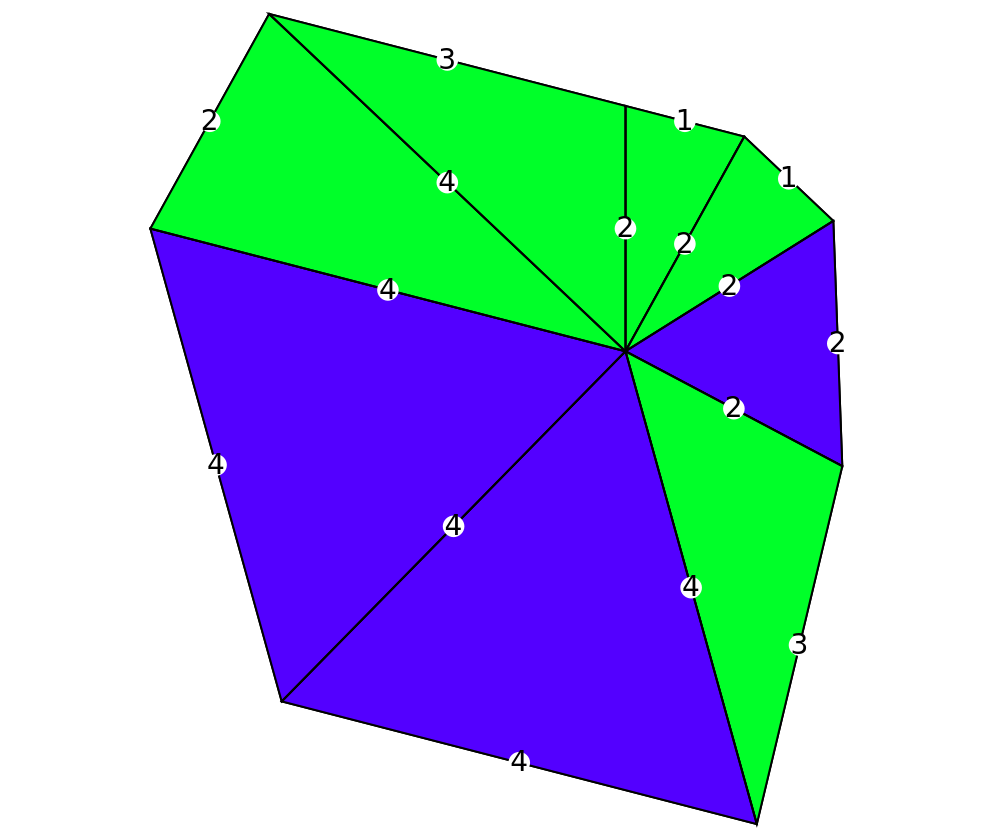
Harborth’s conjecture states that the edges of any planar graph can all have integer length.
Planar graphs with non-triangular faces can have edges added to get a maximal planar (or triangulated) graph, where all faces are triangles. A solution for a given maximal planar graph would contain many integer wheel graphs. This Demonstration shows many integer wheel graphs found with searches. Triangles are colored by their area radicals.
Planar graphs with non-triangular faces can have edges added to get a maximal planar (or triangulated) graph, where all faces are triangles. A solution for a given maximal planar graph would contain many integer wheel graphs. This Demonstration shows many integer wheel graphs found with searches. Triangles are colored by their area radicals.
If true, and the individual triangles are colored by their discriminant, a maximum of two colors would surround every vertex.
Out[]=


Power Wheel Graphs
Power Wheel Graphs
How can similar triangles fit around a vertex?
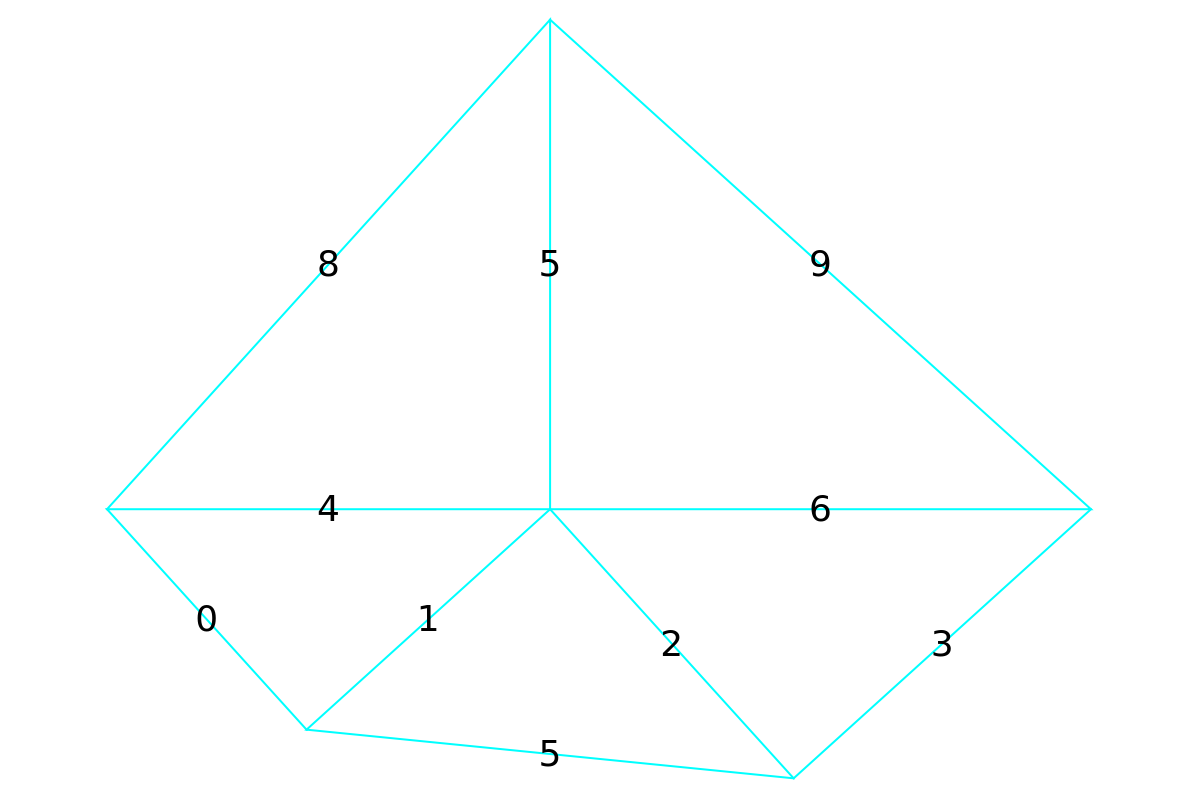
Some triangles have sides . In terms of a value , they have power sides . If all sides are multiplied by , one gets the similar triangle . This is called a powered triangle (not to be confused with a power triangle, used for AC circuits). For the given problem, powered triangles can simplify the solution process.
When powered triangles fit perfectly around a vertex, they make a wheel graph. Sometimes these wheels can lead to solutions when more triangles are added. For example, wheel 5 based on--10 with powers and additions gives a solution when is also added. If the original figure is a triangle, it cannot be similar to the component triangles.
(,,)
a
x
b
x
c
x
x
(a,b,c)
x
(a+1,b+1,c+1)
When powered triangles fit perfectly around a vertex, they make a wheel graph. Sometimes these wheels can lead to solutions when more triangles are added. For example, wheel 5 based on
8
x
2
x
(0,2,5)
(0,1,2,3,4)
(5,6)
Out[]=

The smaller the discriminant, the more numerous the solutions.
The smaller the discriminant, the more numerous the solutions.
In the previous experiment, values that were involved in self-summing infinite series seemed to have particularly nice solutions.
Pisot, Salem and Cyclotomic Polynomials
Pisot, Salem and Cyclotomic Polynomials
The Golomb Graph and Sqrt Space
The Golomb Graph and Sqrt Space
When something doesn’t work, try 0, 1 and the square root.
If you remove the square below, you’ll get an error.
Once in an algebraic space, everything is in the algebraic space.
Squaring was so handy and powerful that I started using it everywhere. It converts everything into nice numbers.
The function is bidirectional.
Below, you can hover over the vertices to see the algebraic coordinates of the point.
The simplest root space doesn’t use any roots. Rational space consists entirely of rational number coordinates.
For the 3-in-a-line problem, this solution was not in the literature even though all points are simple integer coordinates.
The Heilbronn problem arranges points in a unit square to make the largest possible smallest triangle. For 11 and 16 points you only need rational coordinates. Hued triangles have the same area.
Hexagrammum Mysticum -- A ridiculous example
Hexagrammum Mysticum -- A ridiculous example
Consider six points on a conic section (circle, ellipse, parabola or hyperbola). Label them B L A I S E and connect them to form a hexagon. There are 15 ways to choose two points, leading to 15 lines that intersect at 45 points.
Pascal: If opposing sides (BL-IS, LA-SE, AI-EB) are extended, the three intersections are collinear, forming what is called a Pascal line. Six points give 60 possible hexagons, with a Pascal line for each hexagon. L(BLAISE) is one of these 60 Pascal lines.
Kirkman: For a given hexagon on six points, consider the three other hexagons that share no edges with the first. For the hexagon BLAISE, the three others are BASLEI, BAEILS and BILEAS. These three hexagons define three Pascal lines that concur on a Kirkman point. Each of the 60 hexagons defines a Kirkman point. N(BLAISE) is one of these 60 Kirkman points.
Cayley: Consider the vertices of a hexagon as a cyclic permutation and square that as a permutation. For example, BLAISE, BLSEAI and BISLAE have permutations (123456), (125634) and (145236), all with the same permutation square BAS.LIE or (135)(246). There are 20 possible results in sets of three, always giving a pair of 3-cycles. In any of these sets, the three corresponding Kirkman points are collinear, forming what is called a Cayley line. L(BAS.LIE) is one of these 20 Cayley lines.
Steiner: Just as in Cayley’s case, consider a hexagon as a cyclic permutation and square that as a permutation. There are 20 possible results in sets of three. In any of these sets, the three corresponding Pascal lines concur on a Steiner point. N(BAS.LIE) is one of these 20 Steiner points.
Plücker: Consider one of the 15 triplets of 2-cycles, such as BL.AI.SE or (12)(34)(56). Find the four Steiner points that commute with the given cycle under permutation products. In this case, (12)(34)(56)×(135)(246)(135)(246)×(12)(34)(56), and similarly for (136)(245), (145)(236) and (146)(235). These four Steiner points are collinear, forming what is called the Plücker line. L(BL.AI.SE) is one of these 15 Plücker lines.
Salmon: As shown in Plücker, consider one of the 15 triplets of 2-cycles. The four corresponding Cayley lines concur on a Salmon point. N(BL.AI.SE) is one of these 15 Salmon points.
There are 60 Pascal lines and 60 Kirkman points, 20 Cayley lines and 20 Steiner points, and 15 Plücker lines and 15 Salmon points, for a total of 95 lines and 95 points that form what is called the Hexagrammum Mysticum. This Demonstration offers some initial six-point sets where the 95 generated points are all within a distance of 100 from the origin.
The vertices and diagonal intersections of a dodecagon are in this space. Hover over a point to see the algebraic coordinates.
So what is the bronze ratio?
The Heilbronn problem arranges points in a unit square to make the largest possible smallest triangle. The solution for 8 points can be cast in bronze. Hued triangles have the same area. The thickened red lines have a ratio that is exactly the bronze ratio.
Heegner spaces and Prime Visualizations
Heegner spaces and Prime Visualizations
Here’s a Manipulate that finds primes in all nine spaces.
Cubics
Cubics
The plastic constant is the smallest of the Pisot numbers mentioned in the introduction. The Greek letter ρ (rho) is usually used to indicate the plastic constant. The radical form isn’t particularly friendly.
The plastic constant allows a square to be divided into three similar rectangles. The side length ratios are all the same.
The ratio of neighboring terms in both the Padovan sequence and Perrin sequence tends to ρ, as shown at Fibonacci and Padovan Spiral Identities, and Padovan Spiral. The value makes several Rauzy fractals.
Here’s GeometricScene solving the problem:
A self-similar fractal exists for ρ. The numbers on green lines indicate a particular power of a complex root of ρ.
The plastic fractal triangle demonstrates an infinite series. Increase the iterations to improve the fractal.
Here is an unusual polynomial built up from components of the plastic constant.
This is a rare quartic equation with equivalent roots and coefficients.
This is a rare quartic equation with equivalent roots and coefficients.
Here’s a plastic ratio rectangle divided into seven similar triangles in series.
Points of a heptagon in the radius 2 circle converted to the underlying algebraic space:
The algebraic number field also provides a solution for the 12 point Heilbronn problem maximizing the area of the smallest triangle in a unit square.
The Infinite Series Series
The Infinite Series Series
Remember how I mentioned self-summing infinite series seemed to have particularly nice solutions?