Extractive Distillation Column to Separate Isopropyl Alcohol from Water
Extractive Distillation Column to Separate Isopropyl Alcohol from Water


The binary mixture of water and isopropyl alcohol (isopropanol or propan-2-ol) presents a positive azeotrope at 1 atm. This azeotrope contains mole % isopropanol. It is possible to break this azeotrope using extractive distillation. Possible entrainers include: (1) 1,2-ethanediol or ethylene glycol, (2) DSMO (or dimethyl sulfoxide), (3) -methyl-2-pyrrolidone or NMP, (4) -methyl-2-piperidone, and (5) -methyl-6-caprolactam.
69.8
N
N
N
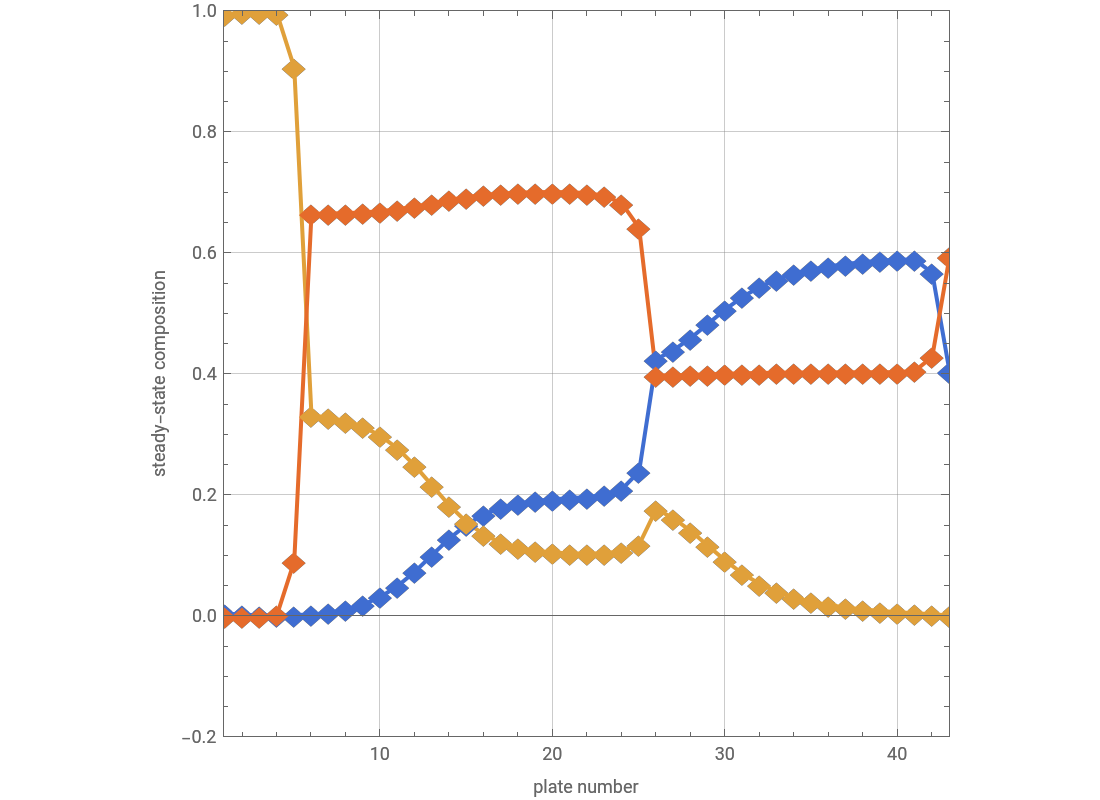
In this Demonstration, DSMO is used as an entrainer in an extractive distillation column. The column has 41 plates, a partial reboiler, and a total condenser. This column has an upper feed entering the column at plate 5 and containing pure DSMO with a flow rate of 1708 mol/min. The column has also a lower feed entering the column at plate 25 and containing mole isopropanol and mole water. This lower feed has a flow rate of 1666 mol/min. You can set the reflux and reboil ratios, and . For and , the distillate obtained is almost pure isopropanol ( mole %) and the bottom is a mixture of water mole %) and DSMO mole %), which can be easily separated in a second distillation column—the entrainer regeneration column.
30%
70%
R
s
R=2
s=0.52
99.6
(40.48
(59.39
Details
Details
For more information, see S. Arifin and I–L. Chien, Design and Control of Isopropyl Alcohol Dehydration via Homogeneous Azeotropic Distillation Using Dimethyl Sulfoxide as Extractive Agent.
Permanent Citation
Permanent Citation
Housam Binous
"Extractive Distillation Column to Separate Isopropyl Alcohol from Water"
http://demonstrations.wolfram.com/ExtractiveDistillationColumnToSeparateIsopropylAlcoholFromWa/
Wolfram Demonstrations Project
Published: December 6, 2010