This notebook is one of the support materials that I’ve prepared for students of Phonetics at the Department of Linguistics, Stockholm University, (“Det vardagliga talets musik”, course LIN020, 7.5 hp). The complete title of this notebook is “Resonance in a two-tube system modelling vocal tract configurations for stop-consonants”.
Revised 2021-05-24
Francisco Lacerda ©
Revised 2021-05-24
Francisco Lacerda ©
Background
Background
This notebook shows how the vocal tract resonance frequencies change as a function of the place of articulation for oral stop consonants.From an acoustic-articulatory perspective, the vocal tract can be viewed as a resonating acoustic tube, closed at the glottis and open at the lips when uttering a schwa-vowel, [ə]. To articulate an oral stop consonant, like [p, t, k, b, d, g], the vocal tract is blocked by the lips, tongue tip or tongue body at the stop-consonant’s articulation place which effectively closes the acoustic tube at the lips ([p, b]) or, more generally, splits the tube into two tubes -- a back tube, between the glottis and the place of articulation, and a front tube, from the place of articulation to the lips. An oral stop-consonant can therefore be modelled by a two-tube system, where the back tube is closed on both ends and the front tube is closed at the place of articulation but open at the lips (obviously, in the case of an oral bilabial stop-consonant, i.e. [p, b], there is no front tube).By splitting the vocal tract into a two-tube system, the formant frequencies associated with the oral stop-consonants can now be calculated as the resulting ordered sequence of individual resonance frequencies contributed by both the back and the front tubes, where the back tube is a half wavelength resonator and the front tube a quarter wavelength resonator (i.e. =(n-1) and =(2n-1) , where c is the speed of sound and VTlength the total length of the vocal tract minus the constriction length).
BackTubeFreq
n
c
2*backTube
FrontTubeFreq
n
c
4*(VTlength-backTube)
As shown by the two-tube model, for a given vocal tract (and constriction) length the system’s resonance frequencies are continuous functions of the place of articulation (conveyed, for instance, by the length of the back tube). For places of articulation near the glottis (short back tube length), the back tube contributes with rather high resonance frequencies (in addition to its first resonance frequency that is theoretically always zero for a rigid lossless acoustic tube symmetrically closed, or open, at both ends) while the front tube contributes with quite low frequencies. As the place of articulation is changed along the vocal tract towards the lips, the resonance frequencies of the back tube become lower while the front tube’s resonance frequencies increase. The changes in each of the tubes’ resonance frequencies are smooth and inverse proportional to the length of the tubes -- the shorter the tube, the higher its resonance frequency, except for the symmetrically closed tube’s first resonance frequency that remains zero for all finite lengths of the tube.
For any given place of articulation of an oral stop-consonant, the formant frequencies associated with the sound is always the ordered sequence of resonance frequencies of the two-tube system, which means that a given formant, for example, may for some places of articulation be a resonance of the back cavity whereas it may be a resonance of the front cavity for other places of articulation.
For any given place of articulation of an oral stop-consonant, the formant frequencies associated with the sound is always the ordered sequence of resonance frequencies of the two-tube system, which means that a given formant, for example
F
2
Quantal Theory of Speech
Quantal Theory of Speech
The acoustic-articulatory two-tube model of oral stop-consonant production predicts a continuous dependence of the stop-consonants’ formant values and the place of articulation along the vocal tract. For and higher formants, the relationship is non-monotonic, with inflections at the places of articulation for which the back and front cavities resonate at identical frequencies. Also, when two coupled resonators resonate at the same frequency, the system as a whole maintains overall resonance frequencies that tend to fluctuate near the theoretical common resonance frequency, rather than resonating at the precise nominal common resonance frequency itself. Because of this, whenever the coupled back and front tubes might be expected to resonate at the exact same frequency, the resulting formant frequencies spontaneously shift in terms of back and front cavity associations, creating an blurred acoustic-articulatory situation for which small deviations from the underlying place of articulation do not critically affect the system’s “theoretically equal” formant frequencies. As a consequence, the acoustic-articulatory function, depicting how the formant frequencies change as a function of the place of articulation, tends to show plateaus around the places of articulation for which some of the two tubes’ resonance frequencies would be theoretically the same. Kenneth Stevens' Quantal theory of speech (Stevens, 1972, 1989) states that languages tend to select speech sounds whose spectral patterns are relatively insensitive to articulatory imprecision, which are exactly the places of articulation for which the back and front resonators have some identical resonance frequencies. To be sure, each of the resonance cavities has in principle an infinite number of resonance frequencies, as expressed by =(n-1) and =(2n-1), which also results in an infinite number of places of articulation for which some of the resonance frequencies from the back and front tubes are the same. However, because each formant is a resonating second-order lowpass-filter (see notebook showing the vocal tract all-pole transfer function) with a roll-off of -12 dB/octave, the amount of available acoustic energy for the higher formants drops quite dramatically and more than the perceptual role of higher formants (above after which the roll-off is -48 dB/octave) can be discarded for practical purposes. Thus, in the interactive model showing the formant frequencies for a two-tube system, the places of interest from the point of view of the Quantal theory of speech are those for which some of the back and front tubes’ lowest frequencies are identical. This happens at about 7 cm from the glottis, where and are identical, at about 11 cm from the glottis, where and are identical, or at about 13-14 cm from the glottis, where and have again the same values. In Phonetic terms, the first place of articulation corresponds to about a pharyngeal consonant, the second to a velar and the third to a dentoalveolar consonant, which, according to Stevens’ Quantal theory of speech, are preferred places of articulation for consonants in natural human languages.
F
2
BackTubeFreq
n
c
2*backTube
FrontTubeFreq
n
c
4*(VTlength-backTube)
F
4
F
3
F
4
F
2
F
3
F
3
F
4
References
References
Stevens, K. (1972), “The quantal nature of speech: Evidence from articulatory-acoustic data”. In P. B. Denes and E.E. David Jr. (Eds.), Human communication: A unified view. New York: McGraw Hill, pp. 51-66.
Stevens, K. (1989), "On the quantal nature of speech", Journal of Phonetics, 17, pp. 3-45.
Interactive demonstrations
Interactive demonstrations
The two-tube model of stop-consonant production
The two-tube model of stop-consonant production
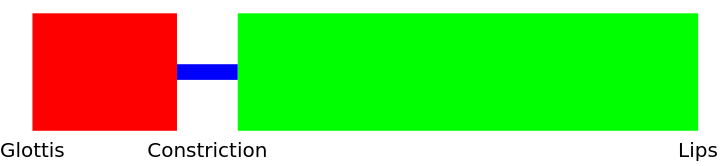
The figure shows schematically how the vocal tract is divided in two tubes by the occlusion created at the place of articulation of an oral stop-consonant.
Move the sliders to vary the place of articulation, as expressed by the back tube’s length, and note how the front tube’s length also changes because the total vocal tract length is constant.
The simulated constriction length can also be varied, affecting the length of the front tube, given that the vocal tract length is constant and that the length of the back tube is here defined as the independent variable specifying the stop-consonant’s place of articulation.
In[]:=
Manipulate[Graphics[{Red,{Rectangle[{0,0},{backTubeLength,3}],Black,Text["Glottis",{0,-0.5}]},Blue,{Rectangle[{backTubeLength,1.3},{backTubeLength+constrictionLength,1.7}],Black,Text["Constriction",{backTubeLength+0.5*constrictionLength,-0.5}]},Green,{Rectangle[{backTubeLength+constrictionLength,0},{VocalTractLength,3}],Black,Text["Lips",{VocalTractLength,-0.5}]}}],{{backTubeLength,10},0.1,VocalTractLength-constrictionLength,Appearance"Labeled"},{{constrictionLength,2},0.5,VocalTractLength-backTubeLength,Appearance"Labeled"},{{VocalTractLength,17},backTubeLength+constrictionLength,18,Appearance"Labeled"}]
Out[]=


Definition of back and front tubes’ resonance frequencies. If the constriction area is not zero, the back cavity can also be modelled as a Helmholtz resonator, formed by the volume of the back cavity and the neck of the constriction itself.
Definition of back and front tubes’ resonance frequencies. If the constriction area is not zero, the back cavity can also be modelled as a Helmholtz resonator, formed by the volume of the back cavity and the neck of the constriction itself.
In[]:=
rb[n_,lb_]:=Max[180,(n-1)34000/(2lb)]rf[n_,lb_]:=(2n-1)34000/(4(17-lb))helmoltz[lb_,ab_,lc_,ac_,ρ_,c_]:=
1
2*Pi**
ρ *lc
ac
lb*ab
ρ*
2
c
Resonance frequency of a Helmholtz resonator
Resonance frequency of a Helmholtz resonator
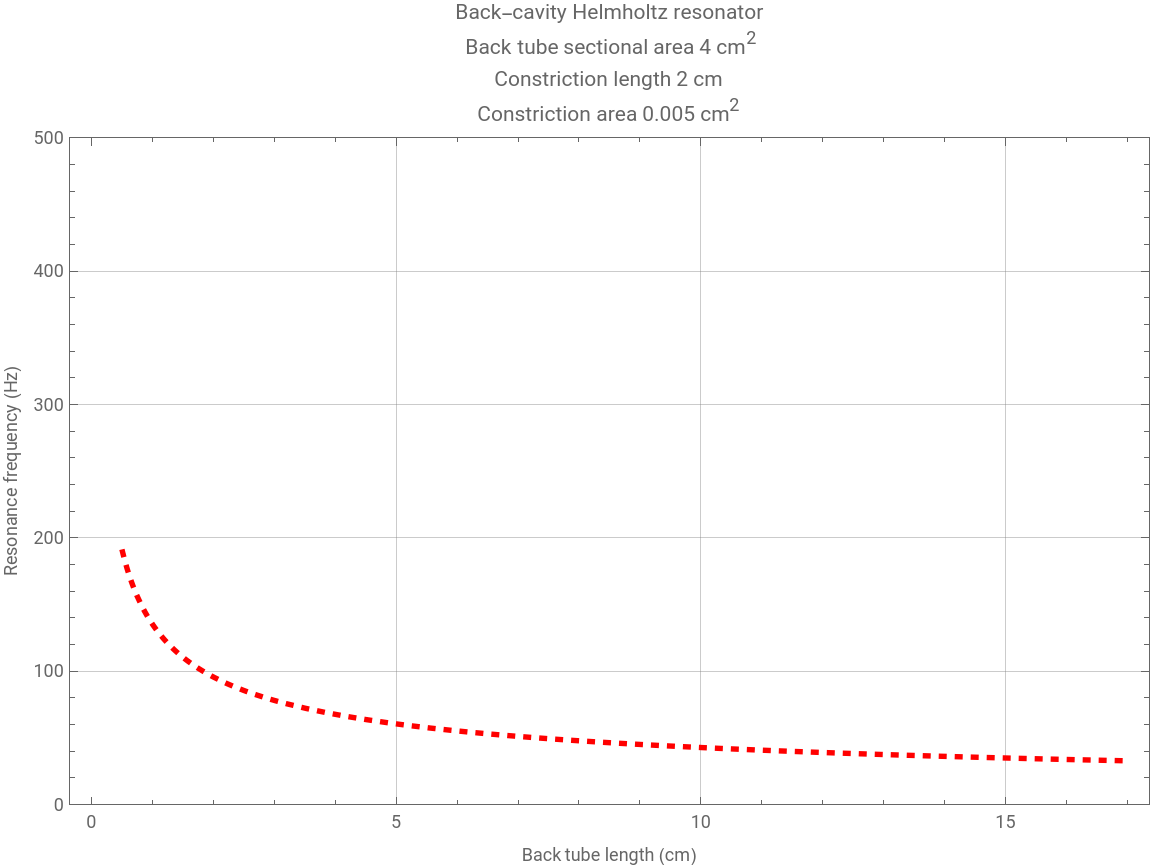
The demonstration below shows how a Helmholtz’s resonance frequency is affected by the volume of the cavity (specified by the area and the length of the back tube) and the cross-section and length of the resonator’s neck.
The volume part of the Helmholtz resonator functions like a spring that stores potential energy and the neck can be viewed as an “air piston” that moves back and forth in the volume, storing kinetic energy. The Helmholtz resonator preserves energy at its resonance frequency by switching back and forth between potential and kinetic energy.
Change the cross-sectional area of the back tube resonator, the constriction length and the cross-section area of the constriction and see how the Helmholtz’s resonance frequency changes for different lengths of the back tube. maxFreq sets the highest visible frequency on the graph.
Why is the resonance frequency lower the longer the back tube?
How does the constriction length affect the resonance frequency?
Check also how the back tube’s and the constriction’s cross sectional areas affect the system’s resonance frequency.
Can you give a physical explanation as to why the resonance frequency can be expected to change the way it does?
In[]:=
Manipulatehelmholtz[lb_,ab_,lc_,ac_,ρ_,c_]:=;Plot[helmholtz[lb,areaBackTube,constrictionLength,constrictionArea,1,34000],{lb,0.5,17},PlotRange{0,maxFreq},ImageSizeLarge,PlotStyle{Thickness[0.005],Red,Dashed},FrameTrue,FrameLabel{"Back tube length (cm)","Resonance frequency (Hz)"},PlotLabel"Back-cavity Helmholtz resonator\n Back tube sectional area "<>ToString[areaBackTube]<>" \nConstriction length "<>ToString[constrictionLength]<>" cm\nConstriction area "<>ToString[constrictionArea]<>" ",BaseStyle{FontFamily"Arial",FontSize12},GridLinesAutomatic],{{areaBackTube,4},1,10,Appearance"Labeled"},{{constrictionLength,2},0.1,5,Appearance"Labeled"},{{constrictionArea,0.005},0.0001,0.7*areaBackTube,Appearance"Labeled"},{{maxFreq,500},100,3000,Appearance"Labeled"}
1
2*Pi**
ρ*lc
ac
lb*ab
ρ*
2
c
2
cm
2
cm
Out[]=
Formant frequencies in a two-tube acoustic system
Formant frequencies in a two-tube acoustic system
The demonstration below shows the resonance frequencies contributed by the back and front tubes in a two-tube acoustic system representing the articulation of oral stop-consonants. The back tube resonances per se as a function of the tube’s length are shown by the red curves and the front tube resonance frequencies are shown by the green curves. For the back tube, the first resonance frequency is calculated assuming that it behaves as a Helmholtz resonator. The cross-sectional area of the back tube and constriction, along with the constriction length can be manipulated but affect only the Helmholtz resonator in this demonstration.
Vary the length of the back tube and observe how the formant values change and how the back and front cavities associated with a given formant change with the place of articulation (length of back tube).
What are the highest and lowest possible frequencies for each of the displayed formants?
Can you explain why the formant values are limited to certain ranges?
How do you expect those ranges to be affected by an increase or decrease in the vocal tract’s total length?
Manipulatec=34000;ρ=1;rb[n_,lb_]:=Max,(n-1)c(2lb);rf[n_,lb_]:=(2n-1)c(4(17-lb-constrictionLength));formant=Sort[{rb[1,backTubeLength],rb[2,backTubeLength],rb[3,backTubeLength],rb[4,backTubeLength],rb[5,backTubeLength],rb[6,backTubeLength],rb[7,backTubeLength],rf[1,backTubeLength],rf[2,backTubeLength],rf[3,backTubeLength],rf[4,backTubeLength],rf[5,backTubeLength],rf[6,backTubeLength],rf[7,backTubeLength]}];Plot[{rb[1,lb],rb[2,lb],rb[3,lb],rb[4,lb],rb[5,lb],rb[6,lb],rb[7,lb],rf[1,lb],rf[2,lb],rf[3,lb],rf[4,lb],rf[5,lb],rf[6,lb],rf[7,lb]},{lb,0.1,16.9},Epilog{PointSize[Large],Black,Point[{backTubeLength,formant[[1]]}],Text["",{backTubeLength+0.5,formant[[1]]}],PointSize[Large],Darker[Pink],Point[{backTubeLength,formant[[2]]}],Text["",{backTubeLength+0.5,formant[[2]]}],PointSize[Large],Blue,Point[{backTubeLength,formant[[3]]}],Text["",{backTubeLength+0.5,formant[[3]]}],PointSize[Large],Gray,Point[{backTubeLength,formant[[4]]}],Text["",{backTubeLength+0.5,formant[[4]]}]},PlotRange{0,8000},PlotStyle{{Thickness[0.005],Red,Dashed},{Thickness[0.005],Red},{Thickness[0.005],Red},{Thickness[0.005],Red},{Thickness[0.005],Red},{Thickness[0.005],Red},{Thickness[0.005],Red},{Thickness[0.005],Green},{Thickness[0.005],Green},{Thickness[0.005],Green},{Thickness[0.005],Green},{Thickness[0.005],Green},{Thickness[0.005],Green},{Thickness[0.005],Green}},FrameTrue,FrameLabel{"Distance from glottis (cm)","Resonance frequency (Hz)"},PlotLabel"Two-tube model for stop consonants\n(Assuming 17 cm total vocal tract length and c=34000 cm/s)\nBack tube length "<>ToString[NumberForm[backTubeLength,{3,1},NumberPadding{" ","0"}]]<>" cm\nConstriction length "<>ToString[constrictionLength]<>" cm\n="<>ToString[NumberForm[Round[formant[[1]]]]]<>" Hz, ="<>ToString[NumberForm[Round[formant[[2]]]]]<>" Hz, ="<>ToString[NumberForm[Round[formant[[3]]]]]<>" Hz, ="<>ToString[NumberForm[Round[formant[[4]]]]]<>" Hz",BaseStyle{FontFamily"Arial",FontSize12},GridLinesAutomatic,ImageSizeLarge],{{backTubeLength,5.0},0.1,16.9-constrictionLength,Appearance"Labeled"},{{constrictionLength,0.1},0.1,3,Appearance"Labeled"},{{constrictionArea,0.002},0.0001,0.7*areaBackTube,Appearance"Labeled"},{{areaBackTube,4},1,10,Appearance"Labeled"}
1
2*Pi**
ρ*constrictionLength
constrictionArea
lb*areaBackTube
ρ*
2
c
F
1
F
2
F
3
F
4
F
1
F
2
F
3
F
4