PARTICLE IN CONSTANT POTENTIAL
PARTICLE IN CONSTANT POTENTIAL
BY JOHN BAXTER
The Hamiltonian Operator for a particle moving in a constant Potential V(x) takes the following form where the Potential V(x)=V does not depend on the Position, x.=+V(x)Therefore, the Time Dependent Wave Equation becomes…|ψ(x,t)〉=iℏ|ψ(x,t)〉|ψ(x,t)〉+V|ψ(x,t)〉=iℏ|ψ(x,t)〉 where ⟹
H
H
2
P
2m
H
d
dt
2
P
2m
d
dt
ψ(x,t)=
i(kx-ωt)
e
-+V=iℏ
2
ℏ
2m
2
d
2
dx
i(kx-ωt)
e
i(kx-ωt)
e
d
dt
i(kx-ωt)
e
ω=+
2
ℏk
2m
V
ℏ
E T 2 ℏ 2 k 2m | wherek= p ℏ |
In[]:=
Clear[ℏ]ψ[x_,t_]:=GridSimplifySolve-ψ[x,t]+Vψ[x,t]ℏψ[x,t],ω[[1,1]]/.(x_y_)(xy),"Angular Frequency",{ℏω,"Total Energy"},Spacings5,AlignmentLeft
(kx-ωt)
2
ℏ
2m
∂
{x,2}
∂
t
E
T
Out[]=
ω V ℏ 2 k 2m | Angular Frequency |
E T | Total Energy |
In[]:=
Grid[{{Simplify[ℏω/.ToRules[%[[1,1,1]]]],"Total Energy"}},Spacings5,AlignmentLeft]
E
T
Out[]=
E T 2 k 2 ℏ 2m | Total Energy |
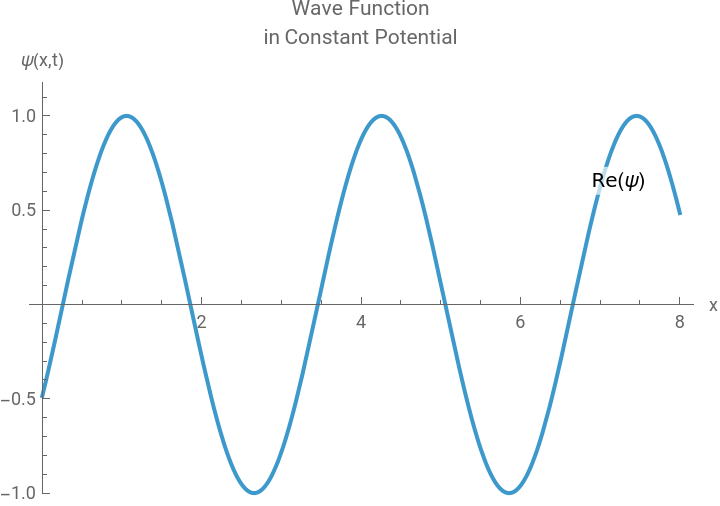
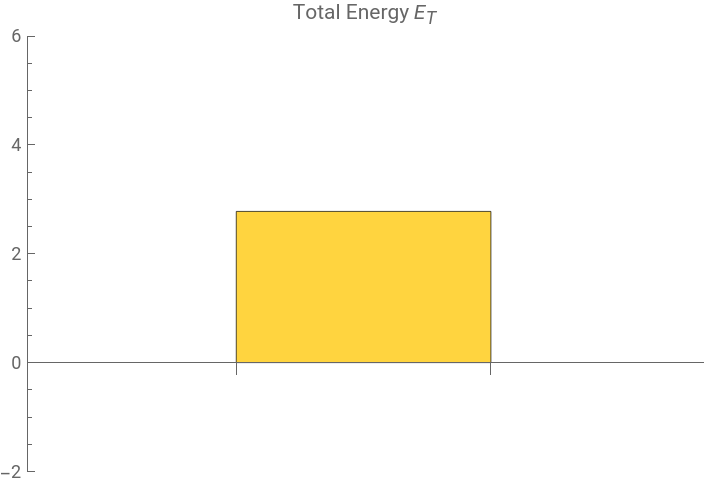
From the relations above, we generate the animated plot below. 1. Momentum, p: The wave moves at momentum p=ℏk. 2. Mass, m: As the mass, m increases, the velocity of the particle decreases to maintain a constant Momentum, k. We see this relation from the equation p=mv. Where lowercase v denotes velocity. 3. Potential Energy, V: The particle moves through a constant Potential Energy Field that opposes the movement of the particle when the Potential Energy, V is positive. 4. Total Energy, : As the Potential Energy, V increases, the particle requires a higher Total Energy, to maintain it’s Momentum, p.
E
T
E
T
In[]:=
ManipulateGridPlotRe/.ω+/.ℏ1,{x,0,8},PlotRange1,PlotLabelsPlaced["Re(ψ)",Scaled[.9]],AxesLabel{"x","ψ(x,t)"},PlotLabelColumn[{"Wave Function","in Constant Potential"},AlignmentCenter],BarChartV+/.ℏ1,PlotRange{-2,6},PlotLabel"Total Energy ",ItemSizeFull,{t,0,4π,AnimationRunningTrue},p,,,π,,{{m,1},1,10,.1},{{V,0},-1,1}
x-ωt
p
ℏ
V
ℏ
2
p
2ℏm
2
p
2m
E
T
π
4
π
8
π
8
Out[]=