This is part of live presentation series called Mathematical Games in which we explore a variety of games and puzzles using Wolfram Language. In this episode, we explore games that involve Pi, circles and spheres.
Watch on YouTube: https://www.youtube.com/watch?v=sZ0xWN6Tka0
demonstrations.wolfram.com
demonstrations.wolfram.com
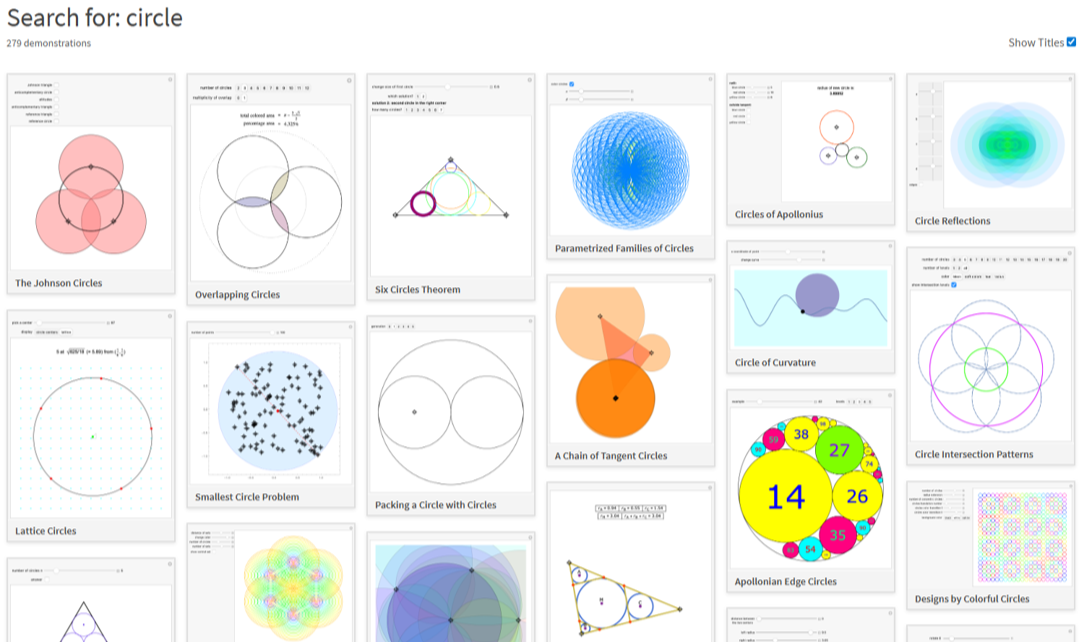
Many demonstrations involve circles
Pi Day (3/14)
Pi Day (3/14)
The area of a circle is Pi r Squared.
In[]:=
{1,2,3,4,5}^2
In[]:=
Characters["abcdefghijklmnopqrstuvwxyz"][[{1,4,9,16,25}]]
Out[]=
{a,d,i,p,y}
In[]:=
%[[{4,3,2,1,5}]]
Out[]=
{p,i,d,a,y}
It suffices to memorize Pi to 768 places.
In[]:=
N[Pi,770]
Out[]=
3.1415926535897932384626433832795028841971693993751058209749445923078164062862089986280348253421170679821480865132823066470938446095505822317253594081284811174502841027019385211055596446229489549303819644288109756659334461284756482337867831652712019091456485669234603486104543266482133936072602491412737245870066063155881748815209209628292540917153643678925903600113305305488204665213841469519415116094330572703657595919530921861173819326117931051185480744623799627495673518857527248912279381830119491298336733624406566430860213949463952247371907021798609437027705392171762931767523846748184676694051320005681271452635608277857713427577896091736371787214684409012249534301465495853710507922796892589235420199561121290219608640344181598136297747713099605187072113499999984
Track the path of digits in Pi.
In[]:=
Graphics[Line[AnglePath[PiRealDigits[N[Pi,20000]][[1]]/10]]]
Out[]=
Pi Day
Pi Day
Pope Leo XIV, for March 14. “in the context of the manifold challenges” ... “He prays, therefore, that everyone involved in the present event will be attentive to the profound spiritual needs of the human heart, will seek ways of humanizing the digital sphere, shaping it as an opportunity for fraternity and creativity, and will be prophets of hope, truth and goodness in the world.”


Melissen Constant
Melissen Constant
Here’s a little trick done with e, π and .
19
In[]:=
N[(E^(Sqrt[19]Pi)+24)^(1/24),11]
Out[]=
1.7692923542
That seems curiously close to the root of =2(x+1):
3
x
In[]:=
N[Root[-2-2#1+&,1],11]
3
#1
Out[]=
1.7692923542
We can use that root for the optimal covering of a circle by twelve circles:
Out[]=
Melissen's 12 Disk Covering |
Here’s a similar trick done with e, π and .
163
In[]:=
N[(E^(Sqrt[163]Pi)+24)^(1/24),33]
Out[]=
5.31862821775018565910968015331802
That seems curiously close to the root of =2(3-2x+1):
3
x
2
x
In[]:=
N[Root[-2+4#1-6#1^2+&,1],33]
3
#1
Out[]=
5.31862821775018565910968015331802
But is there a geometric trick?
More on Pi
More on Pi
Here’s five digits of accuracy with four digits:
In[]:=
NPi-
7
7
9
4
Out[]=
0.0000254234
If coins have a golden ratio to each other, three golden coins will surround a unit coin against a wall. The penny and half dollar are close to this ratio.
Five coins can surround a unit coin against a wall if they have a tribonacci-based ratio:
DoyleSpiral (Dieter Steemann)
DoyleSpiral (Dieter Steemann)
Doyle spirals are special logarithmic spirals of touching circles in which every circle is surrounded by a corona of six touching circles. A linear fractional transformation (or Möbius transformation) is applied to map such spirals (in particular, circle packings) into double spirals.
Plot a Doyle spiral:
Circle Packings with Linear Fractional Transformations (Enrique Zeleny)
Circle Packings with Linear Fractional Transformations (Enrique Zeleny)
The transformation here acts on a hexagonal grid with disks inscribed in each cell. Mapping just three points, it is possible to calculate the radius and the coordinates of the centers of the new disks.
The Conway Circle (Claude Fabre)
The Conway Circle (Claude Fabre)
Take a triangle. Extend each side by the lengths of the other two sides, as in the figure where all segments of the same color are equal. Then the endpoints of the extended segments (with length the triangle’s perimeter) lie on a circle centered at the incenter.
The Circles of Descartes
The Circles of Descartes
Using both formulas, a vast Apollonian packing can be found. This Demonstration focuses on initial circle sets with integer curvature. Hover over an empty circle to see its curvature. Various wonderful results can occur:
1. If the initial curvatures are integers, so are all the curvatures.
2. If the first circle is a line, the configuration is the set of Ford circles.
3. With a large interior circle, the configuration is a Pappus chain.
4. Modulus 12, only 4 values can occur. Circles with a similar value get the same color.
2. If the first circle is a line, the configuration is the set of Ford circles.
3. With a large interior circle, the configuration is a Pappus chain.
4. Modulus 12, only 4 values can occur. Circles with a similar value get the same color.
Frederick Soddy, who won a Nobel prize for his study of isotopes, is better known for his research on circles and a poem he published in Nature in 1936.
The Kiss Precise
by Frederick Soddy
For pairs of lips to kiss maybe
Involves no trigonometry.
'Tis not so when four circles kiss
Each one the other three.
To bring this off the four must be
As three in one or one in three.
If one in three, beyond a doubt
Each gets three kisses from without.
If three in one, then is that one
Thrice kissed internally.
by Frederick Soddy
For pairs of lips to kiss maybe
Involves no trigonometry.
'Tis not so when four circles kiss
Each one the other three.
To bring this off the four must be
As three in one or one in three.
If one in three, beyond a doubt
Each gets three kisses from without.
If three in one, then is that one
Thrice kissed internally.
Annulus for a Regular Polygon
Annulus for a Regular Polygon
Euler Line
Euler Line
The following triangle has nice Euler line points for the circumcenter, centroid, nine-point center and orthocenter:
The isogonal conjugates of the Euler points are the orthocenter, symmedian, Kosnita point and circumcenter:
A graphic of the triangle with the Euler line (blue), circumcenter|circumcircle|perpendicular bisectors (red), centroid|medians (cyan), nine-point center|circle (brown) and orthocenter|altitudes (green) and the isogonal conjugate of the Euler line, the Jerabek hyperbola:
Exspheres
Exspheres
An excircle is also called an escribed circle. An exsphere is also called an escribed sphere.
An incircle is internally tangent to the edges of a triangle. A triangle has three excircles that are externally tangent to each side and to the other sides when extended indefinitely.
Find the excircles for a triangle:
Show the excircles, incircle and infinite lines:
Show a tetrahedron along with its exspheres:
Circles of Apollonius
Circles of Apollonius
Given 3 circles, draw a tangent circle. There are actually 8 solutions. It occurred to me after I put this together that I should call it ApolloniusSphere.
There are 8 solutions because each circle allows an inner and outer tangency.
With spheres, there are 16 solutions.
Eyeball Theorem
Eyeball Theorem
Fermat Point
Fermat Point
The Fermat point minimizes the total distance to the vertices:
Check that:
Circumspheres of the Fermat point and three vertices coincide with the segment endpoints:
Incircle 3D
Incircle 3D
Incircles of the faces of an icosahedron:
JohnsonCircles
JohnsonCircles
The three Johnson circles are congruent to the circumcircle of the reference triangle.
The Johnson circles are closely related to the circumcircle and orthocenter of the reference triangle:
The three Johnson circles are congruent to the circumcircle of the reference triangle:
The three Johnson circles are congruent to the circle that passes through the centers of the three Johnson circles:
The three Johnson circles meet at the orthocenter of the reference triangle:
Visualize the five congruent circles in one diagram with the reference triangle:
Kenmotu Circle
Kenmotu Circle
Do you find it too trivial to find the center and radius of the incircle or the circumcircle? Then try and find the center and radius of the Kenmotu circle! Indeed, each triangle has exactly one Kenmotu circle: its intersections with the edges are the contact points of three equal squares, each of which has two vertices on the triangle and which share a common vertex. This common vertex, the Kenmotu point, is the center of the circle.
Loeschian Spheres
Loeschian Spheres
But first, something else. A different sequence is the Farey sequence, which at order 5 is
In two dimensions, the Farey sequence can make Ford circles, each with the number as a radius, centered above their number, and tangent to the zero line and each other.
LucasCircles
LucasCircles
The Lucas circles of a triangle are the three circles that are mutually externally tangent to each other and are each internally tangent to the circumcircle of the triangle at a vertex of the triangle.
The three Lucas circles are externally tangent to each other. They are internally tangent to the circumcircle of the reference triangle:
MalfattiCircles
MalfattiCircles
The three Malfatti circles of a triangle are tangent to the sides of the triangle and each other.
Show the Malfatti circles of an arbitrary triangle in a Manipulate:
Miquel’s Theorem (Jay Warendorff)
Miquel’s Theorem (Jay Warendorff)
Let A', B', and C' be points (green, not labeled in the figure) on the sides BC, CA, and AB of the triangle ABC. Then the circumcircles through the triangles AB'C', A'BC', and A'B'C intersect in a common point.
Drag the vertices of the triangle or the sliders to change the figure.
Miquel’s Pentagram Theorem (Jay Warendorff)
Miquel’s Pentagram Theorem (Jay Warendorff)
Extend the sides of a pentagon to form five triangles, one on each side of the pentagon. Then the five points of intersection of neighboring pairs of circumcircles that are not on the pentagon lie on a circle.
MixtilinearIncircles
MixtilinearIncircles
The mixtilinear incircles of a triangle are the three circles that are tangent to two sides and internally tangent to the circumcircle.
Visualize the three mixtilinear circles along with the reference triangle:
SchmidtArrangements
SchmidtArrangements
Schmidt arrangement for the Gaussian integers:
Zooming in
The Heegner numbers are 1, 2, 3, 7, 11, 19, 43, 67, and 163
Steiner Chain of Circles (Gregory Hartman and Michael Schreiber)
Steiner Chain of Circles (Gregory Hartman and Michael Schreiber)
Given two fixed nonintersecting circles (shown here in red and blue), a Steiner chain is a sequence of circles, each tangent to the two given circles and each tangent to their neighboring circles in the sequence. When the chain is closed, the first and last circles in the chain are also tangent to each other. If a closed chain can be found for a given pair of circles, then infinitely many such chains can be found—use the rotation slider. Also, regardless of whether the chain is open or closed, the centers of circles of the chain lie on an ellipse, shown in green.
The Taylor Circle (Jay Warendorff)
The Taylor Circle (Jay Warendorff)
Let ABC be a triangle. Let A’, B’, and C’ be the points where the altitudes drawn from A, B, and C intersect the opposite sides or their extensions. From each of A’, B’, and C’ draw lines perpendicular to the adjacent sides. The resulting six points all lie on a circle called the Taylor circle.
The altitudes of the altitudes make a circle.
What happens if another layer is added? Well... it turns out not much.
Villarceau Circles (Stan Wagon)
Villarceau Circles (Stan Wagon)
It is obvious that every point on a torus is contained in two circles that lie on the torus. Less obvious is the fact that every such point is contained in two additional circles, called the Villarceau circles.
For 2D, an approximation for the area of a circle
For 3D, an approximation for the volume of a sphere:
That’s the same volume as a sphere of radius 1. What would one of these fractals look like? The code is similar: getting the digits 1, 2, or 3 in bases 3, 5, or 7 more than once causes a triplet to get tossed out.
I took another look at the code... need the reverse of this:
Three Circles Defined by Chords (Jay Warendorff)
Three Circles Defined by Chords (Jay Warendorff)
Through a point on a circle draw three chords. Using each chord as a diameter, draw three circles. The pairwise intersections of the circles are collinear.
The Sum of Opposite Angles of a Quadrilateral in a Circle is 180 Degrees
The Sum of Opposite Angles of a Quadrilateral in a Circle is 180 Degrees
The sum of the opposite angles of a quadrilateral in a circle is 180°, as long as the quadrilateral does not cross itself.
The Seven Circles Theorem (Claude Fabre)
The Seven Circles Theorem (Claude Fabre)
Take six circles tangent to each other in pairs and tangent to the unit circle on the inside. The points of contact of the six circles with the unit circle define a hexagon. The diagonals of the hexagon are concurrent.
This concurrency is obvious when the hexagon is regular. The theorem states that it still holds when the radii and the positions of the circles vary.
Sphere Packing
Sphere Packing
Q: What is the densest packing of spheres in a box? A: Depends on the box.
This Demonstration shows the number of unit diameter spheres that can fit in a given box, using one of the lattices SC, FCC, BCC, or HCP (simple cubic, face-centered cubic, body-centered cubic, or hexagonal close-packed). For a sufficiently large box, FCC gives the densest packing. For many small boxes, a denser non-lattice packing exists.
This Demonstration shows the number of unit diameter spheres that can fit in a given box, using one of the lattices SC, FCC, BCC, or HCP (simple cubic, face-centered cubic, body-centered cubic, or hexagonal close-packed). For a sufficiently large box, FCC gives the densest packing. For many small boxes, a denser non-lattice packing exists.
Op Art on a Sphere (Izidor Hafner)
Op Art on a Sphere (Izidor Hafner)
This Demonstration shows op art graphics on a sphere. You can choose patterns with underlying tetrahedral, octahedral or icosahedral symmetry.
Lattice Circles
Lattice Circles
In the lattice display, coordinates for red lattice points can be seen by hovering over them with your mouse.
In the circle centers display, the circle itself is shown, scaled down by 100.
Intersecting Secants Theorem
Intersecting Secants Theorem
Drag the orange points to change the figure.
Circles Packed in a Circle
Circles Packed in a Circle
Best known packings for circles in a circle, for 2 to 100 circles.
Theorem of the Owl’s Eyes (Greg Markowsky and Catherine Wolfram)
Theorem of the Owl’s Eyes (Greg Markowsky and Catherine Wolfram)
No matter which way the owl turns its beak, the eyes remain the same size. The interpretation as a picture of an owl is just for fun, but it is a real result, also known as Archimedes’ Twins. The diameters of the two dark orange semicircles lie on the diameter of the larger, lighter semicircle. The line between the eyes is perpendicular to the diameters of the three semicircles. The two blue circles are inscribed in the curvilinear triangles so formed. The theorem states that the two blue circles are the same size. The ears have nothing to do with the theorem, but the hope is that they make the picture look more like an owl.
TetrahedronCenter
TetrahedronCenter
Find the incenter where the dihedral angle bisectors intersect:
Twelve Point Sphere
Twelve Point Sphere
Find the Euler, Euler projected and medial tetrahedra:
The spheres are all identical. This unique sphere is also known as the 12-point sphere:
Show the 12-point sphere:
Three Point Arc and PG(3,2)
Three Point Arc and PG(3,2)
Find an arc through three points:
Find a representation of the smallest projective space with 15 points, 35 lines and 15 planes:
Haberdasher Problem
Haberdasher Problem
A 3-piece solution of the Haberdasher problem (with a hole) was found by Hiroaki Hamanaka in 2017.
CITE THIS NOTEBOOK
CITE THIS NOTEBOOK
Mathematical Games: Pi, circles and spheres
by Ed Pegg
Wolfram Community, STAFF PICKS, March 19, 2026
https://community.wolfram.com/groups/-/m/t/3666213
by Ed Pegg
Wolfram Community, STAFF PICKS, March 19, 2026
https://community.wolfram.com/groups/-/m/t/3666213