If it’s not beautiful,
it’s not mathematics:)
it’s not mathematics:)
E542 On the remarkable properties of the pentagonal numbers.
https://scholarlycommons.pacific.edu/euler-works/542/
E541 Euler proofs the pentagonal number theorem,
and recalls its application to the partition of numbers.
https://scholarlycommons.pacific.edu/euler-works/541/
https://scholarlycommons.pacific.edu/euler-works/542/
E541 Euler proofs the pentagonal number theorem,
and recalls its application to the partition of numbers.
https://scholarlycommons.pacific.edu/euler-works/541/
The main goal is to introduce Centered Hexagonal Numbers together with a graphical representation using Triangular Numbers and Centered Triangular Numbers. The secondary goal is to introduce Pentagonal Numbers together with a graphical representation using only Triangular Numbers.
https://oeis.org/A000217
Triangular Numbers:
https://oeis.org/A005448
Centered Triangular Numbers:.
https://oeis.org/A003215
Centered Hexagonal Numbers: (starting with index 0)
(starting with index 1)
Triangular Numbers:
a(n)=binomial(n+1,2)=n(n+1)/2=PolygonalNumber(3,n)
https://oeis.org/A005448
Centered Triangular Numbers:
a(n)=3n(n-1)/2+1
https://oeis.org/A003215
Centered Hexagonal Numbers:
3n(n+1)+1
3n(n-1)+1
Definition Triangular Number, :
T
n
In[]:=
TriangularNumber[n_]:=n(n+1)/2
First ten Triangular Numbers:
In[]:=
TriangularNumber/@Range[10]
Out[]=
{1,3,6,10,15,21,28,36,45,55}
Mathematica knows the TriangularNumber[n] as PolygonalNumber[3,n]:
In[]:=
Reduce[PolygonalNumber[3,n]==TriangularNumber[n]]
Out[]=
True
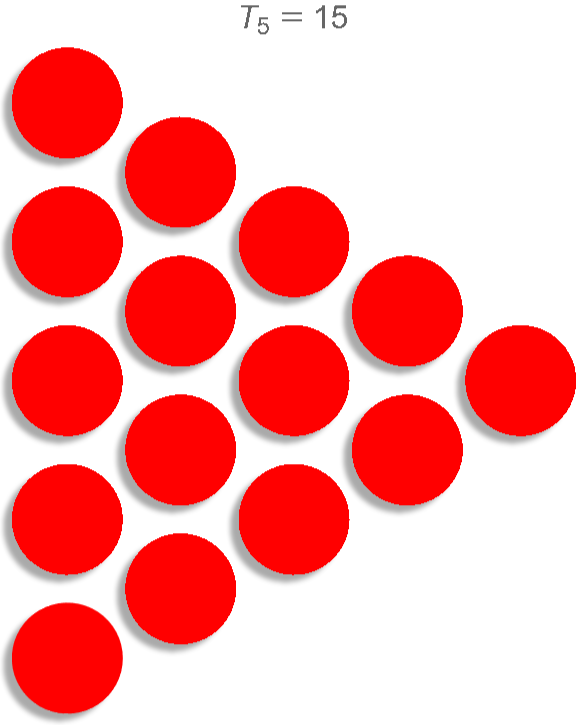
And this is why a triangular number gets its name:
In[]:=
TriangularNumberGraphics[5]
Out[]=
Definition Centered Hexagonal Number, :
CH
n
In[]:=
CenteredHexagonalNumber[n_]:=3n(n-1)+1
Remark: is the same sequence with a shifted index.
3n(n+1)+1
In[]:=
{Map[3#(#+1)+1&,Range[0,9]],Map[3#(#-1)+1&,Range[10]]}
Out[]=
{{1,7,19,37,61,91,127,169,217,271},{1,7,19,37,61,91,127,169,217,271}}
First ten Centered Hexagonal Numbers:
In[]:=
CenteredHexagonalNumber/@Range[10]
Out[]=
{1,7,19,37,61,91,127,169,217,271}
Definition Centered Triangular Number, :
CT
n
In[]:=
CenteredTriangularNumber[n_]:=+1
3n(n-1)
2
First ten Centered Triangular Numbers :
In[]:=
CenteredTriangularNumber/@Range[10]
Out[]=
{1,4,10,19,31,46,64,85,109,136}
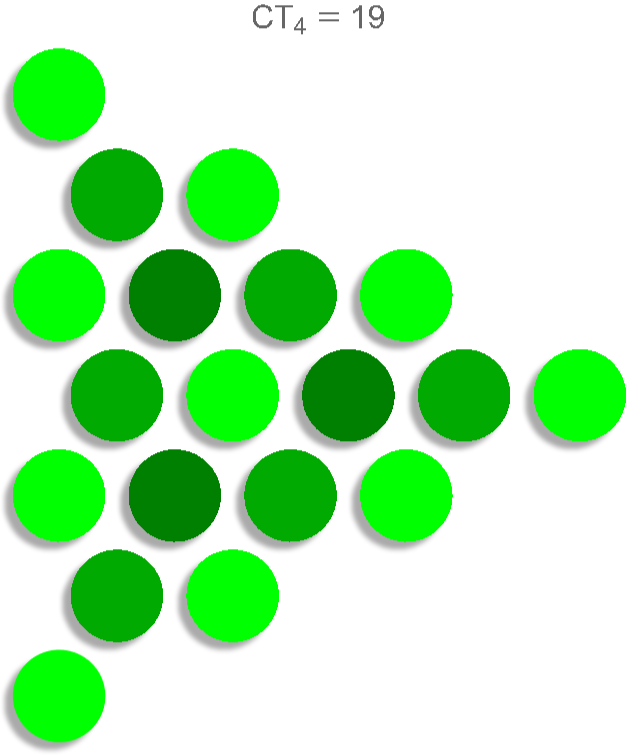
Three consecutive triangular number make a centered triangular number:
In[]:=
RepresentCenteredTriangularNumber[4]
Out[]=
19=10+6+3
And this is what it looks like:
In[]:=
CenteredTriangularNumberGraphics[4]
Out[]=
CT
n
CT
n
T
n
T
n-1
T
n-2
In[]:=
Reduce[TriangularNumber[n-2]+TriangularNumber[n-1]+TriangularNumber[n]==CenteredTriangularNumber[n]]
Out[]=
True
CH
n
CH
n
T
n
CT
n-1
T
n
T
n
T
n
CT
n-1
In[]:=
Reduce[CenteredHexagonalNumber[n]==CenteredTriangularNumber[n-1]+3TriangularNumber[n]-3]
Out[]=
True
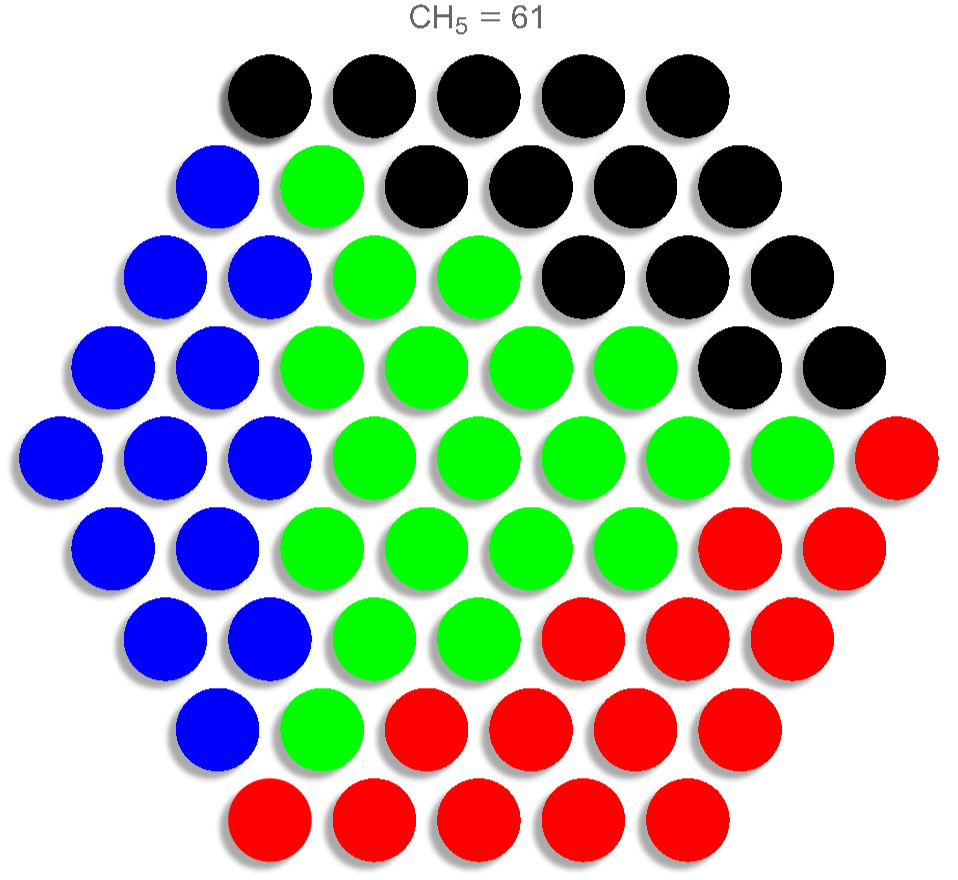
Graphical representation for :
-2 is blue, -1 is black, is red, and is green.
Example:=(-2)+(-1)++:
CH
n
T
n
T
n
T
n
CT
n-1
Example:
CH
5
T
5
T
5
T
5
CT
4
In[]:=
RepresentCenteredHexagonalNumber[5]
Out[]=
61=13+14+15+19
In[]:=
CenteredHexagonalNumberGraphics[5]
Out[]=
Secondary goal: Pentagonal Numbers
Secondary goal: Pentagonal Numbers
Definition Pentagonal Number
P
n
In[]:=
PolygonalNumber[5,n]
Out[]=
1
2
In[]:=
PentagonalNumber[n_]:=n(3n-1)/2
The first ten Pentagonal Numbers:
In[]:=
Map[PentagonalNumber,Range[10]]
Out[]=
{1,5,12,22,35,51,70,92,117,145}
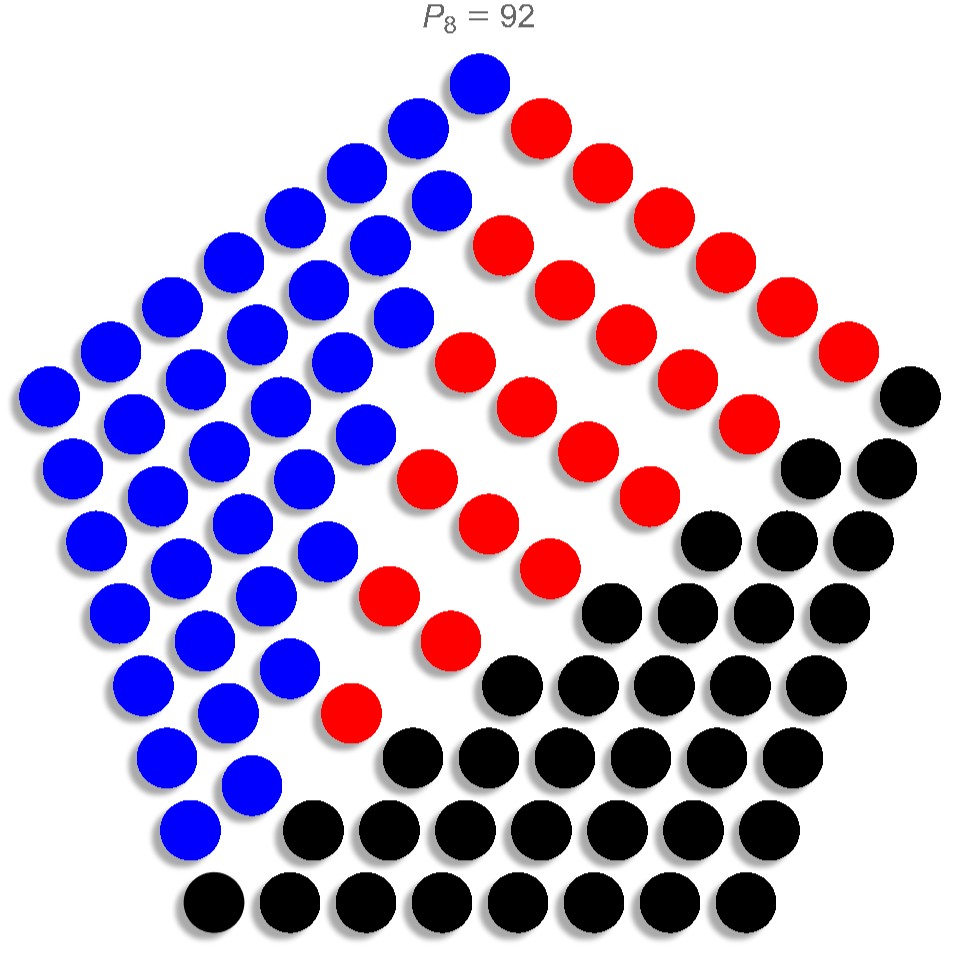
The Pentagonal Numbers can be expressed by Triangular Numbers alone:
=+-1+=+2-1
P
n
T
n-2
T
n
T
n
T
n-2
T
n
In[]:=
Reduce[PentagonalNumber[n]==(TriangularNumber[n-2]+2TriangularNumber[n]-1)]
Out[]=
True
In[]:=
RepresentPentagonalNumber[10]
Out[]=
145=54+55+36
A graphical representation of a pentagonal number:
In[]:=
PentagonalNumberGraphics[8]
Out[]=
Side trip into art
Side trip into art
This is minimal art of a pentagonal number:
A centered hexagonal number with symmetric coloring as minimal art:
Euler’s pentagonal number theorem
Euler’s pentagonal number theorem
Euler is the master of us all.
Pierre-Simon Laplace.
Pierre-Simon Laplace.
Euler’s pentagonal number theorem is the transformation of a given infinite product into an infinite series:
Using pentagonal numbers explicitly:
This function is called Euler function (and QPochhammer[x,x] in Mathematica):
According to https://en.wikipedia.org/wiki/Euler_function, there are some remarkable identities from Ramanujan’s lost Notebook, here is the first:
According to https://en.wikipedia.org/wiki/Euler_function,
“Using the Pentagonal number theorem, exchanging sum and integral, and then invoking complex-analytic methods, one derives.”:
“Using the Pentagonal number theorem, exchanging sum and integral, and then invoking complex-analytic methods, one derives.”:
CITE THIS NOTEBOOK
CITE THIS NOTEBOOK
Centered Hexagonal, Centered Triangular, Triangular and Pentagonal Numbers
by Oliver Seipel
Wolfram Community, STAFF PICKS, October 11, 2023
https://community.wolfram.com/groups/-/m/t/3032508
by Oliver Seipel
Wolfram Community, STAFF PICKS, October 11, 2023
https://community.wolfram.com/groups/-/m/t/3032508