ABSTRACT (original article): We explore the connection between low-scale CP-violating Dirac phase (δ) and high-scale leptogenesis in a Left-Right Symmetric Model (LRSM) with scalar bidoublet and doublets. The fermion sector of the model is extended with one sterile neutrino ) per generation to implement a double seesaw mechanism in the neutral fermion mass matrix. The double seesaw is performed via the implementation of type-I seesaw twice. The first seesaw facilitates the generation of Majorana mass term for heavy right-handed (RH) neutrinos ), and the light neutrino mass becomes linearly dependent on SL mass in the second. In our framework, we have taken charge conjugation (C) as the discrete left-right (LR) symmetry. This choice assists in deriving the Dirac neutrino mass matrix ) in terms of the light and heavy RH neutrino masses and light neutrino mixing matrix (containing δ). We illustrate the viability of unflavored thermal leptogenesis via the decay of RH neutrinos by using the obtained MD with the masses of RH neutrinos as input parameters. A complete analysis of the Boltzmann equations describing the asymmetry evolution is performed in the unflavored regime, and it is shown that with or without Majorana phases, the CP-violating Dirac phase is sufficient to produce the required asymmetry in the leptonic sector within this framework for a given choice of input parameters. Finally, we comment on the possibility of constraining our model with the current and near-future oscillation experiments, which are aimed at refining the value of δ. CITATION (original article): Patel, U., Adarsh, P., Patra, S. et al. Leptogenesis in a Left-Right Symmetric Model with double seesaw. J. High Energ. Phys. 2024, 29 (2024). https://doi.org/10.1007/JHEP03(2024)029. CITATION (original article): Utkarsh Patel, Lekhika Malhotra, Sudhanwa Patra, Urjit A. Yajnik (2023), Cogenesis of visible and dark sector asymmetry in a minimal seesaw framework, arXiv:2211.04722. https://doi.org/10.48550/arXiv.2211.04722.
(
S
L
(
N
R
(
M
D
U
PMNS
Introduction
Introduction
Leptogenesis is a theoretical framework within particle physics and cosmology that seeks to explain the observed matter-antimatter asymmetry in the universe. Building upon concepts from both the fields, leptogenesis proposes a mechanism for generating the cosmic baryon asymmetry, the discrepancy between the abundance of baryons and antibaryons. The idea originates from the observation that certain extensions to the Standard Model of particle physics, particularly those involving physics beyond the electroweak scale, naturally predict the existence of heavy, right-handed neutrinos (often called sterile neutrinos). These right-handed neutrinos, if sufficiently massive, could participate in processes violating lepton number conservation and thereby generate a lepton asymmetry in the early universe. This lepton asymmetry can subsequently be converted into a baryon asymmetry via the Sphaleron processes, thus providing a mechanism for explaining the observed matter dominance in our universe.
In the context of leptogenesis, the evolution of lepton number asymmetry is typically described by a set of coupled Boltzmann equations (BEs). These equations capture the dynamics of various particle species, interactions, and their impact on the generation and evolution of lepton asymmetry in the early universe.
To solve these coupled Boltzmann equations, one must consider several key factors. First, the equations account for the production and decay processes of heavy right-handed neutrinos, which are crucial players in generating the lepton asymmetry. These processes involve interactions mediated by Yukawa couplings and can lead to the production of lepton-antilepton pairs. In this notebook, I present the numerical formulation that one can follow to solve the set of coupled Boltzmann equations to track the evolution of lepton asymmetry of the universe in two simplified scenarios.
1
.High Scale Thermal Leptogenesis in a SM + 3 generation sterile right-handed neutrinos (RHNs) framework.
2
.Cogenesis of dark and visible sector asymmetry in a SM + 3 gen. Heavy RHNs + dark sector (DM + SM singlet scalar).
1. High Scale Thermal Leptogenesis
1. High Scale Thermal Leptogenesis
In the Standard Model (SM) of particle physics, neutrinos are assumed to be massless. However, experiments have shown that neutrinos do have mass, which implies the existence of physics beyond the Standard Model (BSM). One possible explanation for the mass of neutrinos is the so-called “Majorana mass mechanism”. In this mechanism, the neutrino is assumed to be its own antiparticle, which means that it has no distinct particle-antiparticle partner. The Majorana mass term arises from a term in the Lagrangian that violates lepton number conservation, and it takes the form of a two-component spinor bilinear:
T
m
N
N
R
N
R
(
1
)where is the Majorana mass, is the right-handed neutrino field (which is a singlet under the Standard Model gauge group), and C is the charge conjugation matrix.
m
N
N
R
To account for tiny masses of active SM neutrinos, the simplest possibility can be achieved by adding 3 generation sterile RHNs to SM. These RHNs can have Majorana masses and by the application of type-I seesaw mechanism on the overall neutrino mass matrix, the tiny masses of active neutrinos can be expressed in terms of heavy RHNs masses. Such an exercise is readily available in the literature.
In order to achieve the level of matter-antimatter asymmetry that is observed in experimental data, the three Sakharov conditions needs to be satisfied in a framework. SM in itself has been seen to satisfy the “C and CP violation” condition out of the three conditions but the amount of asymmetry generated from SM solely is many orders of magnitude smaller than the required amount. The remaining two conditions can also be satisfied at specific times during the formation of universe like during the electro-weak phase transition, or via the non-perturbative Sphaleron processes, but essentially all these conditions together does not account for the observed asymmetry. Now, the addition of the 3 RHNs to SM can not only solve the neutrino mass issue, but also provide an elegant solution to the matter-antimatter asymmetry problem of the universe. This can be achieved by the thermal leptogenesis process. The asymmetry produced via leptogenesis in the lepton sector is then argued to get transferred to baryon sector via the Sphalerons in the early universe.
In order to achieve the level of matter-antimatter asymmetry that is observed in experimental data, the three Sakharov conditions needs to be satisfied in a framework. SM in itself has been seen to satisfy the “C and CP violation” condition out of the three conditions but the amount of asymmetry generated from SM solely is many orders of magnitude smaller than the required amount. The remaining two conditions can also be satisfied at specific times during the formation of universe like during the electro-weak phase transition, or via the non-perturbative Sphaleron processes, but essentially all these conditions together does not account for the observed asymmetry. Now, the addition of the 3 RHNs to SM can not only solve the neutrino mass issue, but also provide an elegant solution to the matter-antimatter asymmetry problem of the universe. This can be achieved by the thermal leptogenesis process
1
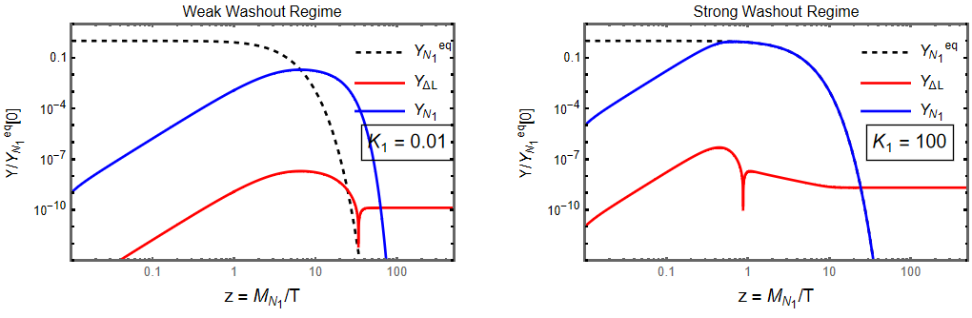
I have followed the work in reference TesaDavis to solve numerically and then plot the coupled Boltzmann equations for type-I thermal leptogenesis in the weak and strong washout regimes. Few other references that are helpful in this context are .
2-4
Constants & Parameters
Constants & Parameters
In[]:=
mstar=1.08*;(*Equilibriumneutrinomass*)gstar=106.75;(*SMeffectivenumberofdegreesoffreedom*)d[z_]:=z*;(*DecayRate*)Wid[z_]:=**BesselK[1,z];(*InverseDecayRate*)YNeq[z_]:=*0.9**BesselK[2,z];(*Equilibriumnumberdensityoftheparticles*)K1[x_]:=Which[x==2,100,x==1,0.01];(*WashoutParameter.Greaterthan50forstrongwashoutandsmallerthan1forweakwashout*)ϵ1=;(*AsymmetryParameter*)
-12
10
BesselK[1,z]
BesselK[2,z]
1
4
3
z
45
2**gstar
4
π
2
z
-6
10
BEs (Part 1)
BEs (Part 1)
In[]:=
Clear[YN,YL];s1=NDSolve[{YN'[z]==-d[z]*K1[1]*(YN[z]-YNeq[z]),YL'[z]==-(ϵ1*d[z]*K1[1]*(YN[z]-YNeq[z]))-(Wid[z]*K1[1]*YL[z]),YN[]==*YNeq[0.01],YL[]==*YNeq[0.01]},{YN,YL},{z,,},MaxStepSize0.00001];s2=NDSolve[{YN'[z]==-d[z]*K1[1]*(YN[z]-YNeq[z]),YL'[z]==-(ϵ1*d[z]*K1[1]*(YN[z]-YNeq[z]))-(Wid[z]*K1[1]*YL[z]),YN[1]==Evaluate[YN[1]/.s1],YL[1]==Evaluate[YL[1]/.s1]},{YN,YL},{z,,500},MaxStepSize0.001];
-2
10
-9
10
-2
10
-17
10
-2
10
0
10
0
10
BEs (Part 2)
BEs (Part 2)
In[]:=
Clear[YN,YL];t1=NDSolve[{YN'[z]==-d[z]*K1[2]*(YN[z]-YNeq[z]),YL'[z]==-(ϵ1*d[z]*K1[2]*(YN[z]-YNeq[z]))-(Wid[z]*K1[2]*YL[z]),YN[]==*YNeq[0.01],YL[]==*YNeq[0.01]},{YN,YL},{z,,},MaxStepSize0.00001];t2=NDSolve[{YN'[z]==-d[z]*K1[2]*(YN[z]-YNeq[z]),YL'[z]==-(ϵ1*d[z]*K1[2]*(YN[z]-YNeq[z]))-(Wid[z]*K1[2]*YL[z]),YN[1]==Evaluate[YN[1]/.t1],YL[1]==Evaluate[YL[1]/.t1]},{YN,YL},{z,,500},MaxStepSize0.001];
-2
10
-5
10
-2
10
-11
10
-2
10
0
10
0
10
Plotting
Plotting
In[]:=
plot01a=LogLogPlot{YNeq[z]/YNeq[0.01],Abs[{YL[z]/.s1}]/YNeq[0.01],{YN[z]/.s1}/YNeq[0.01]},{z,,1},PlotStyle{{Dashed,Darker[Black]},{Red},{Blue}},PlotRange{{0.01,500},{,10}},FrameLabelStyle"z = /T",Darker[Black],14,Style"Y/[0]",Darker[Black],12,FrameAutomatic,Epilog->Inset[Framed[Style[" = 0.01",Darker[Black],15]],Scaled[{0.88,0.5}]],PlotLegendsPlaced"","","",Scaled[{0.87,0.75}],FrameStyleThick,FrameTicksStyle->{Darker[Black],Thick},ImageSize->Full,PlotLabelStyle["Weak Washout Regime",Darker[Black]];plot01b=LogLogPlot{YNeq[z]/YNeq[0.01],Abs[{YL[z]/.s2}]/YNeq[0.01],{YN[z]/.s2}/YNeq[0.01]},{z,1,500},PlotStyle{{Dashed,Darker[Black]},{Red},{Blue}},PlotRange{{0.01,500},{,10}};plot02a=LogLogPlot{YNeq[z]/YNeq[0.01],Abs[{YL[z]/.t1}]/YNeq[0.01],{YN[z]/.t1}/YNeq[0.01]},{z,,1},PlotStyle{{Dashed,Darker[Black]},{Red},{Blue}},PlotRange{{0.01,500},{,10}},FrameLabelStyle"z = /T",Darker[Black],14,Style"Y/[0]",Darker[Black],12,FrameAutomatic,Epilog->Inset[Framed[Style[" = 100",Darker[Black],15]],Scaled[{0.85,0.5}]],PlotLegendsPlaced"","","",Scaled[{0.85,0.75}],FrameStyleThick,FrameTicksStyle->{Darker[Black],Thick},ImageSize->Full,PlotLabelStyle["Strong Washout Regime",Darker[Black]];plot02b=LogLogPlot{YNeq[z]/YNeq[0.01],Abs[{YL[z]/.t2}]/YNeq[0.01],{YN[z]/.t2}/YNeq[0.01]},{z,1,500},PlotStyle{{Dashed,Darker[Black]},{Red},{Blue}},PlotRange{{0.01,500},{,10}};
-2
10
-13
10
M
N
1
eq
Y
N
1
K
1
eq
Y
N
1
Y
ΔL
Y
N
1
-13
10
-2
10
-13
10
M
N
1
eq
Y
N
1
K
1
eq
Y
N
1
Y
ΔL
Y
N
1
-13
10
In[]:=
leptop1=GraphicsRow[{Show[plot01a,plot01b],Show[plot02a,plot02b]},ImageSize->Full]
2. Co-genesis of Visible and Dark asymmetry
2. Co-genesis of Visible and Dark asymmetry
Boltzmann Equation solution for ADM freeze-out case:
Boltzmann Equation solution for ADM freeze-out case:
For this analysis, i have followed the work in reference.
5
Theory:
Theory:
The asymmetry in dark sector and visible sector is generated through the decay of RHNs(N1) into the particles instead of anti-particles. Thus, the asymmetry in both the sectors is connected in this way. The first BE describes the evolution of RHNs through time that is affected by its decays and inverse processes, the strength of which is decided by the decay density factor (γD). The other 2 BEs describes the evolution of dark and visible sector leptons. In there, the terms with factor ϵ generates the asymmetries by producing particles instead of anti-particles through the decay of RHNs. The terms containing Br tries to washout the asymmetry by giving inverse processes due to decay of particles back to RHNs. The 2->2 washout terms leads to asymmetry washout of other sector by producing anti-particles of the other sector and finally, the 2->2 transfer terms leads to generation of more asymmetry in the other sector by producing particles of other sector. As the last 2 terms involve both sectors, hence they are said to transfer asymmetry from one to the other sector. The BEs have two basic regimes:
1
.The narrow-width approximation, where the inverse decays are the major source of washout and thus sub-dominant 2-2 processes can be safely neglected. Here, the last two BEs decouple and evolve independently of each-other. One can further sub-divide this regime into two sub-sectors comprising of weak washout and the strong washout regime. (*In general, the rates of decay and inverse-decay processes are same due to CPT invariance.)
1
.1
.Weak washout: Here, the inverse decay processes(aa->N1; aa can be either χ or lepton(l)) are much slower than the Hubble expansion of the universe. Thus, the final asymmetry simple reflects the decay asymmetry of RHNs into that sector.
1
.2
. Strong washout: Here, the asymmetry can be greatly reduced by the strong inverse decay processes.
2
.The large washout/transfer regime. Here, the 2-to-2 contributions are important and thus may modify the final asymmetries by many orders of magnitude. The last two BEs never decouple, and the 2 asymmetries get correlated due to strong washout and transfer effects.
In[]:=
MN1=;gstar=106.75;(*SMeffectivenumberofdegreesoffreedom*)Mpl=1.22*;(*PlanckMassinGeV*)YN1eq[z_]:=*0.9**BesselK[2,z];(*EquilibriumnumberdensityoftheRHNs*)y1=;λ1=;(*y1istheyukawacouplingconstantforvisiblesectortermandλ1istheyukawacouplingconstantfordarksectorterm.*)r=;(*Retrievedfrompage6doi:10.1007/JHEP05(2011)106*)GN1=*+0.0(*Retrievedfrompage6doi:10.1007/JHEP05(2011)106*)H1=Sqrt*(*H1istheHubbleparameteratT=.Retrievedfrompage142arxiv:0809.4960v1*)(*AlsoavailableinTheEarlyUniverseKolbTurnerpage64(76)*)(*γD=;*)(*ThermallyaveragedN1decaydensity*)γD[z_]:=*BesselK[1,z]*z*GN1;s[z_]:=*gstar*;(*sistheentropydensity.Retrievedfrompage142arxiv:0809.4960v1*)(*AlsoavailableinTheEarlyUniverseKolbTurnerpage67(79)*)GN1/H1
11
10
19
10
45
2**gstar
4
π
2
z
-3.4
10
-3.4
10
2
y1
λ1
(+)*MN1
2
y1
2
λ1
16*π
0
10
8**gstar
3
π
90
2
MN1
Mpl
M
RHN
GN1
H1
3
MN1
2
π
2*
2
π
45
3
MN1
z
Out[]=
630.609
Out[]=
14059.6
Out[]=
0.0448526
◼
It is now helpful to define parametric equation in the form, =(0). for describing washout effects. Here denotes the asymptotic number density of RHNs.
∞
Y
Δx
η
x
ϵ
x
eq
Y
N1
∞
Y
Δx
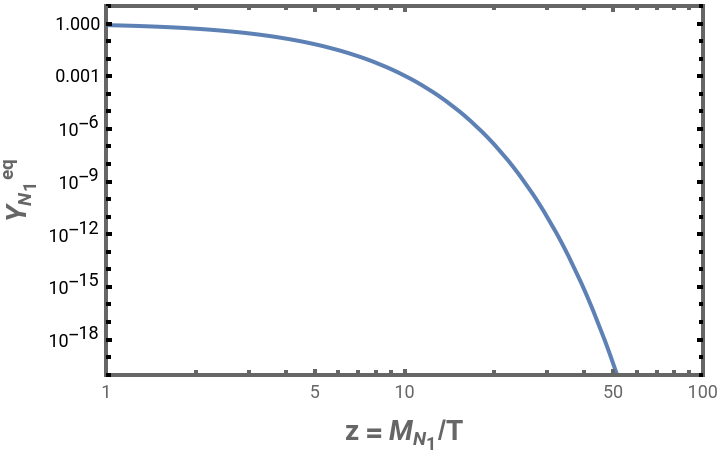
Behaviour of Equilibrium no. density of RHNs:
Behaviour of Equilibrium no. density of RHNs:
In[]:=
MN1=;
11
10
In[]:=
LogLogPlotYN1eq[z]YN1eq[0.01],{z,0.01,100},PlotRange{{1,100},{,10}},FrameAutomatic,FrameStyleThick,FrameTicksStyle->{Darker[Black],Thick},FrameLabelStyle"z = /T",Bold,14,Style"",Bold,14
-20
10
M
N
1
eq
Y
N
1
Out[]=
Important: Narrow-width moderate/weak washout approximation(1i case: with parametric form and mass effect of particles due to branching ratio factor(3-coupled differential equations)):
Important: Narrow-width moderate/weak washout approximation(1i case: with parametric form and mass effect of particles due to branching ratio factor(3-coupled differential equations)):
Plotting:
Plotting:
Washout Effects
Washout Effects
Weak-Weak Regime:
Weak-Weak Regime:
Combining Graphics
Combining Graphics
Notes
Notes
◼
Please feel free to contact me over utkarshp@iitbhilai.ac.in for any issues/queries or discussions surrounding this notebook's work. Also, please cite this work if you find these codes useful for your study. Also, I will keep updating the notebook with newer results and more efficient codes.
CITE THIS NOTEBOOK
CITE THIS NOTEBOOK
Solutions of Boltzmann Equations for the case of Thermal Leptogenesis in 2 simplified scenarios
by Utkarsh Patel
Wolfram Community, STAFF PICKS, April 25, 2024
https://community.wolfram.com/groups/-/m/t/3164323
by Utkarsh Patel
Wolfram Community, STAFF PICKS, April 25, 2024
https://community.wolfram.com/groups/-/m/t/3164323