Dynamics of the circumcenter map over triangles
Authors: Dan Reznik and Ronaldo Garcia
Date: April 1, 2021.
Authors: Dan Reznik and Ronaldo Garcia
Date: April 1, 2021.
Introduction
Introduction
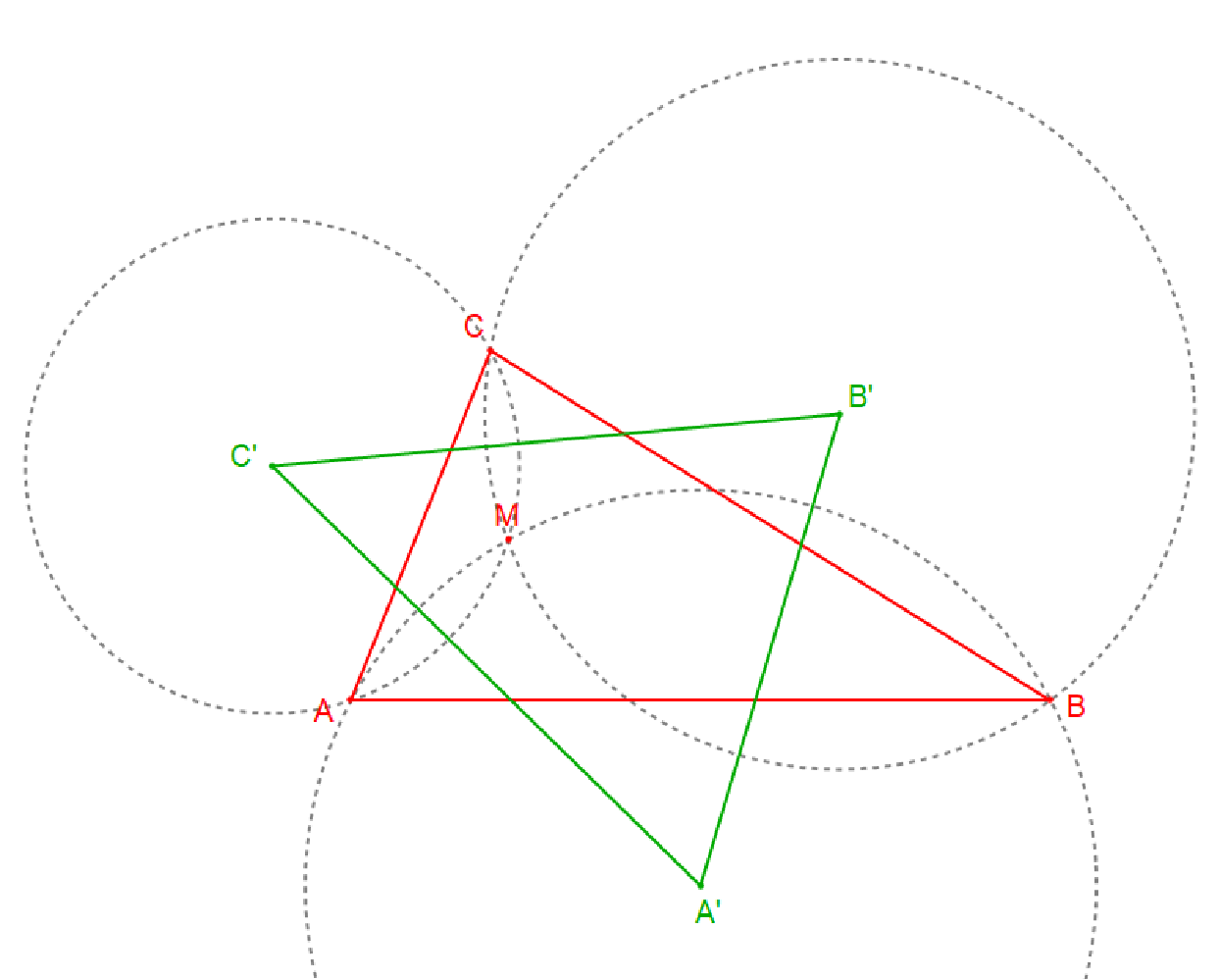
Given a triangle T=ABC (red below) and a point M, consider the “circumcenter map” which sends T to a new triangle T’ (green below) with vertices A’,B’,C’ at the circumcenters of MBC, MCA, MAB, respectively:
Here we explore properties of recursive applications of this map.
Related Work
Related Work
We have been inspired by ideas in two papers:
(i) S. Tabachnikov and E. Tsukerman, "Remarks on the Circumcenter of Mass", Arnold Mathematical Journal volume 1, pp. 101–112, 2015
(ii) V. Ovsienko, R. Schwartz & S. Tabachnikov, "The Pentagram Map: A Discrete Integrable System", Comm. in Math. Physics, vol 299, 2010.
In (i) a special point in an N - gon known as the "circumcenter of mass" is described, corresponding to the weighted average of circumcenters of an arbitrary triangulation of the polygon, where weights are the areas of each triangle. Amazingly, the circumcenter - of - mass is independent of the triangulation chosen.
In (ii) one learns about properties of the "Pentagram Map" which sends one generic N-gon to another one with vertices along intersections of diagonals. Amazingly, every two applications of this map yields the identity modulo homotheties.
Code Initialization
Code Initialization
The Circumcenter Map
The Circumcenter Map
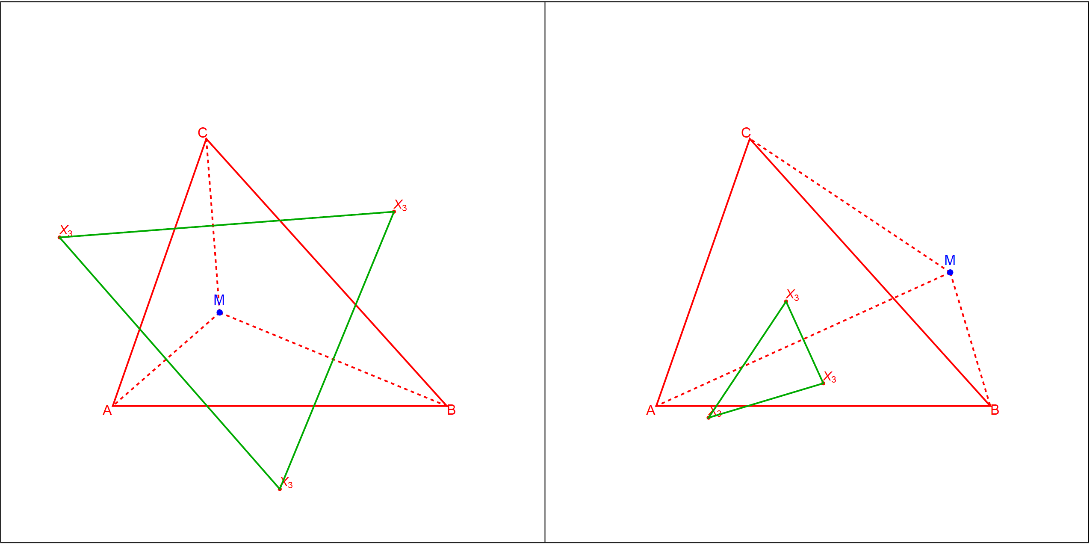
Consider a general triangle T=ABC (red below) and a point M anywhere on its plane. Now construct a “first generation” triangle T’=A’B’C’ (green below) whose vertices are the circumcenters of each of the three subtriangles MBC,MCA,MAB. Below we show an M interior (left), and exterior (right) to T.
X
3
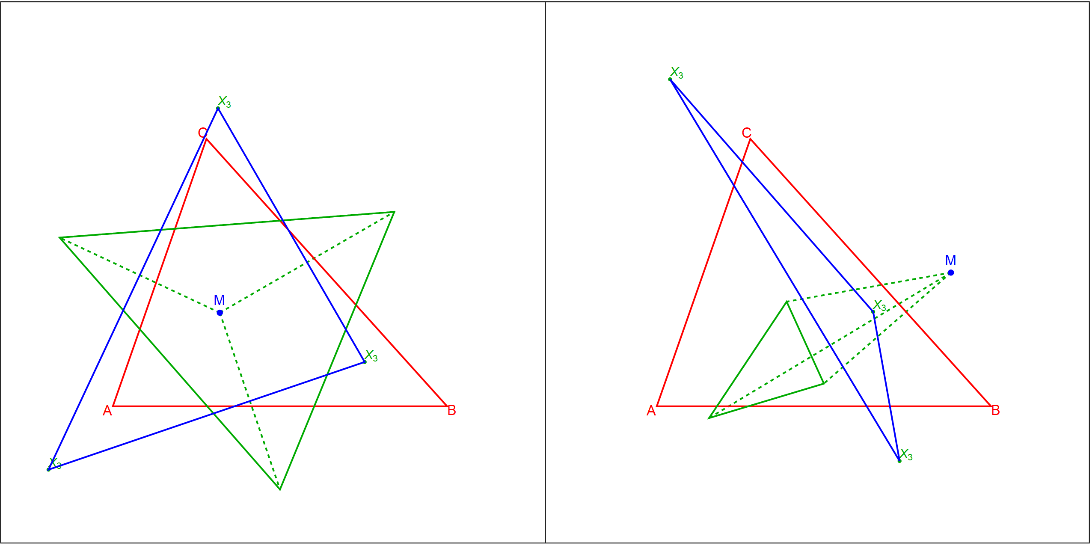
Repeat the above map now departing from T’, i.e., construct a “2nd gen” triangle T’’=A’’B’’C’’ (blue below) whose vertices are the circumcenters of MB’C’,MC’A’,MA’B’ of the 3 subtriangles of T’. Notice T,T’, and T’’ (red,green,blue) are dissimilar triangles both for M interior (left) and exterior (right) to T.
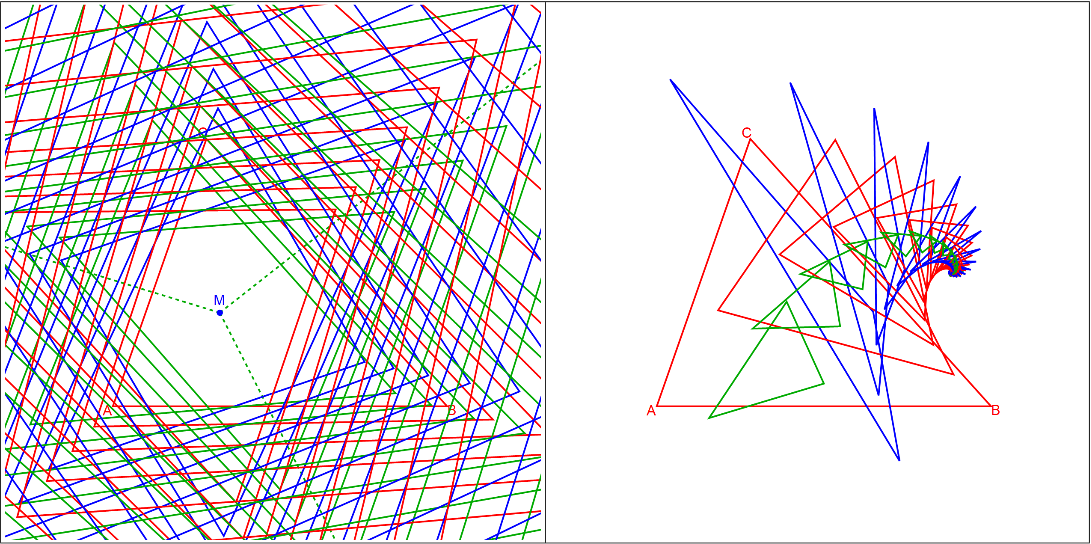
A surprise happens when one reapplies the map 3 further steps. Namely, the next 3 triangles are similar to the former 3:
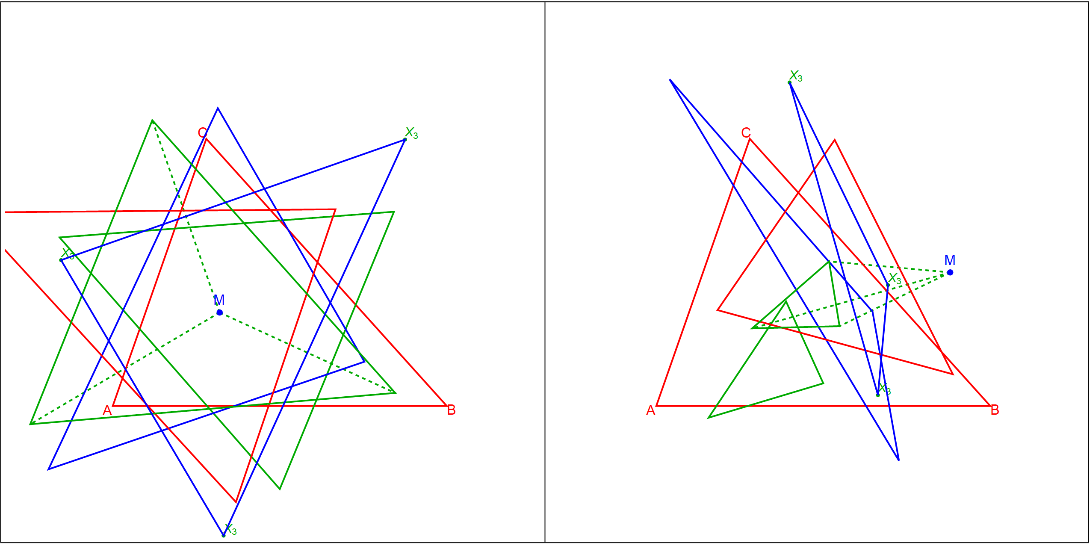
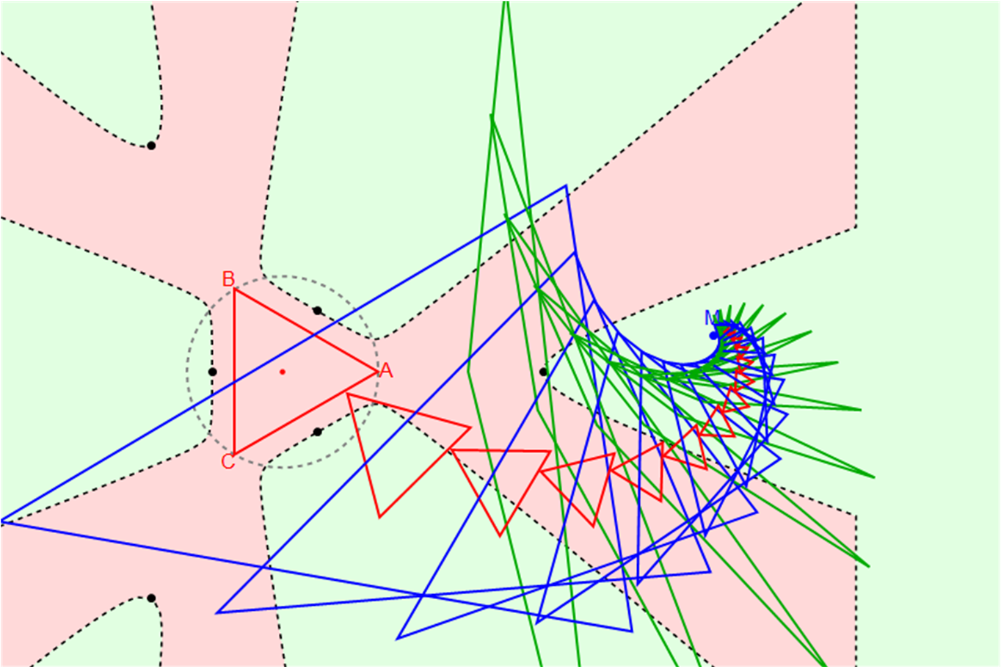
In fact, if the iteration is carried out indefinitely, the sequence will become diverging on the first case (left) and converging toward M on the second case (right):
Convergence / Divergence Regions
Convergence / Divergence Regions
We can compute regions of convergence (green) and divergence (red) over choices of M. Indeed, a point is in the former (resp. latter) region if the scaling factor from step i to step i+3 in the map is less (resp. more) than one (in Mathematica this can be rendered with RegionPlot[]). At the interface, the scaling rate is exactly 1 and the series is stable. The six black dots a shown at critical points (knees) of the interface are explained further down.
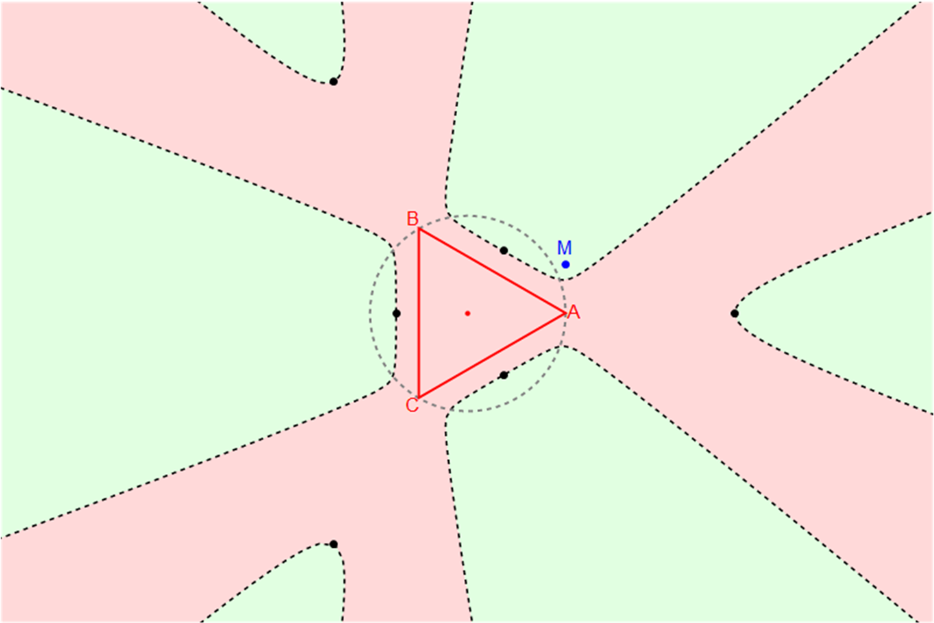
Here is a converging sequence when M is on the left hand side green region :
When M is on the boundary between converging and diverging regions, the shapes neither converge nor diverge. For example:
Six Critical Points
Six Critical Points
Consider the six critical points labeled below P,Q,R for the “outer” triad, and P’,Q’,R’ for the “inner” one. When M on either one of them, interesting things happen (namely, no rotation nor scaling after 3 applications of the map). Notice occur at points of closest proximity of each convergin zone (green) to the centroid of the equilateral. Let L be the side of the equilateral. Then A={L/Sqrt[3],0}, P=A+{L,0}, and P’=A-{L,0}. Q,R and Q’,R’ are rotated copies of P and Q respectively.
When M is on P or P’, the iteration is a succession of 3 “canonical” triangles below.
And when M is at the centroid of the equilateral, one gets a 2-periodic containing only two triangles in "star of david" formation
Extending this to Polygons
Extending this to Polygons
It turns out if instead of departing from triangle we depart from a generic N-gon (regular or not), the circumcenter map is N-periodic, and the sequence will contains N distinct polygons. Below we illustrate this for regular N=4,5,6,7. Successive regular polygons are shown filled with light red.
The zones of convergence (green) and divergence (red) when the N-gon is regular for N=3,4,5,6 look like this :
Video and Open Questions (we welcome help!)
Video and Open Questions (we welcome help!)
A Youtube video of these phenomena is available here: https://youtu.be/y6F8SmA67pw
- why is the circumcenter map 3-periodic for triangles, and N-periodic for N-gons?
- why N applications of it are equivalent to a global rotation + scaling wrt M
- what kinds of curves are the interfaces between converging and diverging regions for N>3
- how many critical points are there for N>3, and where are they? what are their properties?
- are there any quantities conserved over a single application of the circumcenter map?
Interactive Manipulate App
Interactive Manipulate App
Please make sure to include the file “neutralBoundaryX3.mx” in the same folder with this notebook for the following code to work