Fractal Curves Generated by Fourier Series
Fractal Curves Generated by Fourier Series


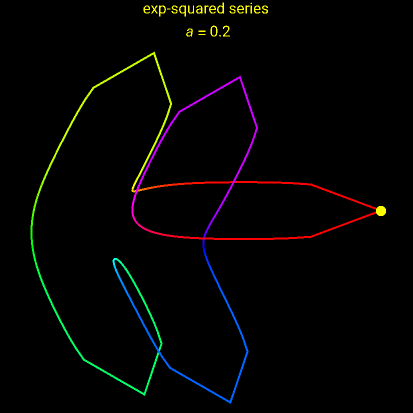
Given a sequence of coefficients , , write the Fourier series . For , the plot of traces out a closed curve in the complex plane. This Demonstration shows this curve for some selected choices of the coefficients .
f(n)
n=1,2,…
F(t)=f(n)
∞
∑
n=1
1
n
2πint
e
t∈[0,1]
F(t)
f(n)
Details
Details
This Demonstration is inspired by a 1995 paper by J. Bohman and C.-E. Fröberg[1] investigating the Fourier series
F(t)=
∞
∑
n=1
f(n)
2πint
e
n
for various classes of oscillating coefficients . In many cases, they observed remarkable fractal-like patterns in the plots of . More recent work by E. Kowalski and W. F. Sawin[2] examines the behavior of series of this type from a probabilistic point of view. Their work sheds some light on the peculiar shape of the curve traced out by when the coefficients are given by the Möbius function.
f(n)
F(t)
F(t)
f(n)
This Demonstration shows the closed curve in the complex plane traced out by as ranges from 0 to 1 for the following coefficient sequences :
F(t)
t
f(n)
Möbius: , where is the Möbius function.
f(n)μ(n)
μ(n)
Jacobi symbol: , where the modulus is a prime in the range , selected randomly. Use the "randomize modulus" button to generate a new randomization.
f(n)
n
m
m
2≤m≤20000
Exp-squared: , in which you set the parameter in the range . Of particular interest is the behavior of the associated Fourier series in the case when the parameter is close to a rational number with a small denominator. To study this behavior, this Demonstration offers a list of predefined rational values for . Use the "perturbation" slider to perturb the parameter over a narrow range.
f(n)
2πia
2
n
e
a
0≤a≤3
F(t)
a
a
a
Sine-squared: , for selected parameter .
f(n)sin(a)
2
n
a
Fractional part: , for selected parameter . The braces denote the fractional part.
f(n)
an
a
Tangent: , for selected parameter .
f(n)tan(an)/n
a
randomize coefficients: is selected randomly, with uniform probability, from . Use the "randomize coefficients" button to generate a new randomization.
f(n)
{-1,0,1}
Implementation Notes
This Demonstration uses the built-in Mathematica function Fourier, which, given a list of complex numbers, outputs the discrete Fourier transform of this list. Applying this function to the list ,n=1,…,N, we obtain an approximation to the Fourier series , sampled at equally spaced points . The path shown in this Demonstration is the polygonal path through these sampled points. Use the "terms" control to select the truncation value . Larger values provide a more accurate approximation to the true path of , while smaller values lead to smoother animations of these paths.
N
f(n)
n
F(t)
N
t
N
N
F(t)
Snapshot 1: Exp-squared series, with and steps to show more detail. Changing the perturbation will vary the size, shape and position of the fractal-like patterns.
a=0.001437
10000
Snapshot 2: Sine-squared series, with and steps. Showing more steps will show more detail, and changing the perturbation will vary the size, shape and position of the fractal-like patterns.
a=0.529914
5000
Snapshot 3: Tangent series, with and steps. Changing the perturbation will vary the size of the fractal-like patterns, from points to circles that almost fill the entire shape.
a=1.31302
5000
References
References
[1] J. Bohman and C.-E. Föberg, "Heuristic Investigation of Chaotic Mapping Producing Fractal Objects," BIT Numerical Mathematics, 35, 1995 pp. 609–615. doi:10.1007/BF01739831.
[2] E. Kowalski and W. F. Sawin, "Kloosterman Paths and the Shape of Exponential Sums," Compositio Mathematica, 152(7), 2016 pp. 1489–1516. doi:10.1112/S0010437X16007351.
External Links
External Links
Permanent Citation
Permanent Citation
Nick Kokkines, Andre Park, Efstathios Konstantinos Chrontsios Garitsis, A. J. Hildebrand
"Fractal Curves Generated by Fourier Series"
http://demonstrations.wolfram.com/FractalCurvesGeneratedByFourierSeries/
Wolfram Demonstrations Project
Published: March 22, 2022