I have always cooked with electric appliances, until my recent move to a home with a gas-powered cooktop and oven. It’s been a learning curve for me, especially when aiming for that golden brown crust in baking. Using the new formulas available in Wolfram|Alpha, I decided to get answers to my questions about cooking and baking with electricity versus gas. Also, does it really help reduce my electric bill to clean out my refrigerator and freezer each week?
How much energy is used to roast a chicken?
How much energy is used to roast a chicken?
In this example, I am roasting a 1.5 kg whole chicken in the oven at 180°C (356°F) for 1 hour and 20 minutes (after preheating). The oven starts at room temperature of 20°C (68°F). The uncooked chicken has been in the refrigerator at 4°C (39-40°F), and I want the final internal cooked temperature to reach 74°C (165°F). I use an average heat capacity for chicken, then check the energy used by an electric oven:
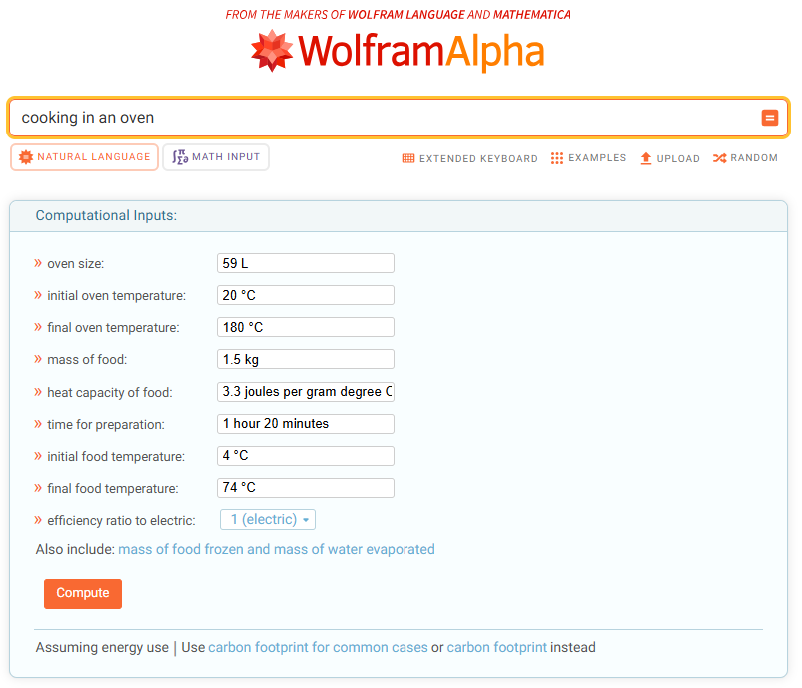
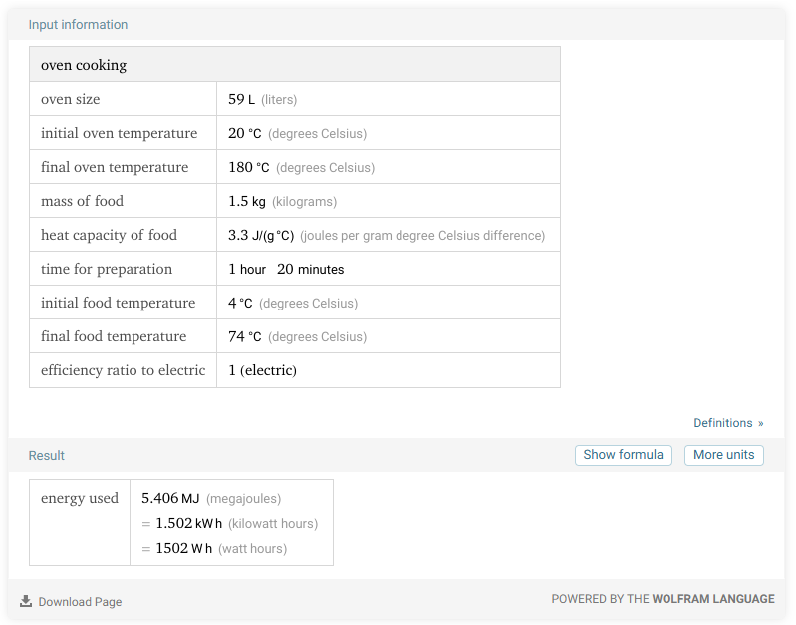
Wolfram|Alpha tells me that 5.4 megajoules (MJ) of energy are used to roast the chicken. Next, I check the energy used for the same food in a gas oven:
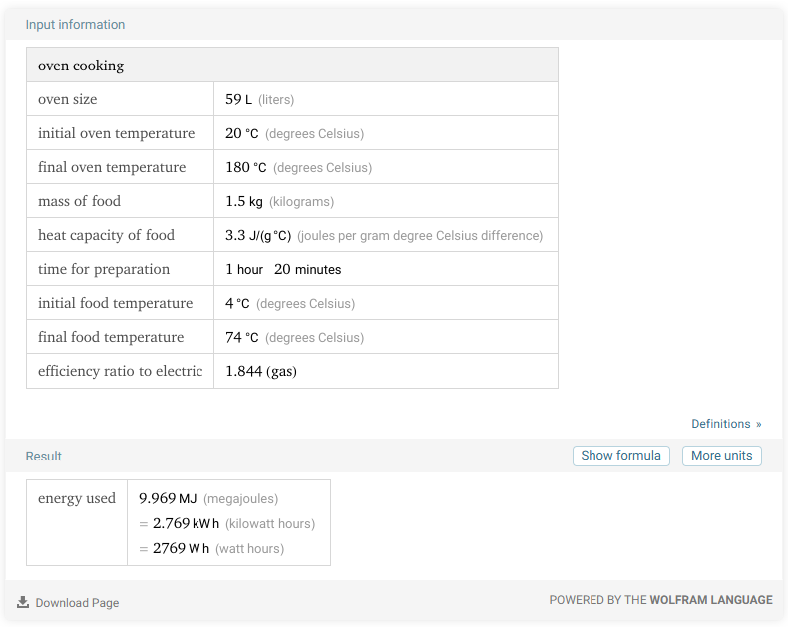
The energy used has almost doubled, from 5.4 to 10 MJ. This was expected, as shown by the gas efficiency ratio to electric of 1.844:1. This efficiency factor was derived by the U.S. Department of Energy. For every unit of energy used by an electric oven, a gas oven needs approximately 1.844 units of energy to do the same job, making electric ovens more efficient at converting energy into heat.
A note about oven size:
The capacity of ovens, refrigerators and freezers is measured in cubic feet in North America. Liter is the measurement commonly used in other regions globally.
The Wolfram|Alpha formula for energy used is based on a research study that utilized ovens with internal capacities of 23 to 59 liters. Use the following functions to convert liters to cubic feet and vice versa:
In[]:=
litersToCubicFeet[liters_]:=NumberForm[UnitConvert[Quantity[liters,"Liters"],"Feet"^3]//N,{Infinity,2}]cubicFeetToLiters[cubicFeet_]:=NumberForm[UnitConvert[Quantity[cubicFeet,"Feet"^3],"Liters"]//N,{Infinity,2}]litersToCubicFeet[59]
Out[]//NumberForm=
How does the carbon footprint compare between electric and gas ovens?
How does the carbon footprint compare between electric and gas ovens?
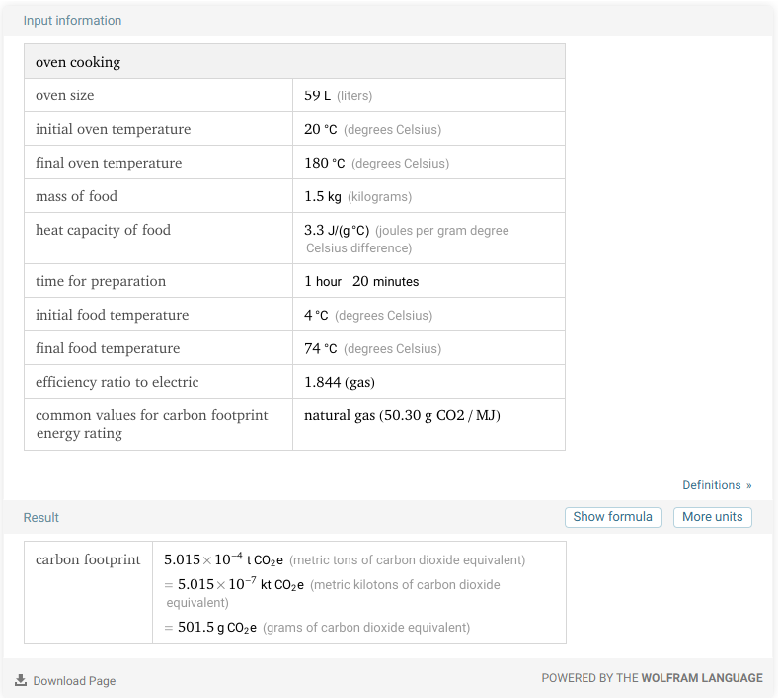
I next discovered above that, although electric ovens are more energy-efficient than gas, gas-powered ovens tend to have a lower carbon footprint than electric. In my roast chicken example, the electric oven left a carbon footprint of 684 grams of carbon dioxide equivalent (CO₂e), compared with 501 grams for the gas oven:
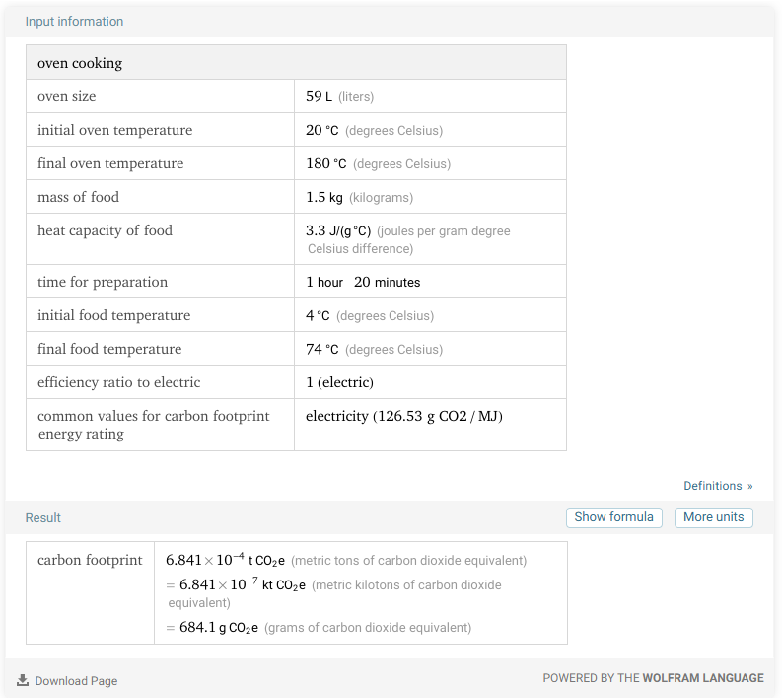
Why is this? Gas ovens can have a lower carbon footprint because natural gas tends to have lower emissions compared to the burning of other fossil fuels sometimes used to generate electricity.
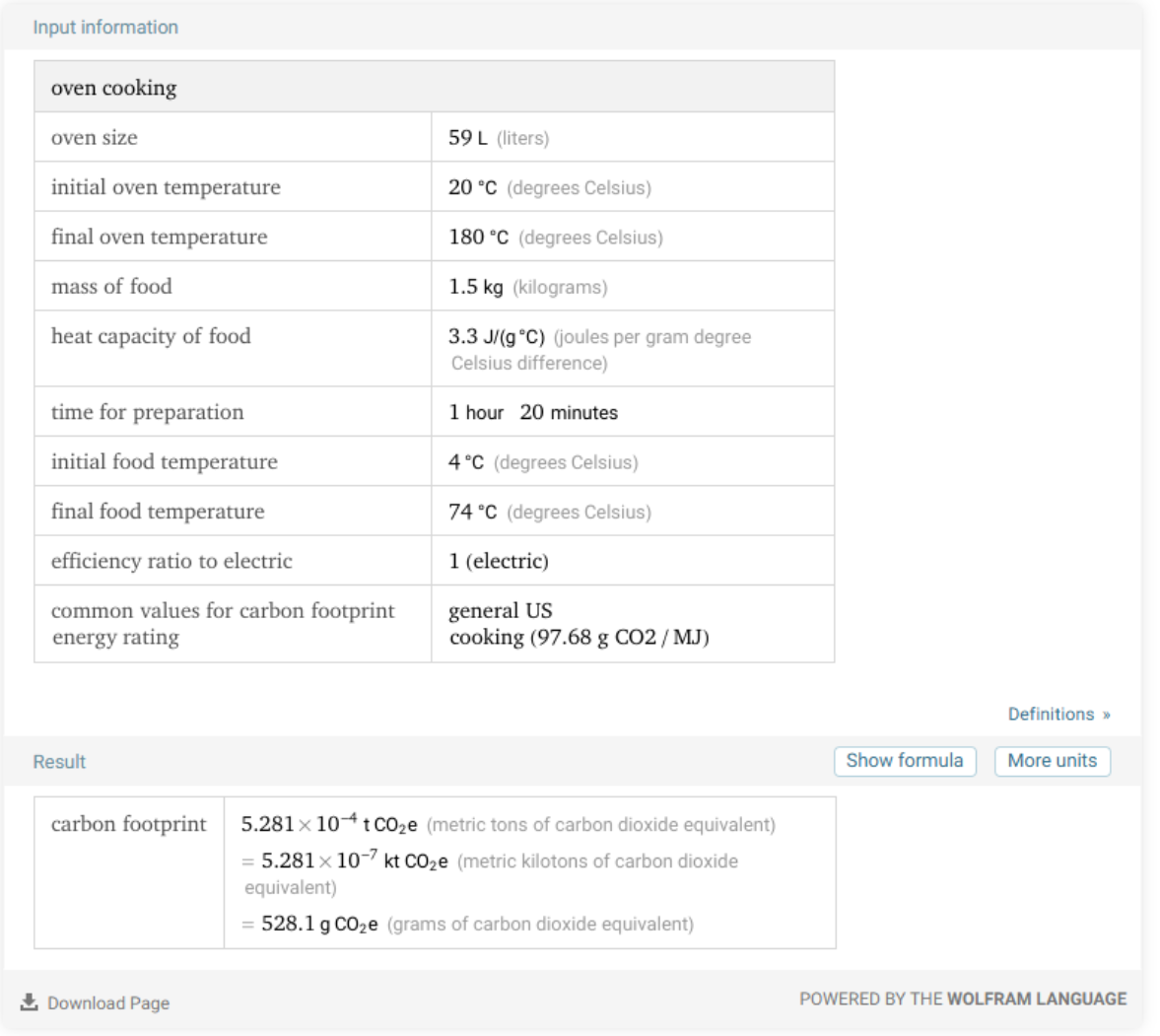
It was interesting to look at the carbon footprint of general U.S. cooking, which includes all energy sources. As expected, it was between the electric and natural gas carbon footprint results, coming in at 528g CO₂e. This value is based on the carbon footprint energy rating published in 2018 by the U.S. Energy Information Administration (EIA) and the U.S. Environmental Protection Agency (EPA). At that time, 61% percent of U.S. residences used electric stoves, 33% used natural gas stoves, 5% used propane, and 1% used a mix of propane and natural gas. The most recent figures published by the EIA (for 2020) show only small changes in the mix: 59% electric, 32% natural gas, 4% propane and 5% dual fuel.
It was interesting to look at the carbon footprint of general U.S. cooking, which includes all energy sources. As expected, it was between the electric and natural gas carbon footprint results, coming in at 528g CO₂e. This value is based on the carbon footprint energy rating published in 2018 by the U.S. Energy Information Administration (EIA) and the U.S. Environmental Protection Agency (EPA). At that time, 61% percent of U.S. residences used electric stoves, 33% used natural gas stoves, 5% used propane, and 1% used a mix of propane and natural gas. The most recent figures published by the EIA (for 2020) show only small changes in the mix: 59% electric, 32% natural gas, 4% propane and 5% dual fuel.
Although the proportion of homes using electric versus gas-powered appliances has remained about the same, I was curious if there has been much change in the mix of U.S. electricity sources since 2018. Coal has dropped 11%, and petroleum has dropped by almost 1%. Natural gas usage is up 8%, and renewable energy use is up 4%. Nuclear energy use has remained steady.
How do these results compare with other sources of carbon emissions? Using the electric oven carbon footprint of 684g CO₂e for roast chicken, I checked Wolfram|Alpha for a comparison to carbon emissions while driving. Based on the average fuel economy for U.S. mid-sized cars (24 mpg), I would drive almost two miles. But in Europe, I would drive almost three miles, assuming a 35 mpg average:
How do these results compare with other sources of carbon emissions? Using the electric oven carbon footprint of 684g CO₂e for roast chicken, I checked Wolfram|Alpha for a comparison to carbon emissions while driving. Based on the average fuel economy for U.S. mid-sized cars (24 mpg), I would drive almost two miles. But in Europe, I would drive almost three miles, assuming a 35 mpg average:
Does a cast iron skillet or an aluminum pan use more energy?
Does a cast iron skillet or an aluminum pan use more energy?
Cast iron cooking has regained popularity among home cooks. It’s good to see these durable skillets, passed down from generation to generation, back in action. I’m cooking more often in cast iron myself, so I was curious to see the energy it uses compared with a lighter-weight aluminum pan.
For the cast iron calculation, I used the mass of a 10-inch, 4.5-lb. cast iron skillet with a 7.5-inch diameter cooking surface area. I asked Wolfram|Alpha to calculate the energy used to fry 1/4 lb. of refrigerated bacon, using an average heat capacity for bacon, for 10 minutes on an electric cooktop. Then I asked for the same calculation, but with an aluminum pan. The Wolfram|Alpha formula factors in both the energy used to heat up the pan to frying temperature and the energy used to maintain the temperature during frying.
For the cast iron calculation, I used the mass of a 10-inch, 4.5-lb. cast iron skillet with a 7.5-inch diameter cooking surface area. I asked Wolfram|Alpha to calculate the energy used to fry 1/4 lb. of refrigerated bacon, using an average heat capacity for bacon, for 10 minutes on an electric cooktop. Then I asked for the same calculation, but with an aluminum pan. The Wolfram|Alpha formula factors in both the energy used to heat up the pan to frying temperature and the energy used to maintain the temperature during frying.
For the aluminum pan calculation, I used the same usable cooking area and the weight of an average 10-inch aluminum nonstick fry pan:
It takes 1.9 MJ of heat to cause a temperature change to 320°F in a 4.5 lb. cast iron skillet, and it also takes 1.9 MJ of heat for a 2 lb. aluminum pan. Why is the amount of energy similar for these two pans when their respective materials and heat capacities are so different? Although cast iron has a lower specific heat capacity than aluminum, the cast iron skillet has a much greater mass to heat than the aluminum pan. As a result, the energy used to heat each pan to the same temperature is approximately equivalent.
Does cleaning out my fridge help lower my energy use?
Does cleaning out my fridge help lower my energy use?
Circling back to my original question about whether it pays to clean out my refrigerator each week (besides the food safety benefits of not eating spoiled food), I asked Wolfram|Alpha about refrigerating 1 gallon of milk for 7 days.
The cold storage formulas in Wolfram|Alpha account for several variables: the internal capacity (volume) of the refrigerator or freezer cabinet (liters); how long the food will be stored (days); the volume of the food product to be refrigerated or frozen (liters), including its packaging; the volume of all other foods already in the cabinet (liters); the mass of only the food itself (kilograms); the water content of the food (as a percentage); and the initial and final temperatures of the food. The USDA recommends refrigerators be set to maintain a temperature of 40°F (4-5°C) or below.
The cold storage formulas in Wolfram|Alpha account for several variables: the internal capacity (volume) of the refrigerator or freezer cabinet (liters); how long the food will be stored (days); the volume of the food product to be refrigerated or frozen (liters), including its packaging; the volume of all other foods already in the cabinet (liters); the mass of only the food itself (kilograms); the water content of the food (as a percentage); and the initial and final temperatures of the food. The USDA recommends refrigerators be set to maintain a temperature of 40°F (4-5°C) or below.
A note about volume of cabinet:
The Wolfram|Alpha formulas for cold storage are based on a research study that utilized refrigerators with maximum internal capacities of 500 liters.
The Wolfram|Alpha formulas for cold storage are based on a research study that utilized refrigerators with maximum internal capacities of 500 liters.
The results showed that, for refrigerating that gallon of milk over the relative short term (7 days), it does not make a big difference in energy used whether I have an almost-empty fridge (20L) or a fuller fridge (380L). But it was surprising to see that the fuller refrigerator shows a slightly lower amount of energy used. We’ll explore the reason for that next while freezing some blueberries.
Should I throw out those mystery foods in the back of my freezer?
Should I throw out those mystery foods in the back of my freezer?
Perhaps. They may no longer be appetizing to eat, but they may still serve a purpose. I asked Wolfram|Alpha to calculate the energy used to freeze 130 grams of fresh blueberries for 30 days, with the freezer fairly empty at first and then mostly full. I have added the weight of a reusable silicone food storage bag, since the value for volume of product should include the food’s packaging, and used the average heat capacity of blueberries. Per the USDA, freezers should be set to maintain a temperature of 0°F (-18°C) or below.
In this case, the difference in energy used is clear. It takes more energy to keep the blueberries frozen for a month in an almost-empty freezer (1.3 MJ) than it does in a fuller freezer (369 kJ).
What’s the explanation? An empty freezer holds a large amount of air, and air is a poor insulator. Every time someone opens the freezer door, the cold air escapes and is replaced by warmer air from the room. The freezer has to work harder to cool down the new, warmer air. But the other frozen foods help buffer the internal temperature when the door is opened, reducing the work of the freezer to keep things cold.
So, for energy efficiency, you can keep those mystery foods in the back of the freezer (but don’t eat them), or fill the empty freezer spaces with containers of water, to help maintain a stable temperature and reduce the freezer’s workload and energy use.
More Wolfram|Alpha formulas
More Wolfram|Alpha formulas
◼
Boiling in water
◼
Caloric content by food mass
◼
Heating of water in an electric kettle
◼
Microwave cooking
Sources
Sources
◼
◼
“Energy for Preparation and Storing of Food: Models for calculation of energy use for cooking and cold storage in households,” Swedish University of Agricultural Sciences (SLU) and MISTRA, The Foundation for Strategic Environmental Research, 2003.
◼
◼
“Freezing and Food Safety,” Food Safety and Inspection Service, U.S. Department of Agriculture (USDA)
◼
“Refrigeration & Food Safety,” Food Safety and Inspection Service, U.S. Department of Agriculture (USDA)
◼
“What is U.S. electricity generation by energy source?,” U.S. Energy Information Administration (EIA)
CITE THIS NOTEBOOK
CITE THIS NOTEBOOK
Energy use and carbon footprint in cooking and cold storage
by Gay Wilson
Wolfram Community, STAFF PICKS, December 30, 2024
https://community.wolfram.com/groups/-/m/t/3347029
by Gay Wilson
Wolfram Community, STAFF PICKS, December 30, 2024
https://community.wolfram.com/groups/-/m/t/3347029