ABSTRACT (original thesis): In order to use quantum devices for computations, it is necessary to understand the intricacies of the theoretical description. To this end, we provide several novel constructions useful for the comprehension of quantum mechanics from the perspective of mappings and designs. The unistochasticity problem, which relates the classical and the quantum domain, is solved in specific cases, e.g. for all matrices of dimension 4. Furthermore, we provide an explicit formula for entangling power in the multipartite case. Most importantly, the thesis presents and elaborates on the path that lead to the recent construction of absolutely maximally entangled state of four subsystems six levels each. Finally, we study cardinality as a measure of “quantumness” of quantum Latin squares and quantum Sudoku (SudoQ). Arrays of the highest cardinality yield families of quantum measurements of special properties. A connection between SudoQ designs and mutually unbiased bases is demonstrated. CITATION (original thesis): Grzegorz Rajchel-Mieldzioć (2022), Quantum mappings and designs, arXiv:2204.13008v1. https://doi.org/10.48550/arXiv.2204.13008. CITATION (original article): Suhail Ahmad Rather, Adam Burchardt, Wojciech Bruzda, Grzegorz Rajchel-Mieldzioć, Arul Lakshminarayan, Karol Życzkowski (2022), Thirty-six Entangled Officers of Euler: Quantum Solution to a Classically Impossible Problem, Phys. Rev. Lett. 128, 080507. https://doi.org/10.1103/PhysRevLett.128.080507
Introduction
Introduction
Orthogonal Latin squares are combinatorial designs that exist in all dimensions d apart from d=2 and d=6. These arrays are useful in quantum mechanics; namely, their existence leads to the existence of absolutely maximally entangled (AME) states of 4 subsystems of local dimension d. Therefore, one is tempted to assume that for 4 systems of local dimension d=2 (qubits) and d=6 (quhexes), the corresponding maximally entangled states do not exist. This is indeed the case for qubits [Phys. Lett. A 273 (2000), 213-217] but this contribution proves the existence of AME states of 4 quhexes.
In this Mathematica file, we provide an explicit analytical construction of such a state, together with tools that allow one to check all of the necessary conditions. To sum up, quantum orthogonal squares can exist when there are no classical orthogonal squares! For the whole story, read the related paper [Phys. Rev. Lett. 128, 080507 (2022)]. More files available at: https://chaos.if.uj.edu.pl/~karol/Maestro7/data2
In this Mathematica file, we provide an explicit analytical construction of such a state, together with tools that allow one to check all of the necessary conditions. To sum up, quantum orthogonal squares can exist when there are no classical orthogonal squares! For the whole story, read the related paper [Phys. Rev. Lett. 128, 080507 (2022)]. More files available at: https://chaos.if.uj.edu.pl/~karol/Maestro7/data2
Preambule with functions
Preambule with functions
First, the most important functions, i.e. reshuffle and partial transpose, taken from qi package https://zksi.iitis.pl/wiki/projects:mathematica-qi
Reshuffle[ρ_]:=Block{dim}, dim=Sqrt[Length[ρ]]; IfAnd[SquareMatrixQ[ρ],IntegerQ[dim]], Reshuffle[ρ,{{dim,dim},{dim,dim}}] (*else*), Message[Reshuffle::argerr] Reshuffle::argerr="Reshuffle works only for square matrices of dimension \!\(\*SuperscriptBox[\"d\", \"2\"]\)×\!\(\*SuperscriptBox[\"d\", \"2\"]\), \where d is an Integer, for other dimensions use ReshuffleGeneral";Reshuffle[A_,{n_,m_}]:=Flatten Table[Flatten[Part[A,1+i1;;n[[2]]+i1,1+i2;;m[[2]]+i2]],{i1,0,n[[1]]n[[2]]-1,n[[2]]},{i2,0,m[[1]]*m[[2]]-1,m[[2]]}],1;PartialTranspose[a_]:=Module[{dim,sdim,temp},dim=Dimensions[a][[1]];sdim=Sqrt[dim];temp=Partition[a,{sdim,sdim}];temp=Map[Transpose,temp,{2}];temp=ArrayFlatten[temp];Return[temp];];
We create swap matrix, which is permutation matrix defined that state {i,j}<->{j,i}.
swapFunction[i_,dim_]:=dimMod[i-1,dim]+1+Floor[(i-1)/dim];swap[dim_]:=Table[If[swapFunction[i,dim]j,1,0],{i,},{j,}];
2
dim
2
dim
Measures of the linear entropy, entangling power and gate typicality of a state, following Clarisse et al., Phys. Rev. A 72, 012314.
These are normalized so that Max[linEntropy] = 1, Max[entPower] = 1, Max[gt] = 1.
These are normalized so that Max[linEntropy] = 1, Max[entPower] = 1, Max[gt] = 1.
linEntropy[A_]:=1-Tr.;entPower[A_]:=Chop@N@linEntropy@Reshuffle[A]+linEntropy@ReshuffleA.swaplinEntropy@Reshuffle[A]-linEntropy@ReshuffleA.swap
Length@A
Length@A-1
A.A
Tr[A.A]
A.A
Tr[A.A]
Length@A
Length@A+1
Length@A
-linEntropy@swapLength@A
;gt[A_]:=Chop@N@1
2
Length@A
+linEntropy@swapLength@A
;Main body with state
Main body with state
AME46=;
Below reshuffled and partially transposed version of the AME (4, 6) state
AME46//Reshuffle;AME46//PartialTranspose;
Below matrices with absolute values depicted
Row[MatrixPlot[#,ImageSize400]&/@Abs/@{AME46,Reshuffle@AME46,PartialTranspose@AME46}]
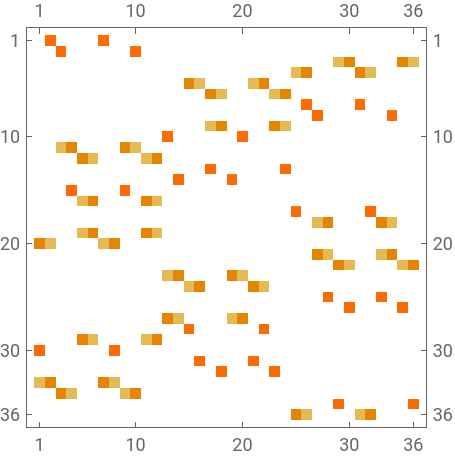
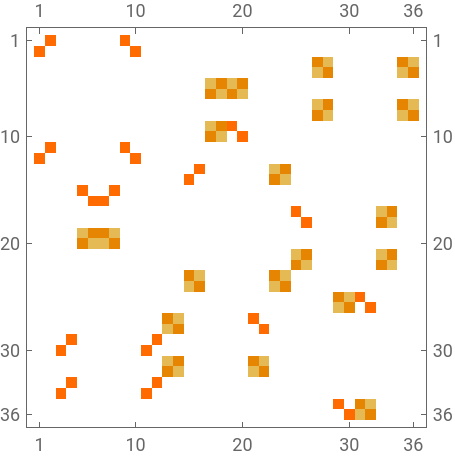
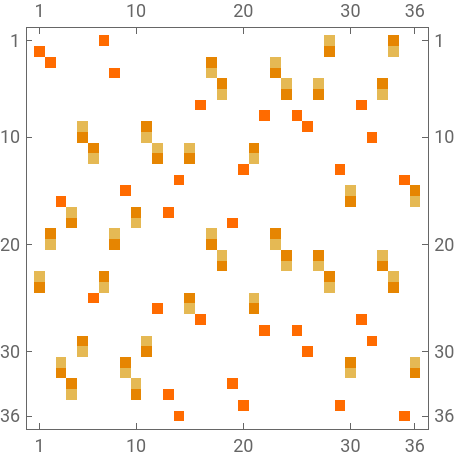
Proof that this is AME(4,6)
Proof that this is AME(4,6)
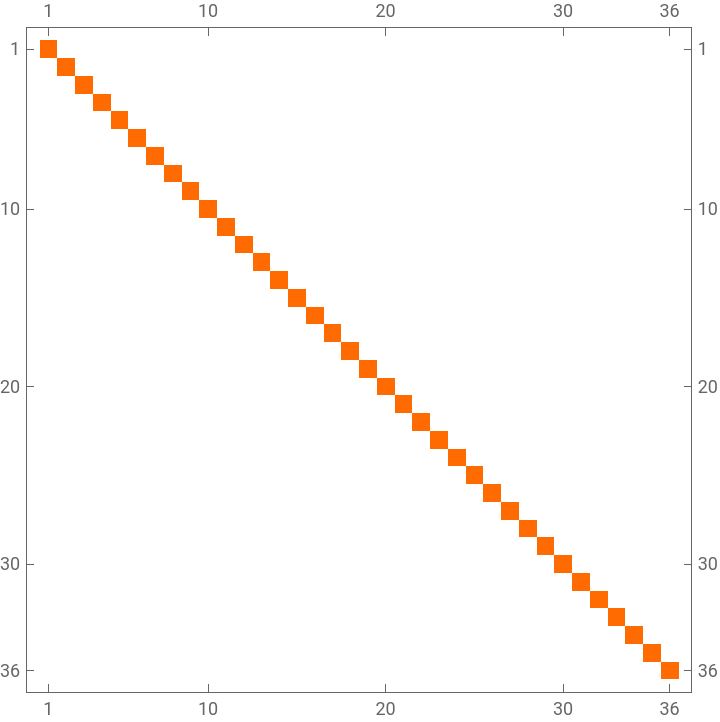
In order to show that our matrix defines an AME state we only need to check the unitarity of the reshuffling, partial transposition and the matrix itself.
Below we present UU, which equals identity in all of these three cases.
Below we present UU, which equals identity in all of these three cases.
MatrixPlot/@(MatrixForm@FullSimplify[#.#]&/@{AME46,Reshuffle@AME46,PartialTranspose@AME46})
Out[]=
,
,
Permutations which bring it to the block-diagonal form
Permutations which bring it to the block-diagonal form
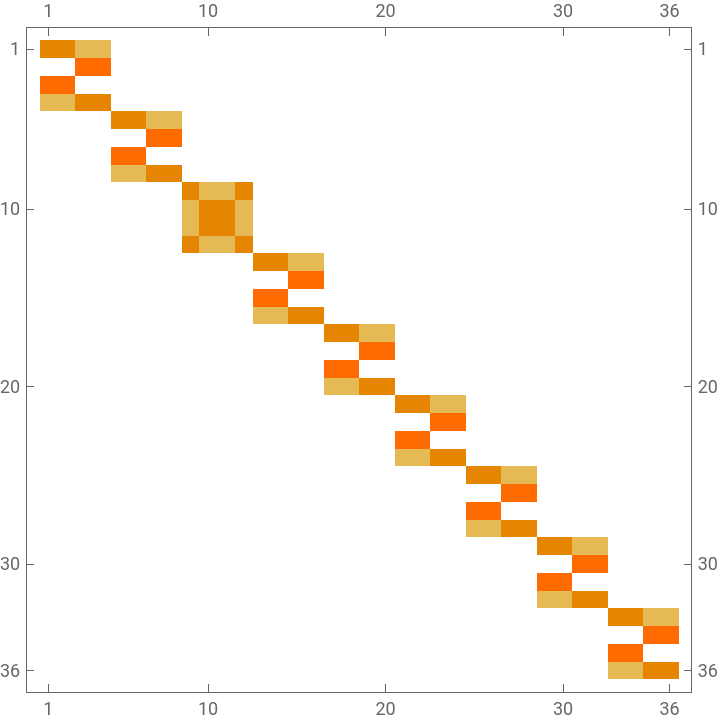
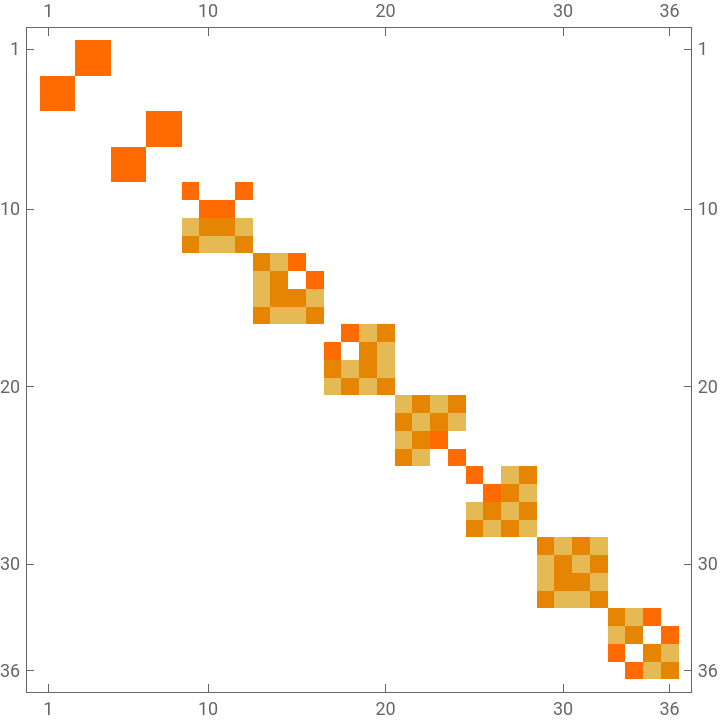
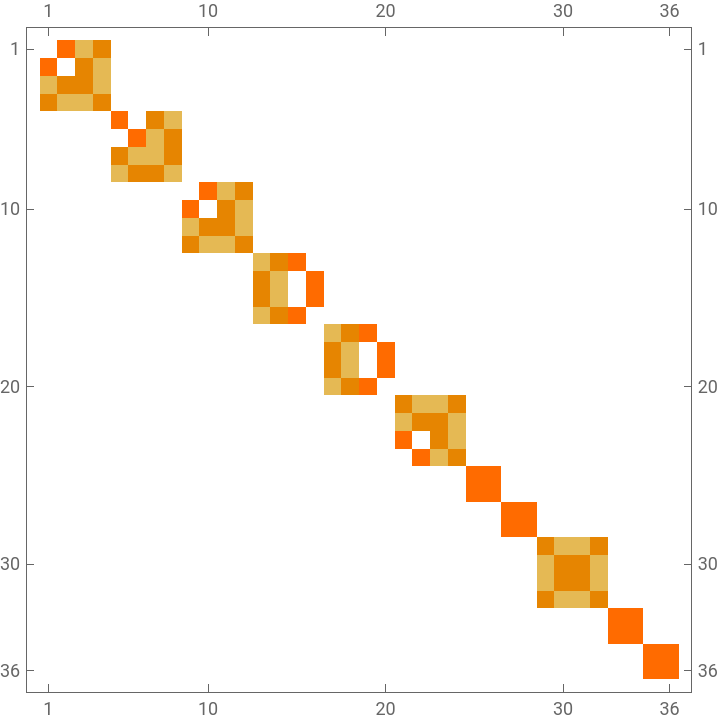
Below we list the permutations which correspond to the diagonalization of AME(4,6)
{rowPerm,colPerm}={{20,1,30,33,34,15,2,11,12,16,19,29,27,14,10,23,5,31,28,24,6,32,13,9,36,7,17,4,21,25,8,18,22,26,35,3},{1,8,7,2,3,10,9,4,5,6,11,12,13,20,19,14,15,22,21,16,17,24,23,18,25,32,31,26,27,34,33,28,29,36,35,30}};AME46〚rowPerm,colPerm〛//Abs//MatrixPlot
{rowPerm,colPerm}={{1,11,2,12,29,33,30,34,15,16,19,20,27,28,31,32,13,14,23,24,5,6,9,10,17,18,21,22,3,4,7,8,25,26,35,36},{1,10,2,9,3,11,4,12,5,6,7,8,13,14,21,22,15,16,23,24,17,18,19,20,25,26,33,34,27,28,35,36,29,30,31,32}};(Reshuffle@AME46)〚rowPerm,colPerm〛//Abs//MatrixPlot
{rowPerm,colPerm}={{1,2,23,24,3,4,19,20,15,16,31,32,17,18,33,34,9,10,29,30,11,12,25,26,14,36,7,27,5,6,21,22,13,35,8,28},{1,7,28,34,2,8,17,23,3,9,30,36,4,10,13,19,5,11,26,32,6,12,15,21,14,35,16,31,18,24,27,33,20,29,22,25}};(PartialTranspose@AME46)〚rowPerm,colPerm〛//Abs//MatrixPlot
Card form of AME(4,6)
Card form of AME(4,6)
Similarly to the description from our paper, we can present the state as an array of cards
Click on the matrix above for higher resolution.
This is precisely the same form of the AME state as in the Fig. 2 of the “36 entangled officers of Euler” paper.
Quantum AME state
Quantum AME state
Additional matrices and the history of finding
Additional matrices and the history of finding
Best permutation matrix as of Clarisse et al.
Best permutation matrix as of Clarisse et al.
Improved matrices by Wojciech Bruzda and Arul Lakshminarayan
Improved matrices by Wojciech Bruzda and Arul Lakshminarayan
Extension beyond the line by Wojciech Bruzda and Grzegorz Rajchel-Mieldzioc
Extension beyond the line by Wojciech Bruzda and Grzegorz Rajchel-Mieldzioc
Matrix, which has the highest entPower, which is at the corner of the elipse, has the following form:
Original numerical AME by Suhail Ahmad Rather from VII 2020
Original numerical AME by Suhail Ahmad Rather from VII 2020
Another AME was sent in the email from 23 IX 2020, more specifically the seed for it
From this stems ameNew
CITE THIS NOTEBOOK
CITE THIS NOTEBOOK
Quantum mappings and designs
by Grzegorz Rajchel-Mieldzioć
Wolfram Community, STAFF PICKS, April 18, 2024
https://community.wolfram.com/groups/-/m/t/3160370
by Grzegorz Rajchel-Mieldzioć
Wolfram Community, STAFF PICKS, April 18, 2024
https://community.wolfram.com/groups/-/m/t/3160370