Although it’s not going to get as much media attention as the total solar eclipse that crossed the United States earlier this year, this eclipse is interesting for a different reason... it’s an annular eclipse. This means the Moon will pass directly in front of the Sun, but because it’s so far away from Earth, it will appear smaller than the Sun and a ring of the Sun, an annulus, will be visible. Make sure to wear your eclipse glasses to avoid damage to your eyes!
All dates in this notebook will be reported for time zone -5, our local time zone here in Champaign, not the time zone of the locations of observation. Time zones can be easily changed with the function TimeZoneConvert, if needed.
Let’s start by asking SolarEclipse when there will be the next solar eclipse:
In[]:=
eclipse=SolarEclipse[]
Out[]=
Global properties
Global properties
This eclipse will be an annular eclipse:
SolarEclipse[eclipse,"Type"]
The maximal eclipse (the instant and location when the center of the shadow o the Moon will be closest to the center of the Sun) will be:
SolarEclipse[eclipse,"MaximumEclipseDate"]
SolarEclipse[eclipse,"MaximumEclipsePosition"]
GeoPosition[{-21.9526,-114.519}]
At that moment, the Moon will cover a bit more than 93% of the diameter of the Sun as observed from the maximal eclipse location:
SolarEclipse[eclipse,"MaximumEclipseMagnitude"]
0.933371
This corresponds to covering 87% of the Sun disk at most, so eclipse glasses will be required at all times:
SolarEclipse[eclipse,"MaximumEclipseObscuration"]
0.871181
The maximal location is 35% down to the South Pole from the equator on the orthographic view of the Earth:
SolarEclipse[eclipse,"Gamma"]
-0.350867
The duration of the annularity phase will be more than 7 minutes at the maximum eclipse location:
In[]:=
SolarEclipse["MaximumEclipseUmbraDuration"]
Out[]=
The eclipse can be identified in the set of all solar eclipses with these two indices:
SolarEclipse[eclipse,"SarosSeries"]
144
SolarEclipse[eclipse,"InexSeries"]
63
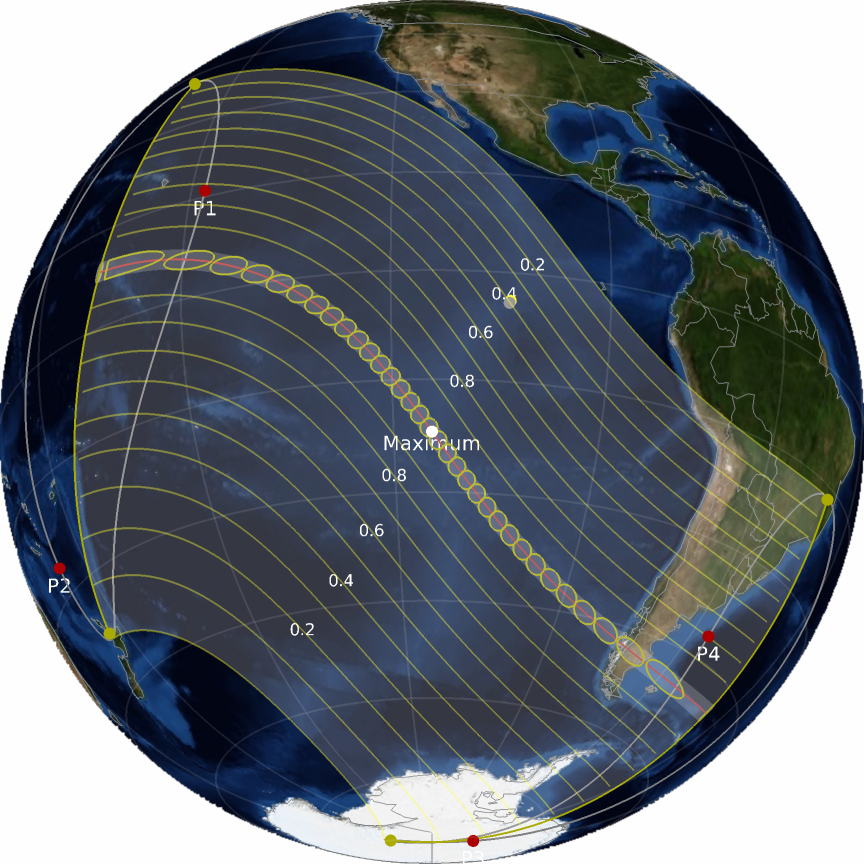
SolarEclipse can produce this global map of the eclipse, including the various contact points of the shadow with the Earth, and the magnitude levels, from 0 to the maximum, as they can be observed from different parts of the Earth. Points in the central umbra band will see an annular eclipse. Points in the gray are will see a partial eclipse.
SolarEclipse["EclipseMap"]
Local properties
Local properties
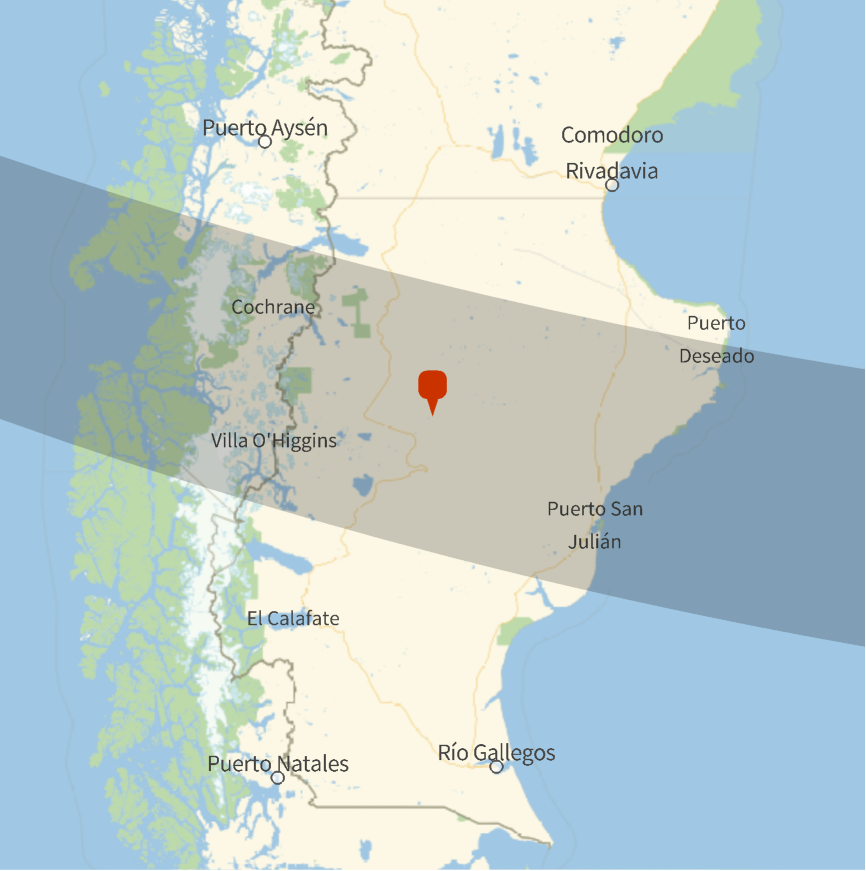
Let us choose choose a particular location in the middle of the umbra polygon, as it crosses South America:
loc=GeoPosition[{-48.2358,-70.1757}]
GeoPosition[{-48.2358,-70.1757}]
GeoGraphics[{SolarEclipse["UmbraEnvelopePolygon"],GeoMarker[loc]},GeoCenter->loc,GeoRange->Quantity[300,"Miles"]]
This is the best instant to observe the eclipse from that location:
date=SolarEclipse[{"LocalMaximumEclipseDate",loc}]
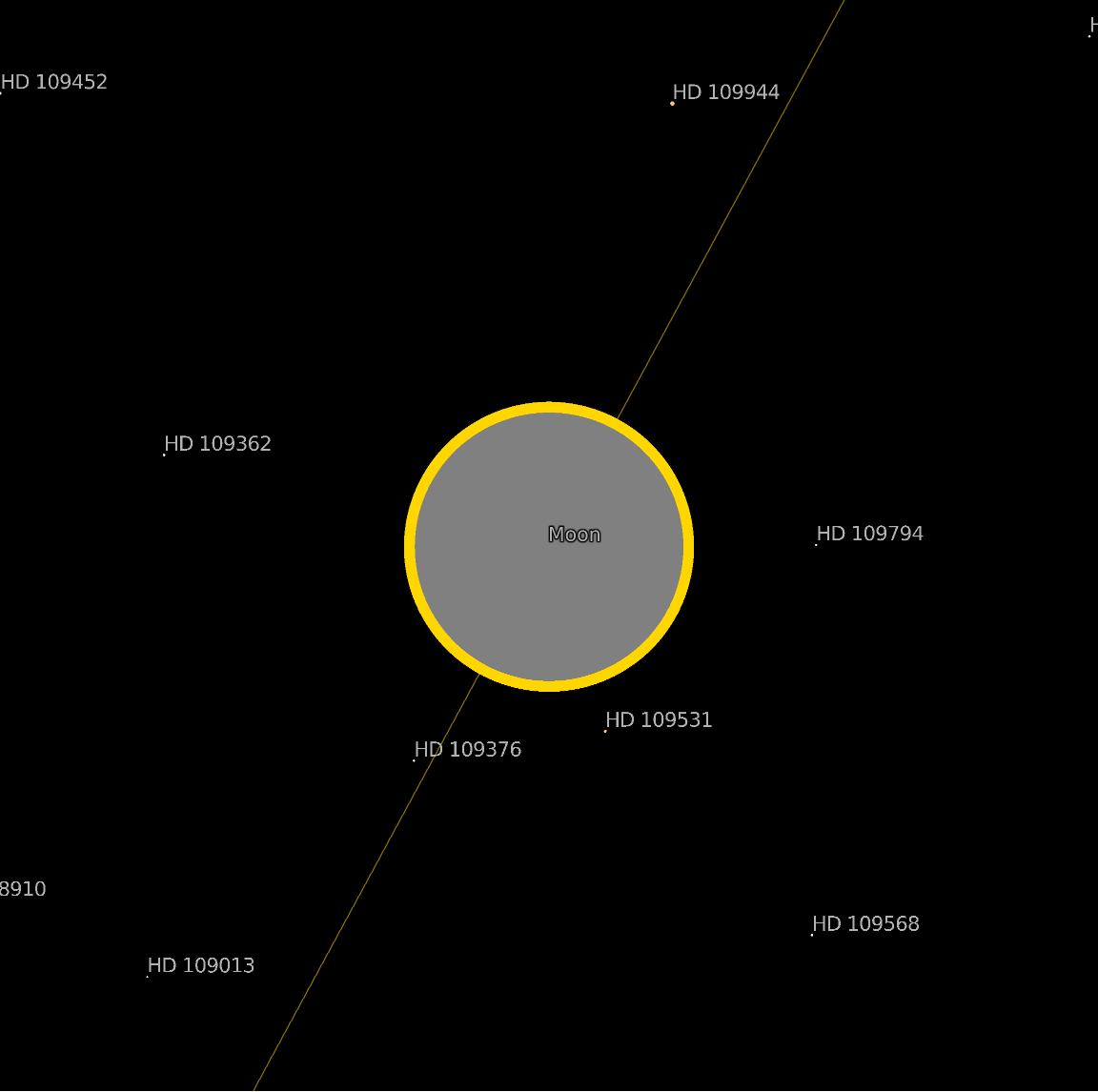
This is how the eclipse will look at that moment:
AstroGraphics,AstroReferenceFrame->{"Horizon",date,loc},AstroRange->Quantity[1,"AngularDegrees"]
These are the values of maximum magnitude and obscuration, for that location:
SolarEclipse[{"LocalMaximumEclipseMagnitude",loc}]
0.925476
SolarEclipse[{"LocalMaximumEclipseObscuration",loc}]
0.856506
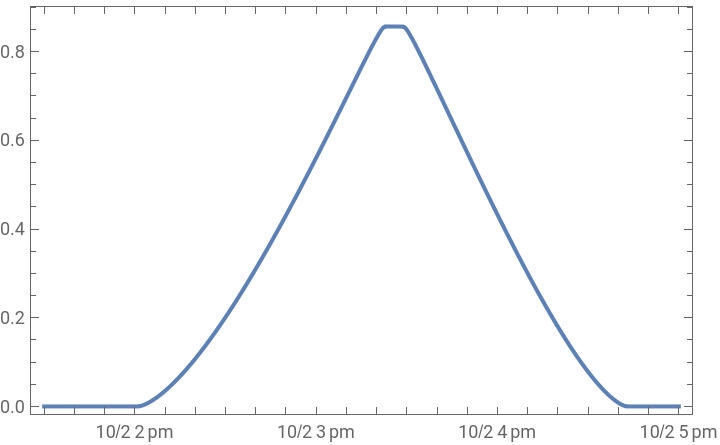
This is the evolution of obscuration during several hours. The flat part on the top corresponds to the annularity part, when the Moon disk always appears inside the Sun disk:
Table[{d=DateObject[{2024,10,2,h,0,0}],SolarEclipse[{"LocalObscuration",d,loc}]},{h,13.5,17,0.01}]//DateListPlot
The Sun will be located at these horizontal coordinates, as observed from that location:
This is an AstroGraphics map of the sky, showing part of the horizon. The grid lines are separated 5 degrees:
Due to the relatively remote locations that will be in the path of totality, mostly in the ocean, we probably won’t see much media coverage. Will any adventurous users of Wolfram Language be traveling to observe this eclipse? If so, we’d love to see any pictures or observations you might have.
For more information about this and other eclipses, read the book “Predicting the Eclipse”, by Stephen Wolfram.
CITE THIS NOTEBOOK
CITE THIS NOTEBOOK
Annular solar eclipse of Oct 2, 2024
by Jose Martin-Garcia & Jeff Bryant
Wolfram Community, STAFF PICKS, October 2, 2024
https://community.wolfram.com/groups/-/m/t/3289692
by Jose Martin-Garcia & Jeff Bryant
Wolfram Community, STAFF PICKS, October 2, 2024
https://community.wolfram.com/groups/-/m/t/3289692