This project develops a computational model of space using hypergraph theory. Instead of a continuous entity, space is represented as a discrete, crystalline lattice of repeating “unit cells”. The research aims to identify local rewrite rules that maintain structural invariance, creating a “self-preserving vacuum”. By using multi-way graphs to manage complex, non-simultaneous temporal dynamics, the model explores how local updates define space-time. The final objective is to introduce perturbations to the lattice, potentially emulating cosmological phenomena like dark matter or dark energy.
A bit of context
A bit of context
In Quantum Field Theory, the quantum vacuum (or vacuum state) is defined as the quantum state with the lowest possible energy. Contrary to the classical notion of an empty space devoid of matter, the quantum vacuum is far from truly empty. Even when all physical matter is removed and the temperature is lowered to absolute zero, the vacuum remains a “seething” environment. The vacuum is characterized by temporary, random changes in energy at various points in space, known as quantum fluctuations. These fluctuations are often visualized as “virtual particles”—pairs of particles that appear and disappear so rapidly that they do not violate the laws of physics. They are a useful mathematical tool for calculations in quantum field theory, though they are not directly detectable as “real” particles.
Moving to Wolfram Language, we need to circumscribe this space not as a continuous entity, but as a discrete and geometrically regular structure, entirely analogous to a material crystal. In this crystalline hypergraph, there are repetitive and identical segments or components, called “unit cells” which are systematically replicated in one, two, or three dimensions.
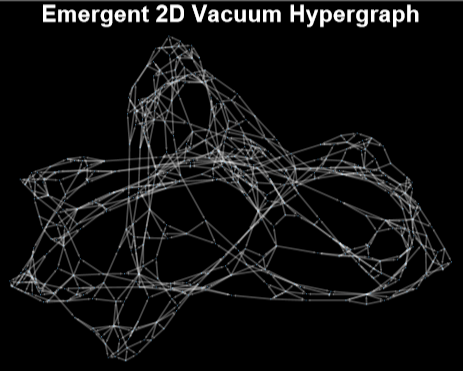
Birth of Lattices
Birth of Lattices
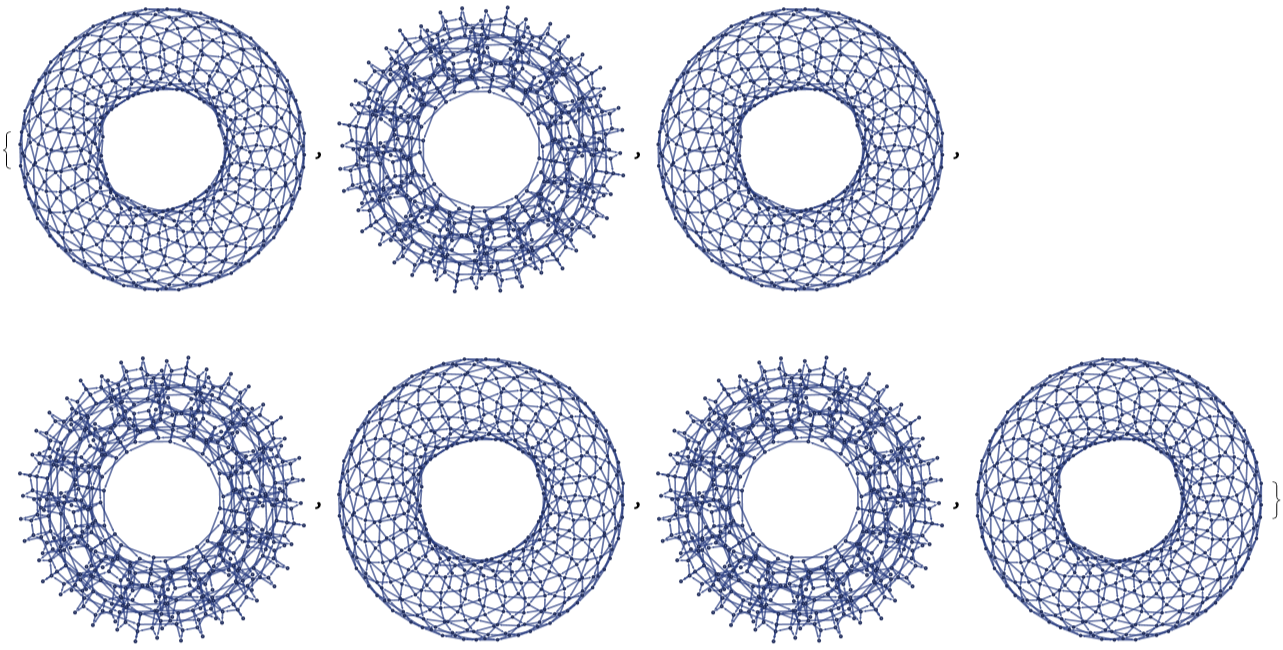
The first step is to create and evaluate some lattices, and test some evolutionary function with specific rules, thanks to “WolframModel”:
Catenate@MapIndexed[List@@@Thread[#2[[1]]->Range[#]]&,Length/@{{1,2,3},{4,5,6},{7},{8}}]Catenate@MapIndexed[#2&,{{1,2,3},{4,5,6},{7},{8}},{2}]lattice=List@@@EdgeList@GeneralizedGridGraph[{32->"Circular",16->"Circular"}];
In[]:=
RulePlot@WolframModel[{{1,2},{2,3}}->{{1,3},{3,2}}]
Out[]=

In[]:=
WolframModel[{{1,2},{2,3}}->{{1,3},{3,2}},lattice,6]["StatesPlotsList"]
Out[]=
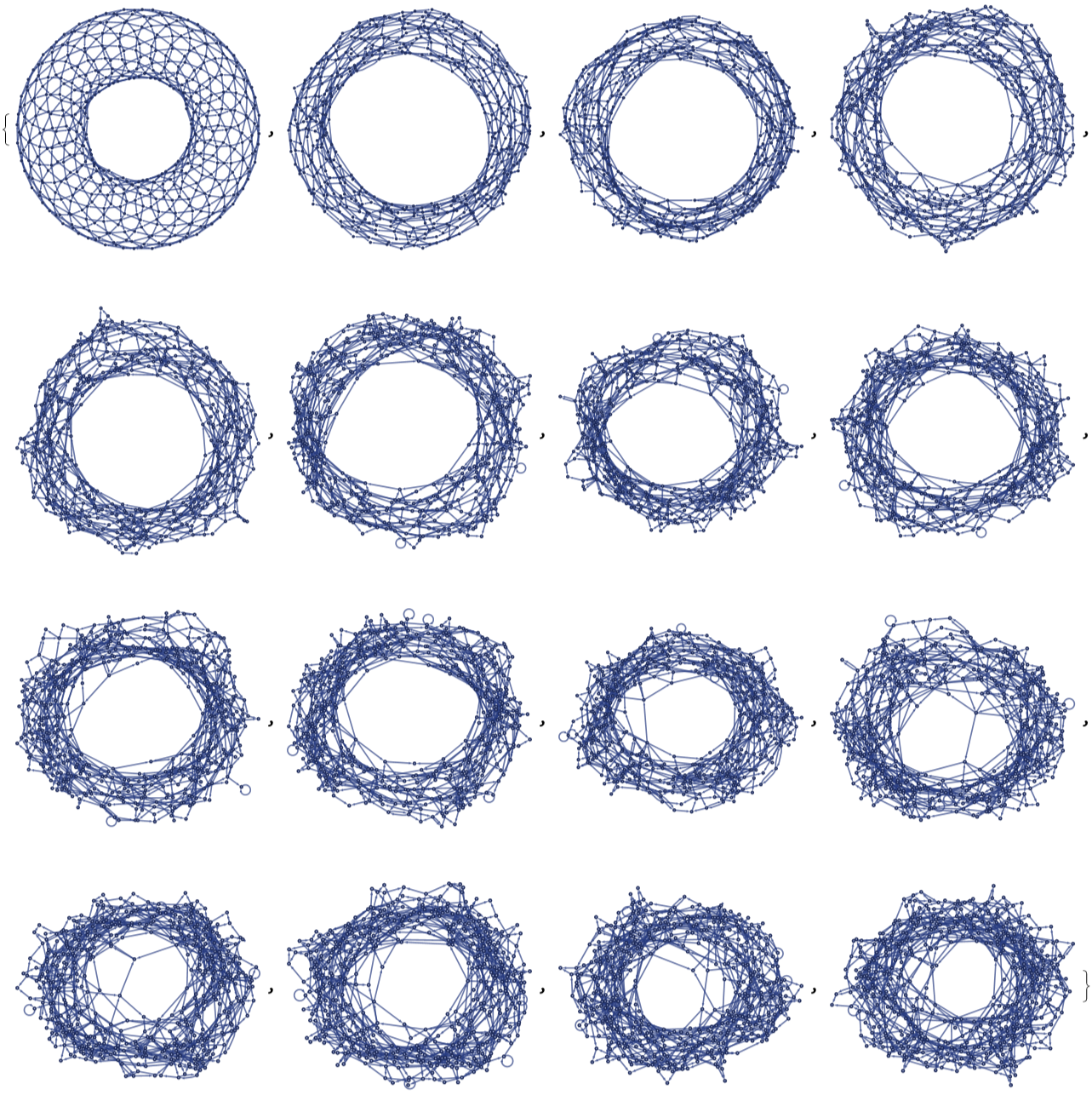
It’s also very interesting to see and study the evolution of the lattices into a chaotic output. By choosing “Random,” we explicitly avoid a global, simultaneous update of the entire lattice. Instead, the model selects and applies rewriting events one by one in a random order. This allows to observe how local updates “intertwine” and propagate through the lattice.
The plots show the system transitioning from a highly regular, symmetric grid (the “crystalline” vacuum) to a more “agitated” or disordered state:
The plots show the system transitioning from a highly regular, symmetric grid (the “crystalline” vacuum) to a more “agitated” or disordered state:
In[]:=
WolframModel[{{1,2},{2,3}}->{{1,3},{3,2}},lattice,15,"EventOrderingFunction"->"Random"]["StatesPlotsList"]
Out[]=
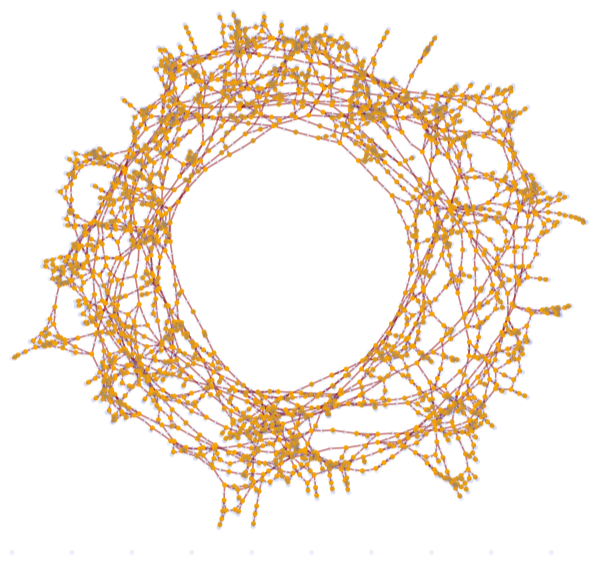
Moving beyond, the states of the hypergraph to visualizing the causal history of the system. The usage of “SpringElectricalEmbedding” treats edges like springs and nodes like electrical charges, pulling them into a visual shape that minimizes “tension”. The following case highlights the high density of interconnected events within the lattice’s toroidal structure :
In[]:=
WolframModel[{{1,2},{2,3}}->{{1,3},{3,2}},lattice,8,"EventOrderingFunction"->"Random"]["ExpressionsEventsGraph",GraphLayout->"SpringElectricalEmbedding"]
Out[]=
Playing with Toy-Universes
Playing with Toy-Universes
The necessity of having well-defined universes is crucial, because it provides a controlled, simplified environment to explore the fundamental dynamics of space and vacuum without the overwhelming complexity of a full-scale physical theory.
The choice falls on some “interesting” geometric configurations, such as Klein Bottle and Torus.
The choice falls on some “interesting” geometric configurations, such as Klein Bottle and Torus.
Klein Bottle
Klein Bottle
A Klein Bottle is a surface with no inside or outside, there’s only one side, and no boundary edge, unlike a normal bottle or a sphere. Imagine a cylinder, a tube open at both ends, if you glue the two circular ends together normally, you get a torus (donut shape). If instead you glue them together with a flip, so the inside surface connects to the outside surface the final result is a Klein bottle.
The Klein bottle is related to non-orientable surfaces, such as Möbius band, in fact both are one-sided, but the Möbius strip has a boundary edge while the Klein bottle has none, just like a sphere or torus. It also can’t be built in ordinary 3D space without the surface intersecting itself.
The Klein bottle is related to non-orientable surfaces, such as Möbius band, in fact both are one-sided, but the Möbius strip has a boundary edge while the Klein bottle has none, just like a sphere or torus. It also can’t be built in ordinary 3D space without the surface intersecting itself.
In Wolfram Language the Klein bottle can be estimated, once given an a*b grid, which represents the dimension of the graph.
In[]:=
kleinBottleGraph=ResourceFunction["KleinBottleGraph"][{25,25}]
Out[]=
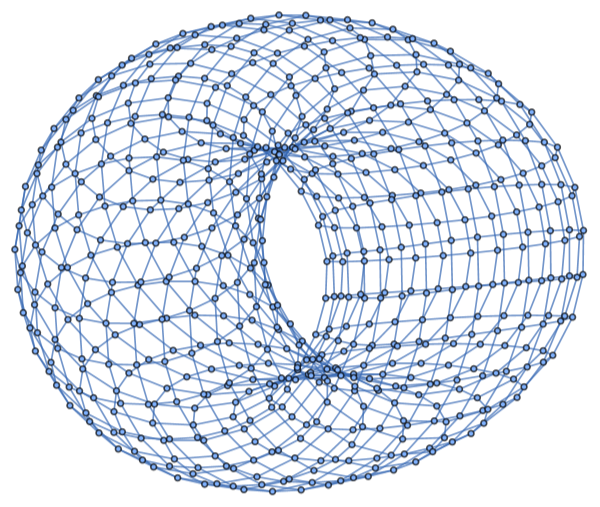
Its’s immediate then to analyze the graph’s 3D structure :
Its’s immediate then to analyze the graph’s 3D structure :
kleinBottleHypergraph=List@@@EdgeList@IndexGraph@kleinBottleGraph;Graph3D@HypergraphToGraph[WolframModel[{{1,2},{1,3}}->{{1,2},{2,3}},kleinBottleHypergraph,1]["FinalState"],"UndirectedDistancePreserving"]
Out[]=
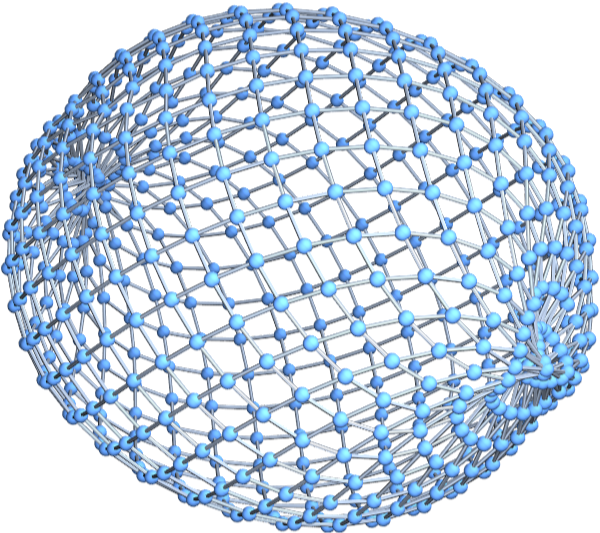
The same process can be repeated for more than 1 “step”, in other words, we can test the function for more generations, for instance 20. The result will be completely different.
Later, the next step is to find a function that, starting from a complex topology, evolve while maintaining connectivity and forming interesting cyclic structures. The goal of the analysis is to filter these rules to isolate only those that exhibit two specific characteristics: the ability to generate cycles within the evolved graph and the preservation of connectivity in the final state. Finally, the code graphically displays the sequence of evolutionary states for the rules that satisfy these criteria, providing a visual representation of the system’s topological transformation over time.
Then we create an association that maps each generated rule to the result of evolving the “Klein Bottle” hypergraph for 20 steps.
To filter out the rules that don’t result in cycles, we use “rulesWithCycles”, ensuring that the evolution retains structured, repeating patterns. “connectedFinalStateQ” further filters the results to guarantee that the final state of the hypergraph remains a connected structure, which is a key criterion for the vacuum model.
Finally we just display the final output, which provides a visual confirmation of how the hypergraph preserves its global topology across 20 iterations, preserving a “back-forth” sequence, or a period of 2.
At this time the next level will be to test whether invariance rules remain valid while increasing the complexity of the unit cell, in this case adding 1 edge to the hypergraph.
The procedure keeps the same road map, with the only difference that every function works with one extra edge.
The procedure keeps the same road map, with the only difference that every function works with one extra edge.
In this case instead, period is higher than 2, and the initial state doesn’t preserve itself while applying the rules.
To visualize this new state more clearly, we display the evolution state of the hypergraph after 20 steps.
In order to return to a graph visualization, we find a concrete 3D graph object that can be spatially rendered, ensuring that the spatial relationships between the nodes are maintained based on the graph’s internal connectivity.
The “shell” obtained shows a highly compact, almost spherical structure. This suggests a rule that promotes strong, dense local connectivity, potentially representing a highly stable or “collapsed” vacuum state.
The “shell” obtained shows a highly compact, almost spherical structure. This suggests a rule that promotes strong, dense local connectivity, potentially representing a highly stable or “collapsed” vacuum state.
The result shows how these rules doesn’t work for a 3D space, even though we obtain a periodic sequence, it has period larger than 2 and it completely changes the global structure of the lattice.
Torus
Torus
A torus is a geometric shape with the appearance of a ring or a doughnut. Mathematically, it is a surface of revolution generated by revolving a circle in three-dimensional space about an axis coplanar with the circle, provided that the axis does not touch the circle.
We can repeat the same procedure just like the Klein bottle, starting from both 2D and 3D graphs:
In this case the initial state is preserved, despite the final output may seem to be indistinguishable:
Concluding Remarks
Concluding Remarks
This research successfully established a stable, self-updating vacuum model within a 2->2 lattice configuration, demonstrating that specific rewriting rules can preserve structural invariance while generating complex causal histories. While the project achieved these foundational results, scaling the simulation to a 3->3 dimension revealed significant computational challenges related to the exponentially increasing complexity of managing local simultaneity and multi-way causal interactions. These findings highlight a critical threshold in the model’s scalability, providing a clear trajectory for future work focused on algorithmic optimization and the implementation of more robust data structures to support higher-dimensional cosmological representations.
Acknowledgements
Acknowledgements
I’d like to express my deepest gratitude to my mentor Max Piskunov, for his guidance and complicity during the program, as well as Pavel Hajek for his inspiring ideas and passion. A special thank also to all mentors and staff members along this amazing journey, and for the new friends found here that will forever be the core of my scientific inspirations.
Last but not least, I’m glad to Stephen Wolfram for the challenging ideas, passionate talks, and to widen my horizons of knowledge.
Last but not least, I’m glad to Stephen Wolfram for the challenging ideas, passionate talks, and to widen my horizons of knowledge.
References
References
1
.Piskunov M. - “https://github.com/maxitg/SetReplace”
AI Disclosure
AI Disclosure
No generative AI tools were used in this project.
CITE THIS NOTEBOOK
CITE THIS NOTEBOOK
HyperVacuum: A Dimension-Agnostic Hypergraph Lattice Model of the Quantum Vacuum
by Federico Selleri
Wolfram Community, STAFF PICKS, July 16, 2026
https://community.wolfram.com/groups/-/m/t/3763367
by Federico Selleri
Wolfram Community, STAFF PICKS, July 16, 2026
https://community.wolfram.com/groups/-/m/t/3763367