Pendulum Waves
Pendulum Waves


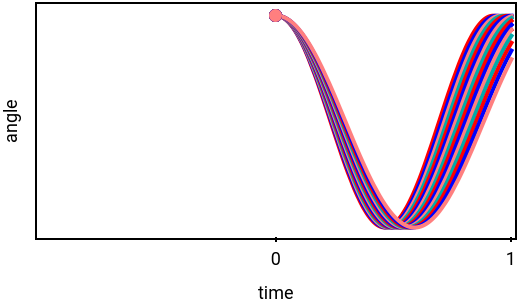
Set in motion 15 to 25 uncoupled pendulums with monotonically increasing lengths from the same initial angle, chosen between 10° and 60°. This produces a stunning visual display including traveling waves, standing waves, and simulated chaotic motion.
The lengths of the pendulums are adjusted so that their oscillation completes an integer number of cycles in 60 seconds. For small angles, the angular frequency and length are related by the approximate formula , but this Demonstration uses the exact relation , where denotes the elliptic integral of the first kind and numerical solutions are found for the classic pendulum differential equation =-sinθ.
ω=
1
2π
g
L
ω=F
32L
g(1-cos)
θ
0
θ
0
2
2
csc
θ
0
2
F
′′
θ
g
L
Once set in motion, the pendulums quickly fall out of sync. But after 60 seconds (neglecting friction and air resistance), they have all undergone an integral number of cycles and return to their starting configuration. Another interesting configuration occurs at 30 seconds, when the pendulums are at alternating maximum phases. The states at 12, 15, 20, 24, 36, 40, 45, and 48 seconds also show some organization. The oscillations can be observed from the front, side, or top.
You can also choose to view a plot of all the pendulum angles against time. This shows the sinusoidal paths of the individual pendulums, color coded to match the corresponding pendulum balls. Note how the chaotic motion becomes ordered at certain times.
References
References
R. E. Berg, "Pendulum Waves: A Demonstration of Wave Motion Using Pendula," American Journal of Physics, 59(2), 1991 pp. 186–187.
J. A. Flaten and K. A. Parendo, "Pendulum waves: A lesson in Aliasing," American Journal of Physics, 69(7), 2001 pp. 778–782.
Pendulum Waves: YouTube
Citadel Physics Department Wave Pendulum: YouTube
Permanent Citation
Permanent Citation
Stan Wagon, S. M. Blinder
"Pendulum Waves"
http://demonstrations.wolfram.com/PendulumWaves/
Wolfram Demonstrations Project
Published: June 17, 2011