ABSTRACT (original article): The second law of thermodynamics imposes a fundamental asymmetry in the flow of events. The so-called thermodynamic arrow of time introduces an ordering that divides the system’s state space into past, future and incomparable regions. In this work, we analyse the structure of the resulting thermal cones, i.e., sets of states that a given state can thermodynamically evolve to (the future thermal cone) or evolve from (the past thermal cone). Specifically, for a d-dimensional classical state of a system interacting with a heat bath, we find explicit construction of the past thermal cone and the incomparable region. Moreover, we provide a detailed analysis of their behaviour based on newly introduced thermodynamic monotones given by the volumes of thermal cones. Finally, we point out that our results also apply to other majorisation-based resource theories (such as that of entanglement and coherence), since the partial ordering describing allowed state transformations is then the opposite of the thermodynamic order in the infinite temperature limit. CITATION (original article): A. de Oliveira Junior, Jakub Czartowski, Karol Życzkowski, and Kamil Korzekwa (2022), Geometric structure of thermal cones, Phys. Rev. E 106, 064109. https://doi.org/10.1103/PhysRevE.106.064109
Introduction
Introduction
Here, we provide a code to construct the thermal cones for an energy-incoherent state p, with Hamiltonian H, interacting with a heat bath at inverse temperature β.
Catalogue of functions
Catalogue of functions
Examples
Examples
We use machine numbers rather than exact to avoid issues when working with regions where vertices are not always in general position. For example β = 2.0 instead of β = 2. Moreover, the handling of 3D regions can give errors for specific values of β in four-level systems.
Although the name of each command is self-explanatory about their function, we now illustrate how to use them:
Code: ThermalCones[state, energies, β]
In[]:=
p={0.7,0.2,0.1};Es={0,1,2};β=0.5;
In[]:=
ThermalCones[p,Es,0.5]
Out[]=
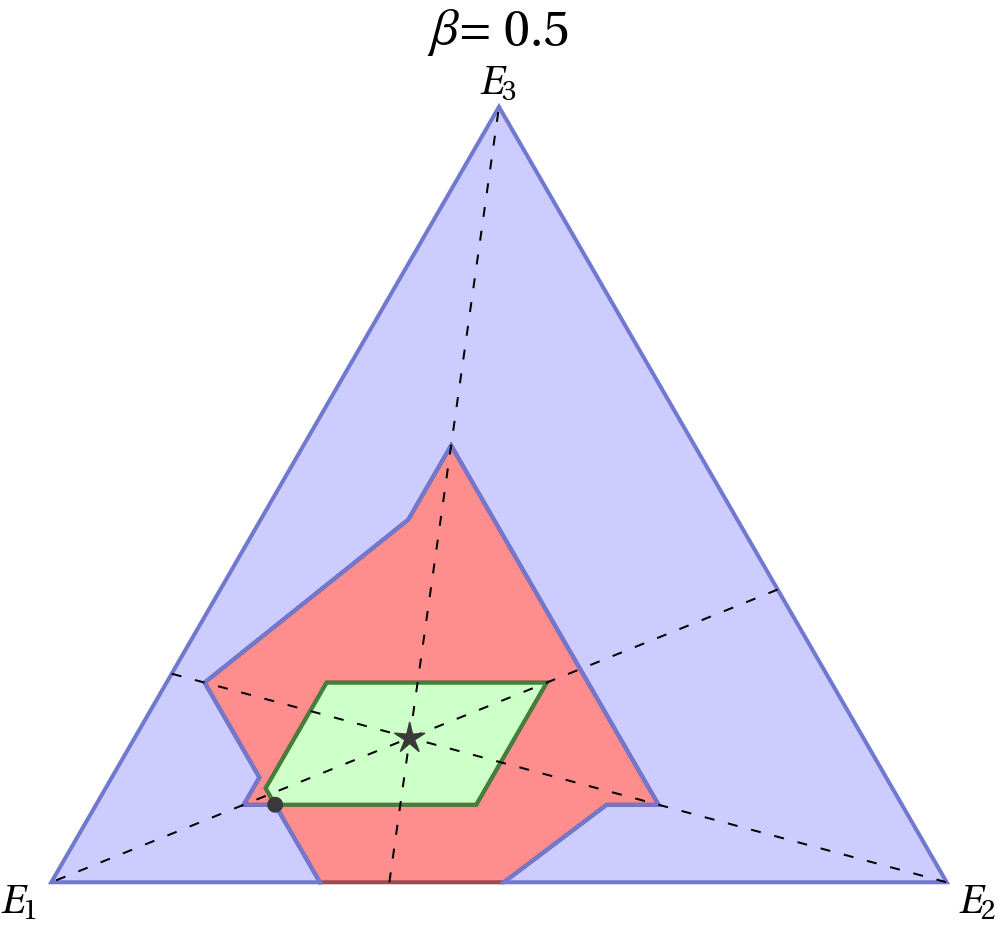
The algorithm also works for a four-level system:
In[]:=
q={0.13,0.09,0.36,0.42};
In[]:=
ThermalCones[q,{0,1,2,4},0.5]
Out[]=

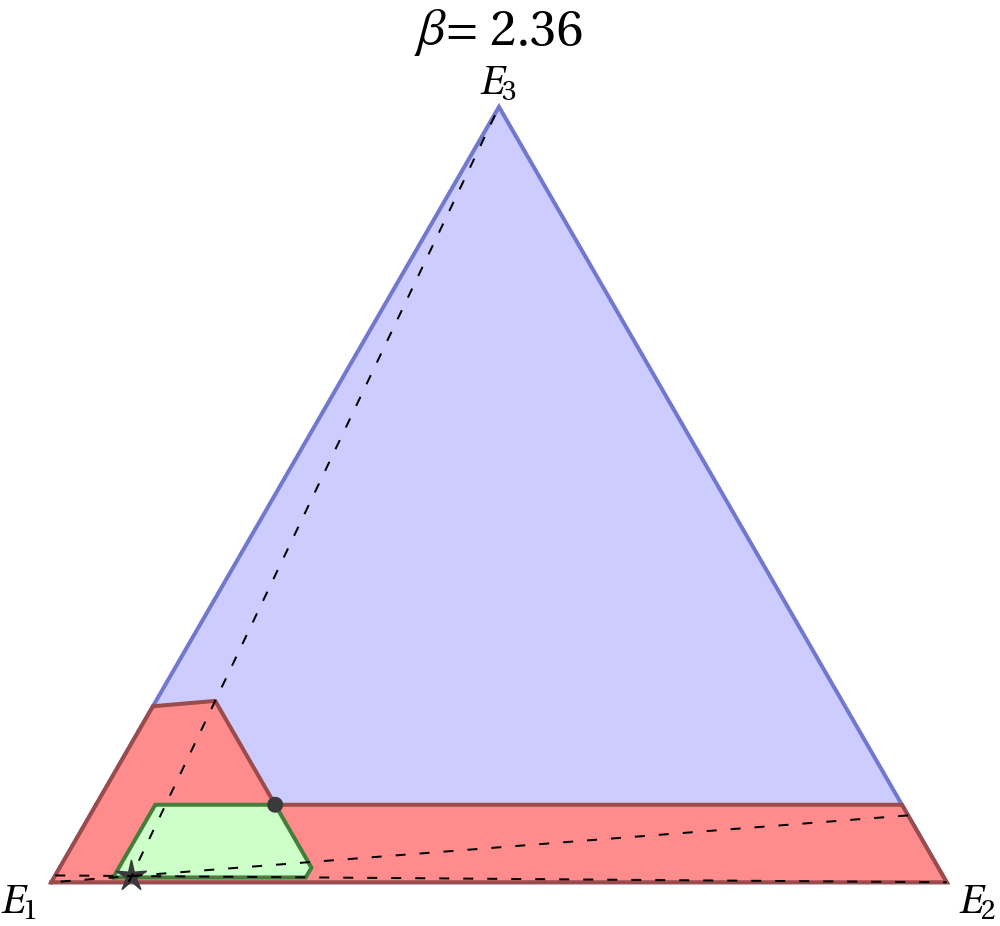
Visualizing the evolution of the thermal cones by going from β = 0 to β ∞:
In[]:=
Monitor[ListAnimate[Table[ThermalConesQuickPlot2D[p,{0,1,2},β],{β,0,4,0.02}]],β]
Out[]=
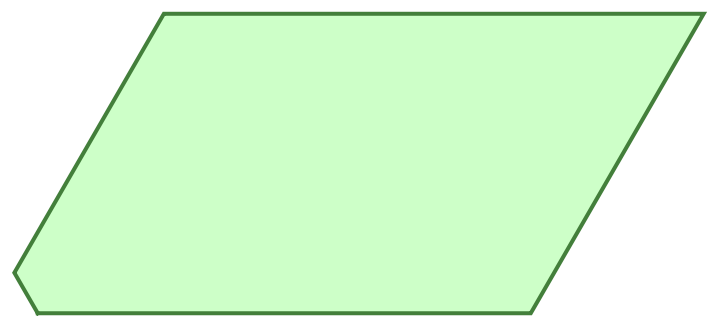
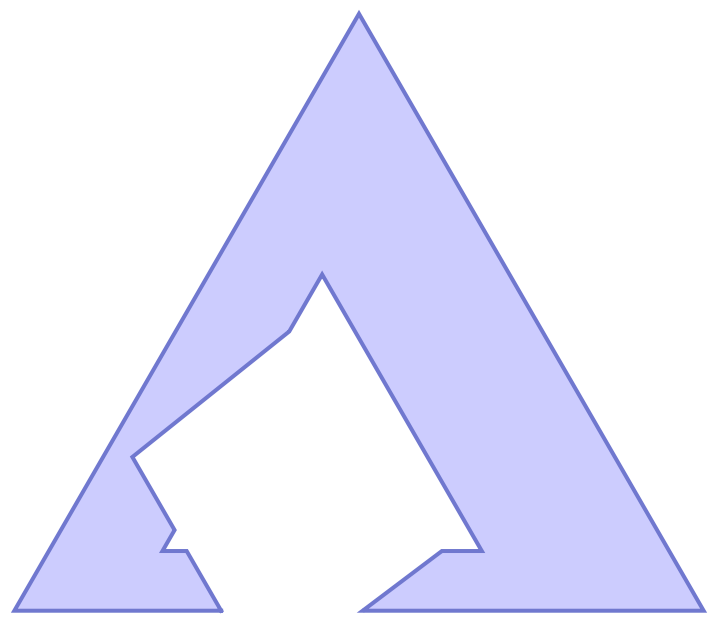
To obtain the past and future thermal cones and the incomparable region separately, one can use the following codes:
Code: PastThermalCone[state, energies, β,], IncomparableRegion[state, energies, β,] and FutureThermalCone[state, energies, β,]
In[]:=
FutureThermalCone[p,Es,β]
Out[]=
In[]:=
FutureThermalCone[q,{0,1,2,3},β]
Out[]=

In[]:=
PastThermalCone[p,Es,β]
Out[]=
For a four-level system these plots are difficult to visualise due to their inner structure. In order to make their visualisation better, we add a way of controlling their opacity: PastThermalCone[state, energies, β, opacity], IncomparableRegion[state, energies, β,opacity]
To visualise them in each Weyl Chamber, we simply need to use the code: ThermalConesChambers[state, energies, β, chamber]
To see them separately in each Weyl chamber, we use PastThermalConeChambers[state, energies, β, chamber], IncomparableThermalRegionChambers[state, energies, β, chamber] and FutureThermalConeChambers[state, energies, β, chamber]
These functions are enough to play around with thermal cones and understand their main behaviour.
Extreme points for arbitrary dimension
Extreme points for arbitrary dimension
For a d-dimensional energy-incoherent state, the set of extreme points of the future and past can be obtained by using the following:
Code: FutureExtremePoints[state, energies, β,], tvectors[state, energies, β, chamber]
Example of usage:
Example of usage:
For a 7-dimensional state:
Volumes evolution with β
Volumes evolution with β
Equi-volumetric level sets in dimension 3
Equi-volumetric level sets in dimension 3
CITE THIS NOTEBOOK
CITE THIS NOTEBOOK
Geometric structure of thermal cones
by A. de Oliveira Junior, Jakub Czartowski, Karol Życzkowski, and Kamil Korzekwa
Wolfram Community, STAFF PICKS, August 19, 2022
https://community.wolfram.com/groups/-/m/t/2601742
by A. de Oliveira Junior, Jakub Czartowski, Karol Życzkowski, and Kamil Korzekwa
Wolfram Community, STAFF PICKS, August 19, 2022
https://community.wolfram.com/groups/-/m/t/2601742