I’m excited to announce that the prerelease version of Exploring Partial Differential Equations: A Computational Approach was published by Wolfram Media on July 17, 2026. You can get your copy of the book free here: https://www.wolfram-media.com/products/exploring-partial-differential-equations/.
This ebook is the companion to the free course Introduction to Partial Differential Equations on Wolfram U, and is an introduction to the subject for university students and graduates.
Wolfram Language provides an ideal environment for studying this subject, thanks to its built-in computational capabilities, both symbolic and numerical, as well as its powerful visualization tools. It allows one to derive and manipulate PDEs symbolically, apply built-in functions for solving them analytically when possible and seamlessly switch to efficient numerical methods for more complex problems.
The book provides an accessible pathway into partial differential equations, starting with basic concepts such as classification, terminology, and initial and boundary conditions, and gradually progressing to advanced topics and applications. It introduces first-order PDEs, the classical equations of mathematical physics—the heat, wave, and Laplace equations—as well as higher-order equations, multidimensional problems, and coordinate systems used in scientific modeling. The final chapters explore some of the most influential PDEs in modern science, including the Black–Scholes equation, the Schrödinger equation, Maxwell’s equations, and the Navier–Stokes equations, demonstrating the wide-ranging impact of PDEs across mathematics, physics, and engineering.
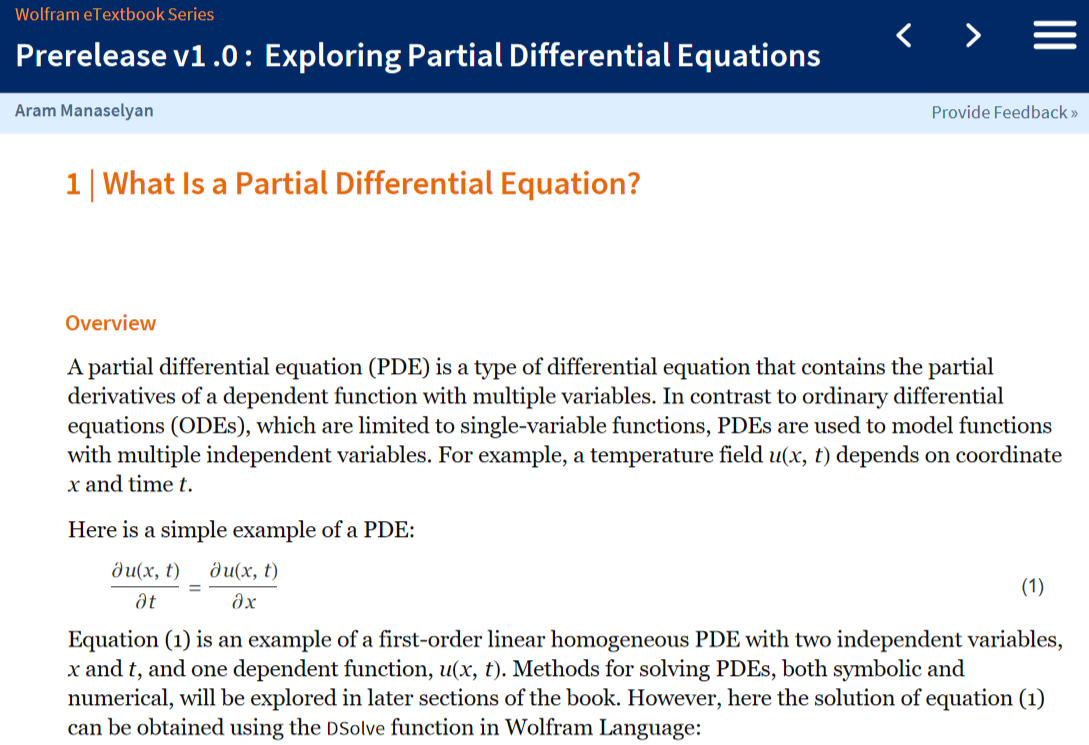
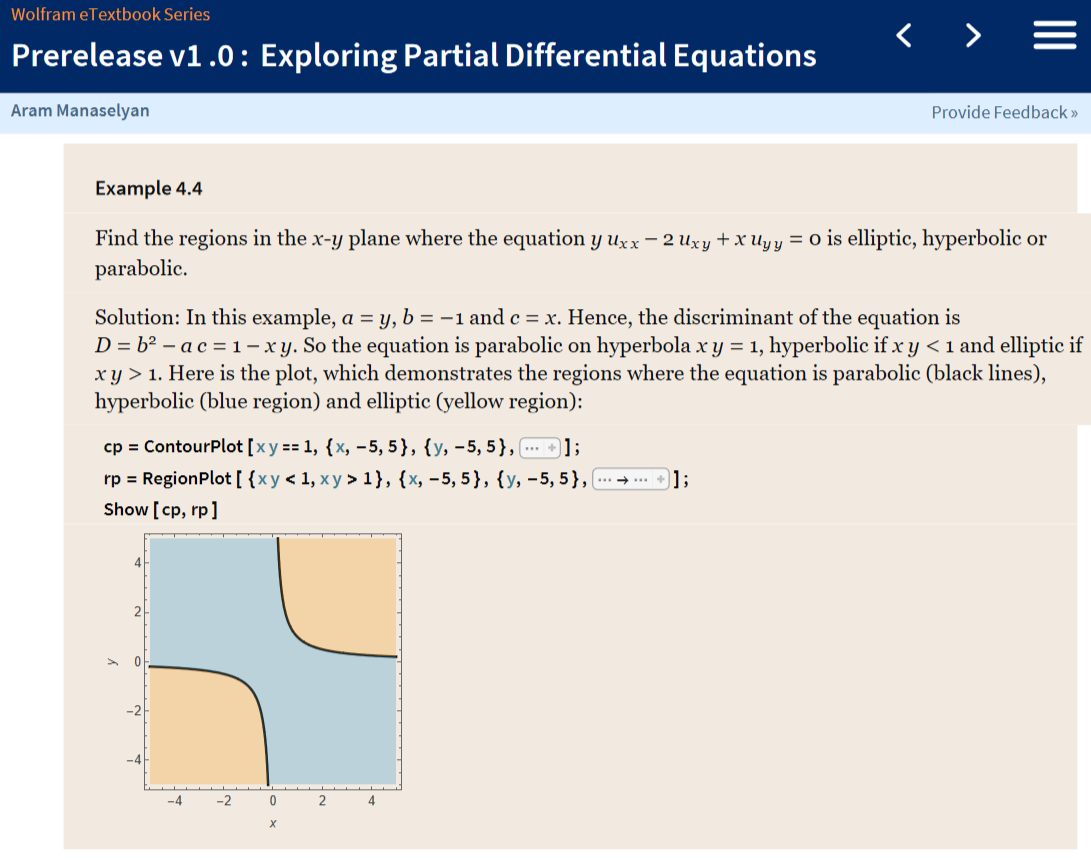
The topics covered are the same as in the Wolfram U course, sometimes expanded in greater detail and depth.
The ebook contains many solved exercises, graphics and interactive demonstrations in Wolfram Language.
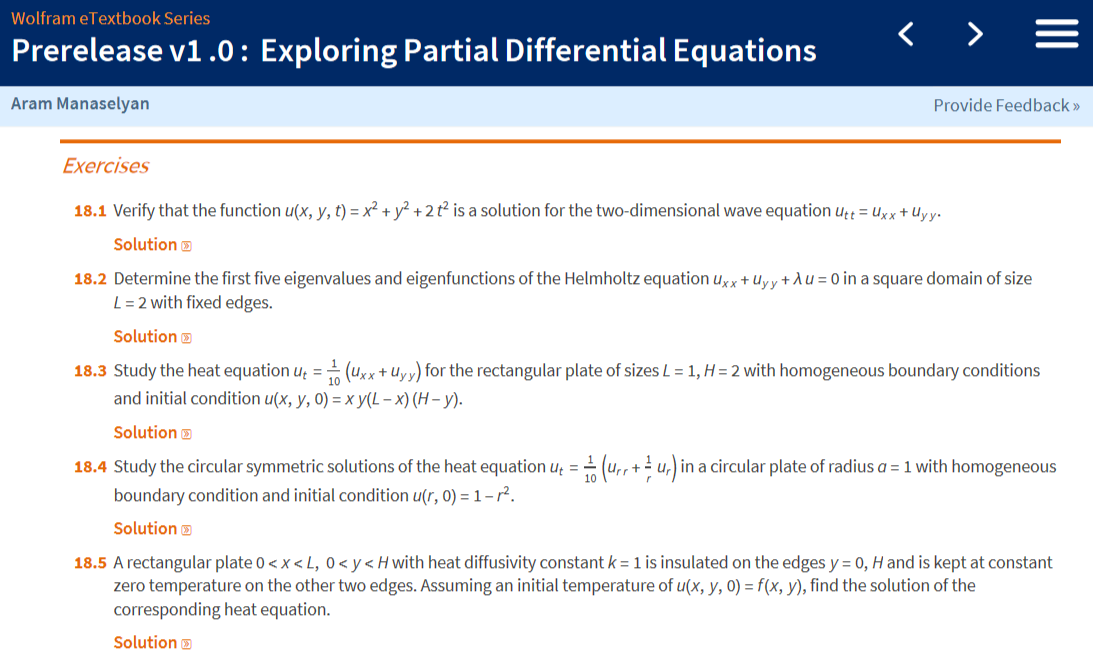
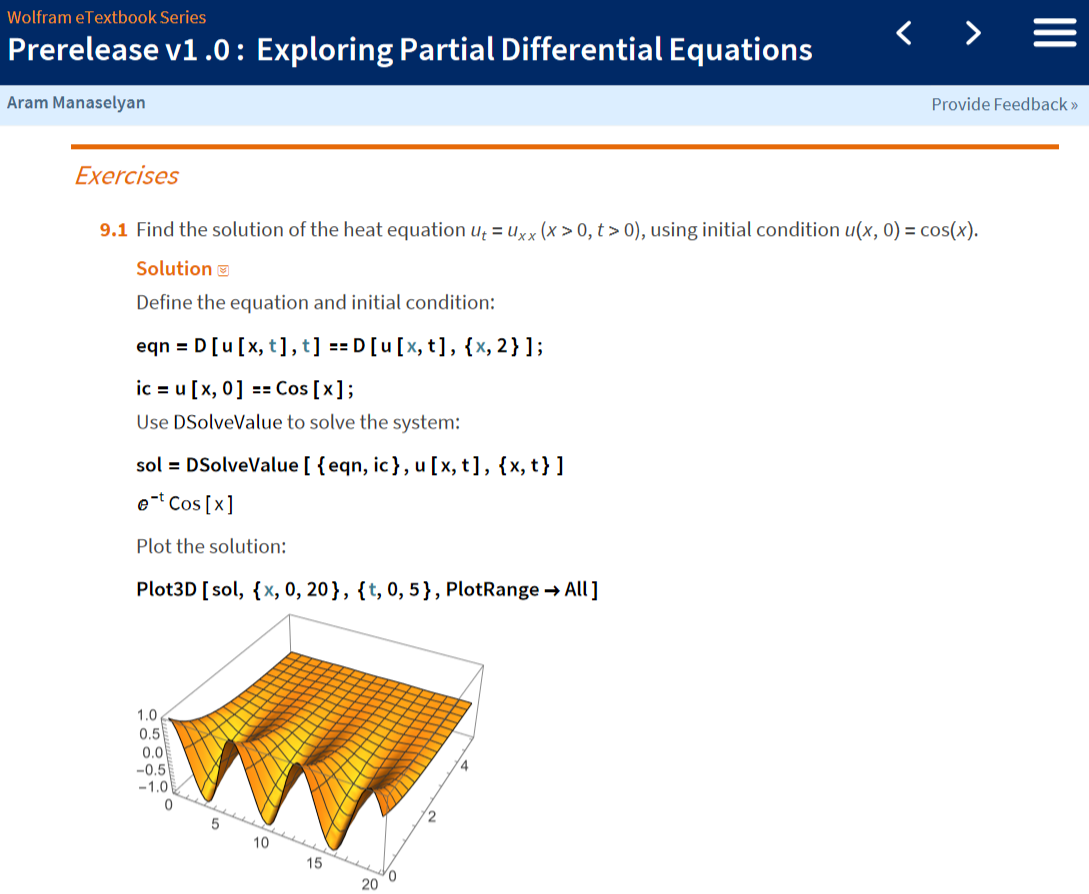
Your free copy of the ebook can be found here: https://www.wolfram-media.com/products/exploring-partial-differential-equations/.
This is the prerelease Wolfram Notebook version of the Exploring Partial Differential Equations: A Computational Approach book and any feedback is appreciated. You might contact us here in this community thread or by email aramm@wolfram.com and publishing@wolfram.com.
Book Introduction
Book Introduction
Partial differential equations (PDEs) stand among the most powerful and influential tools in mathematics. They provide a language for describing change, motion, diffusion, waves, fields, and countless other phenomena that arise throughout science, engineering, and finance. From the flow of heat through a solid object to the propagation of electromagnetic waves, from quantum mechanics to modern financial markets, PDEs form the mathematical foundation of many of the most important theories and technologies of our time.
This book is part of the Wolfram eTextbook Series and is based on the Wolfram U course Introduction to Partial Differential Equations. Combining mathematical theory with modern computational methods, it presents analytical techniques alongside computational exploration to help readers build intuition and practical problem-solving skills.
The purpose of this book is to provide a practical and accessible introduction to partial differential equations, guiding readers from fundamental concepts to some of the most celebrated equations in applied mathematics. The material is organized in a progressive manner, allowing students to build intuition and problem-solving skills while gradually encountering more advanced topics and applications.
The text begins with the fundamental concepts of partial differential equations, including classification, terminology, and initial and boundary conditions. It then introduces first-order PDEs and the three classical equations of mathematical physics: the heat equation, the wave equation, and the Laplace equation. Later chapters explore higher-order equations, PDEs in multiple spatial dimensions, and coordinate systems commonly used in scientific applications.
The book concludes with four of the most influential PDEs in modern science: the Black–Scholes equation, the Schrödinger equation, Maxwell’s equations, and the Navier–Stokes equations. Together, these examples illustrate the remarkable breadth and power of partial differential equations.
Whether used as a textbook for a first course in partial differential equations or as a resource for self-study, this book aims to provide a solid foundation for further exploration of one of mathematics’ most important and fascinating subjects. We hope that the pages that follow will inspire curiosity, deepen understanding, and reveal the remarkable power of partial differential equations in describing the world around us.
Below is a sample chapter from the book
7 | Applications of First-Order PDEs
7
| Applications of First-Order PDEsOverview
Overview
First-order partial differential equations have many applications across various fields of science and engineering.
In this chapter, a few interesting examples will be discussed.
In this chapter, a few interesting examples will be discussed.
Applications of First-Order PDEs
Applications of First-Order PDEs
First-order partial differential equations have numerous applications across various fields of science and engineering. Below are a few interesting examples.
Conservation Equations
Conservation Equations
As a first example, let’s consider the modeling of traffic flow.
Let be the density of cars at the point and at the time of a highway with no exit or entrance ramps. On any segment of the highway, satisfies the following equation
u(x,t)
x
t
[a,b]
u(x,t)
t
b
∫
a
(
1
)where the left-hand side of the equation describes the change in the number of cars in segment over time and is the flux of the cars passing point .
[a,b]
f(x,t)
x
Using the fundamental theorem of calculus, one can transform equation (1) into the form:
b
∫
a
∂u(x,t)
∂t
b
∫
a
∂f(x,t)
∂x
or, after rearrangement, into the form:
b
∫
a
∂u(x,t)
∂t
∂f(x,t)
∂x
Since the segment is arbitrary, the function will be a solution of the following one-dimensional equation:
[a,b]
u(x,t)
∂u(x,t)
∂t
∂f(x,t)
∂x
(
2
)In the literature, the equations in the form of (2) are called conservation equations.
Example 7.1
Example 7.1
Solution : Define the equation and the initial condition :
Equations similar to (3) can also be used to describe several other physical systems. For example, the wave propagation in one dimension for the case when wave shape does not change over time is described by the equation
Example 7.2
Example 7.2
Solution:
Example 7.3
Example 7.3
Solution:
Here is the plot of the solution:
Burgers’s Equation
Burgers’s Equation
or
Burgers’s equation can be solved using the method of characteristics, as discussed previously in this book.
Example 7.4
Example 7.4
Solution:
Here is the plot of the solution:
Example 7.5
Example 7.5
Solution:
In this example, the plot of the solution demonstrates a classic picture of a shock wave solution, where the discontinuity propagates with the increase of time:
Electromagnetic Wave Propagation in Transmission Lines
Electromagnetic Wave Propagation in Transmission Lines
As a next application example of first-order PDEs, let’s consider the electromagnetic wave propagation in transmission lines.
The process of electromagnetic wave propagation in transmission lines can be modeled by following system of two first-order PDEs:
Example 7.6
Example 7.6
Solution:
To summarize, these examples illustrate how first-order linear PDEs can be used to model a wide range of physical phenomena, from traffic flow to wave propagation and chemical reactions.
Summary
Summary
First-order PDEs have numerous applications across various fields of science and engineering.
First-order linear PDEs can model a wide range of physical phenomena, from traffic flow to wave propagation and chemical reactions.
Burgers’s equation is a special nonlinear case of conservation equation that can model shock wave solutions.
A system of two linear first-order PDEs can be used to model electromagnetic wave propagation in transmission lines.
Exercises
Exercises
Exercise 7.1
Exercise 7.1
Exercise 7.2
Exercise 7.2
Exercise 7.3
Exercise 7.3
Exercise 7.4
Exercise 7.4
Exercise 7.5
Exercise 7.5
Use Wolfram Language to solve the system of PDEs
CITE THIS NOTEBOOK
CITE THIS NOTEBOOK
Exploring Partial Differential Equations: A Computational Approach now available in Wolfram Notebook format
by Aram Manaselyan
Wolfram Community, STAFF PICKS, August 3, 2026
https://community.wolfram.com/groups/-/m/t/3773047
by Aram Manaselyan
Wolfram Community, STAFF PICKS, August 3, 2026
https://community.wolfram.com/groups/-/m/t/3773047