As a dietitian, I’m intrigued by the different names used regionally and globally for the same or similar foods. Depending upon where you call home, you may eat French fries or chips. Your salad may contain arugula or rocket. When gumbo is on the menu, do you think of a vegetable side dish or a spicy stew?I decided to explore food names with . I had a great time synonym sleuthing and want to share with you what I found.
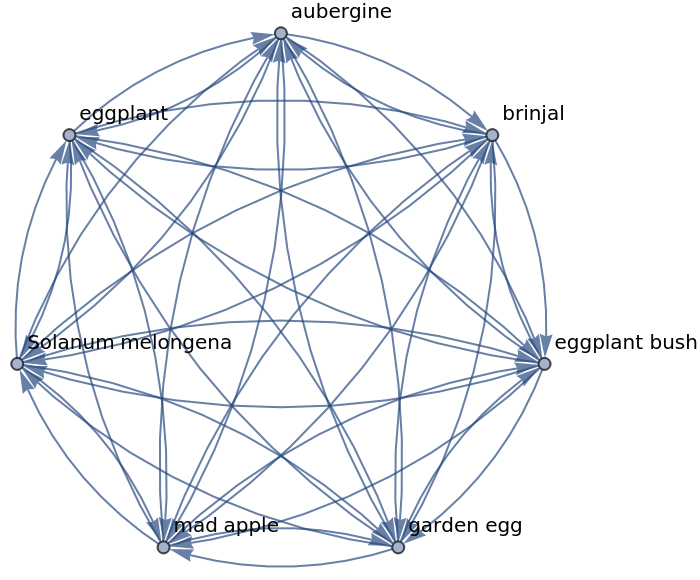
There’s no better place to start than with eggplant. Its synonyms range from melodious (“aubergine” and “brinjal”) to peculiar (“garden egg” and “mad apple”):
In[]:=
Out[]=
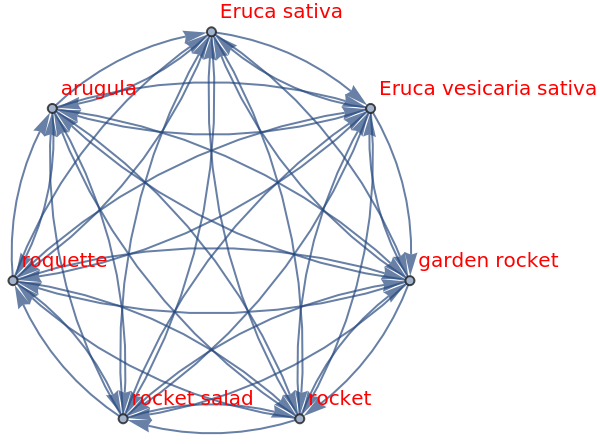
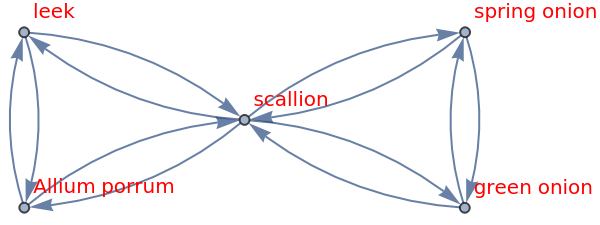
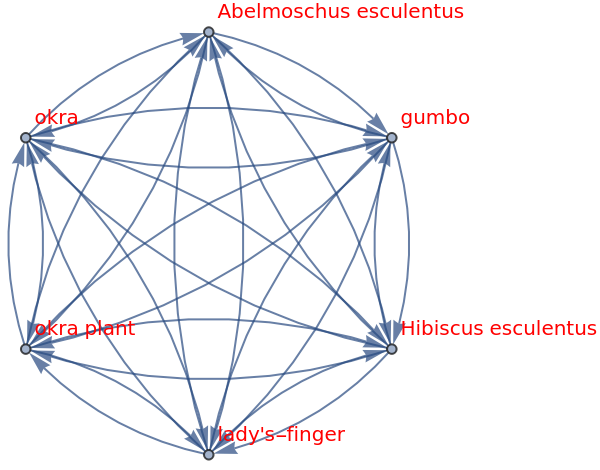
Next, I checked other vegetables and counted the number of vertices and edges. Arugula slightly edged out okra, with a respectable showing by scallion:
In[]:=
foodNames=[#,VertexLabelStyle->Red,ImageSize->300]&/@{"arugula","scallion","okra"}AssociationThread[{"arugula","scallion","okra"},{VertexCount[#],EdgeCount[#]}&/@foodNames]
Out[]=
,
,
Out[]=
arugula{7,42},scallion{5,12},okra{6,30}
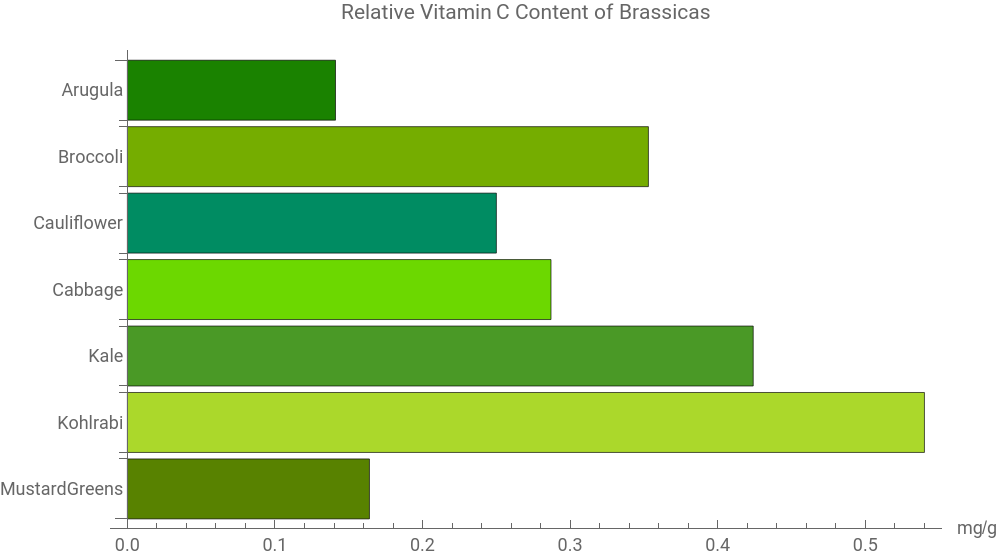
Arugula is a popular salad green, but it’s not a lettuce. It’s a member of the mustard family (Brassicaceae), which also includes broccoli, cauliflower, cabbage, kale, kohlrabi and mustard greens:
In[]:=
EntityValue,{"Kingdom","Phylum","Class","Order","Family"},"PropertyAssociation"//
Out[]=
Kingdom | |
Phylum | |
Class | |
Order | |
Family |
I used to compare the vitamin C in arugula and its brassica cousins:
In[]:=
brassicaList={"MustardGreens","Kohlrabi","Kale","Cabbage","Cauliflower","Broccoli","Arugula"};data=Association#->["RelativeC","Food"->#]&/@brassicaList;values=QuantityMagnitude[#[[1,2]]]&/@Values[data];labels=Keys[data];BarChart[values,ChartLabels->labels,ChartStyle->ColorData[75],BarOrigin->Left,AxesLabel->"mg/g",PlotLabel->"Relative Vitamin C Content of Brassicas",ImageSize->500]
Out[]=
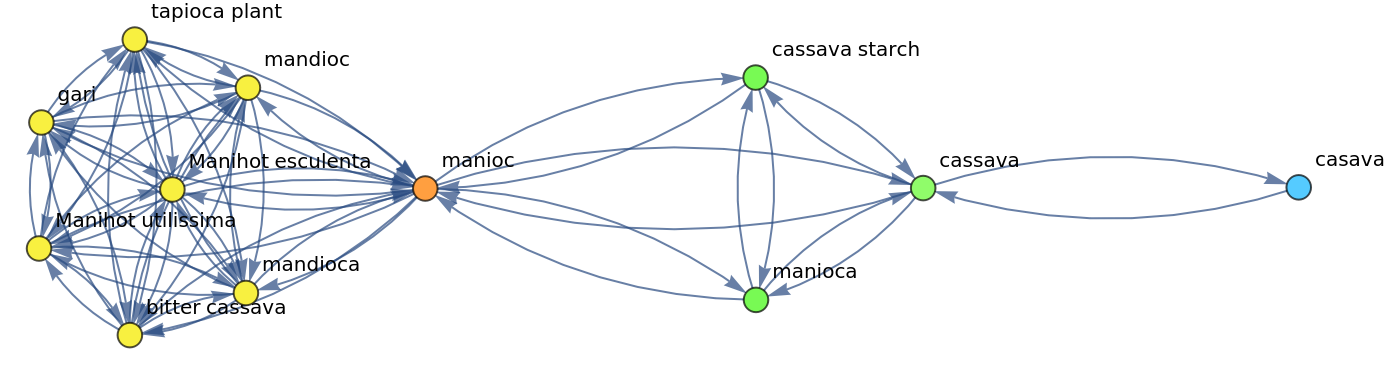
Cassava is an important source of carbohydrates globally. I color-coded the synonym nodes based on ClosenessCentrality:
In[]:=
cassavaGraph=["cassava",2];closeness=ClosenessCentrality[cassavaGraph];nodeWithCentrality=Thread[VertexList[cassavaGraph]->closeness];colorFunction=ColorData["BrightBands"];HighlightGraph[cassavaGraph,Style[#,colorFunction[#2]]&@@@nodeWithCentrality,VertexSize->0.2]
Out[]=
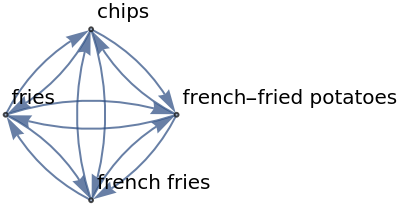
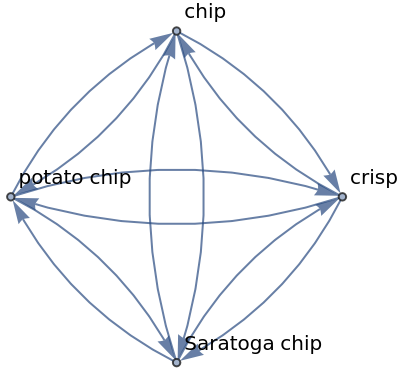
A bag of chips? A packet of crisps? Do I want fries with that? I continued my food synonym sleuthing:
In[]:=
Out[]=
,
,
,

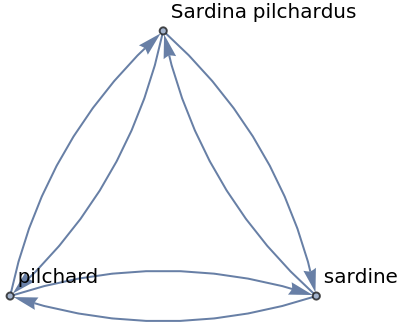
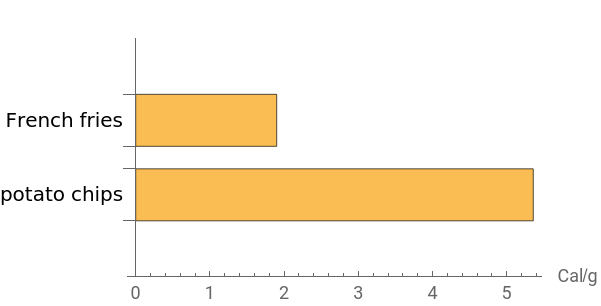
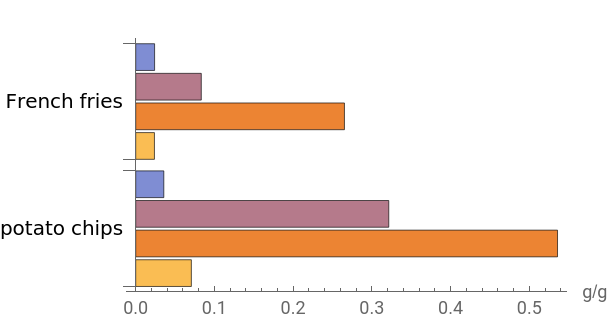
I decided to take “chips versus fries” a step further by using to compare relative macronutrients:
In[]:=
Out[]=
,



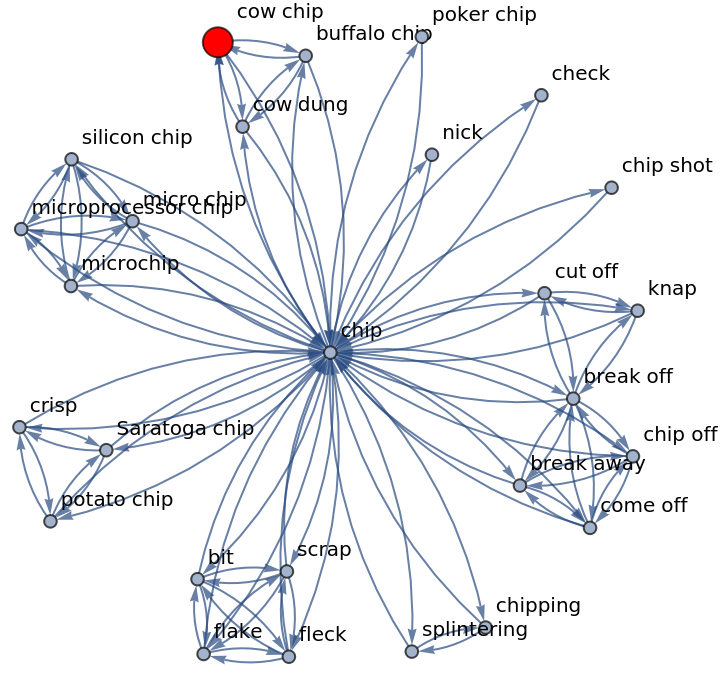
I discovered that “chip” on its own yields more than the usual synonym suspects of food, poker, computers and golf. Ever tossed a cow chip? There are contests. . .really.
In[]:=
chipGraph=["chip"];HighlightGraph[chipGraph,{Style["cow chip",Red]},VertexLabels->"Name",VertexSize->0.4,VertexStyle->{v_:>If[v=="cow chip",Red,Automatic]}]
Out[]=
Baseball season has begun, which made me think: Do you order a hot dog, a frank or a red hot? This was an amusing way to graph the synonyms for this ballpark tradition:
CITE THIS NOTEBOOK
CITE THIS NOTEBOOK
Chips or fries? Exploring food synonyms with Wolfram Language
by Gay Wilson
Wolfram Community, STAFF PICKS, April 2, 2024
https://community.wolfram.com/groups/-/m/t/3151634
by Gay Wilson
Wolfram Community, STAFF PICKS, April 2, 2024
https://community.wolfram.com/groups/-/m/t/3151634