Parliamentary Seat Allocation by the Sainte-Laguë Method
Parliamentary Seat Allocation by the Sainte-Laguë Method
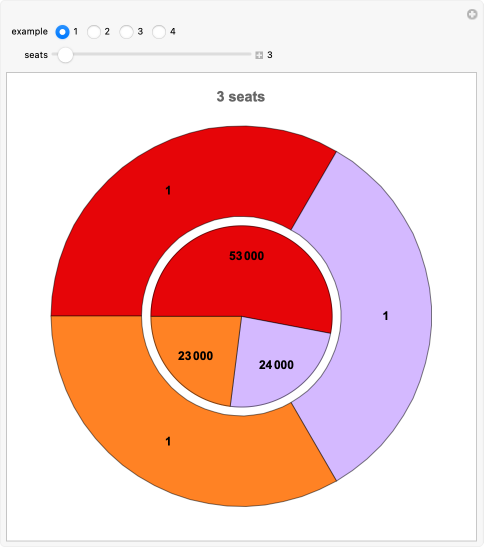
This Demonstration illustrates Sainte-Laguë's method of allocating parliamentary seats.
The party with the most electoral votes obtains the first seat. Each subsequent seat is then awarded to the party for which the quantity is the largest. Here denotes the number of votes party has received in the election, while is the number of parliamentary seats already allocated to party .
p
q(p)=v(p)/(2s(p)+1)
v(p)
p
s(p)
p
In the pie chart, the inner ring shows the actual electoral votes, while the outer ring displays the number of seats awarded.
Details
Details
This method is currently used in countries around the world. It was also used in the United States from 1842–1852 and 1901–1941 to apportion House seats to states according to their population (under the name "Webster method").
The method does not guarantee that a party with the majority of votes receives a majority in parliament (see the thumbnail illustration). This may explain why some countries replace (no seat allocated so far) by , thus giving a slight preference to larger parties over marginal parties.
s=0
s=0.2
External Links
External Links
Permanent Citation
Permanent Citation
Helmut Knaust
"Parliamentary Seat Allocation by the Sainte-Laguë Method"
http://demonstrations.wolfram.com/ParliamentarySeatAllocationByTheSainteLagueMethod/
Wolfram Demonstrations Project
Published: June 3, 2014