ABSTRACT: The trajectory of a light ray incident on the inner reflecting wall of a circular cavity is constructed by analytic and geometric means. Analogous to what is done in this more common geometric configuration, trajectories of light rays in a semicircular closed region with perfectly reflecting inner walls are also found. An analytic and a ruler-and-compass method for obtaining these trajectories is illustrated. The simple Mathematica code to reproduce the captivating figures is also given. CITATION (original article): R De Luca (2023), The path of a light ray in a semicircular cavity, Phys. Educ. 58 065018. https://doi.org/10.1088/1361-6552/acf74f
Introduction
Introduction
Simulating real-world problems is a very instructive activity in physics teaching [R. De Luca, O. Faella, A. Stabile, Il Nuovo Cimento 46 C, 205 (2023)]. In this respect, we start by considering that the study of trajectories of point particles in billiards with perfectly reflecting walls is a known topic in the literature [M. V. Berry, Eur. J. Phys. 2, 91–102 (1981)] and that the properties of mechanical reflection are similar to those of reflection in optics. Therefore, the trajectory of a light ray trapped inside a cavity with perfectly reflecting inner walls is similar to that of a point particle in the same cavity. In the former case, however, the experimental activity becomes more viable, since the use of a laser gives an immediate real representation of the trajectory.
The study of these trajectories may be useful when trying to conceive light trapping devices in some solar energy harvesting applications [A. Parretta, Int. J. Opt. Appl. 3, 27–39 (2013)]. In fact, concentration of light in a small region S of space may be used to trap solar radiation inside a cavity in which a small opening coincides with the region S [R. De Luca, F. Romeo, P. Zozzaro, 2 Eur. J. Phys. 27, 347–52 (2006)]. The notion of the inner trajectory of light rays for various geometries may be therefore of help in maximizing the energy transfer from solar radiation to an absorbing body eventually placed inside the cavity. These applications may be of some importance in the effort to construct a sustainable future, which young students are now righteously asking for. In this way, the geometric construction of light trajectories in a circular cavity may be seen not just as a mere mathematical exercise, but also as a useful way of looking at future applications in the realm of alternative energy devices based on solar energy. In the present notebook we consider the case of a circular and a semicircular cavity with perfectly reflecting inner walls. We first give a summary of the reflection law for plane and curved surfaces. Successively, we specialize our analysis to a circular and a semicircular cavity. Finally we give a representation of the trajectories by means of a rather simple Mathematica code.
The study of these trajectories may be useful when trying to conceive light trapping devices in some solar energy harvesting applications [A. Parretta, Int. J. Opt. Appl. 3, 27–39 (2013)]. In fact, concentration of light in a small region S of space may be used to trap solar radiation inside a cavity in which a small opening coincides with the region S [R. De Luca, F. Romeo, P. Zozzaro, 2 Eur. J. Phys. 27, 347–52 (2006)]. The notion of the inner trajectory of light rays for various geometries may be therefore of help in maximizing the energy transfer from solar radiation to an absorbing body eventually placed inside the cavity. These applications may be of some importance in the effort to construct a sustainable future, which young students are now righteously asking for. In this way, the geometric construction of light trajectories in a circular cavity may be seen not just as a mere mathematical exercise, but also as a useful way of looking at future applications in the realm of alternative energy devices based on solar energy. In the present notebook we consider the case of a circular and a semicircular cavity with perfectly reflecting inner walls. We first give a summary of the reflection law for plane and curved surfaces. Successively, we specialize our analysis to a circular and a semicircular cavity. Finally we give a representation of the trajectories by means of a rather simple Mathematica code.
The reflection law and the ruler-and-compass method
The reflection law and the ruler-and-compass method
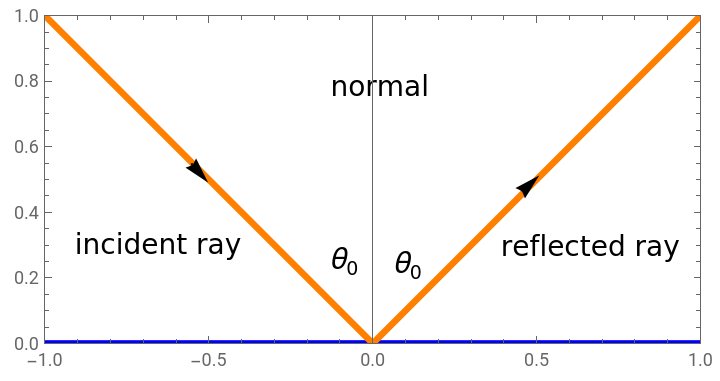
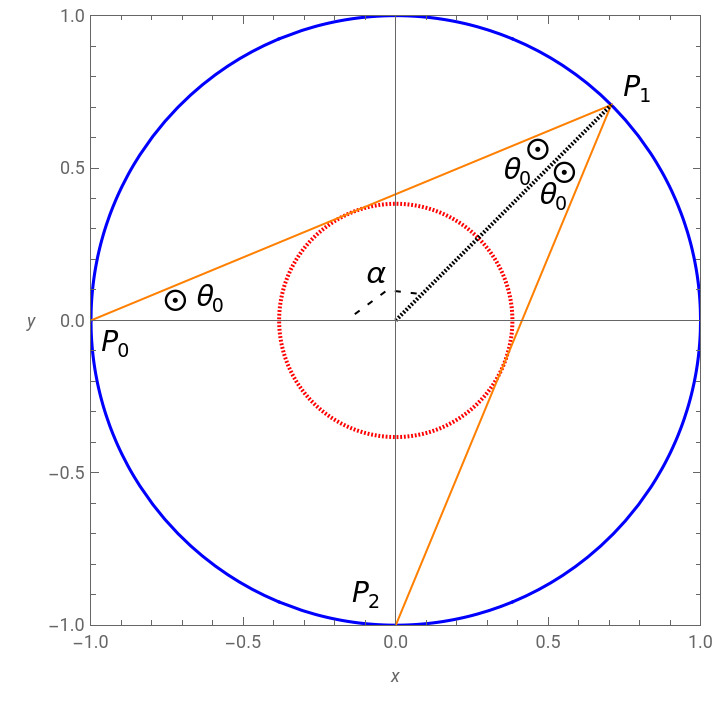
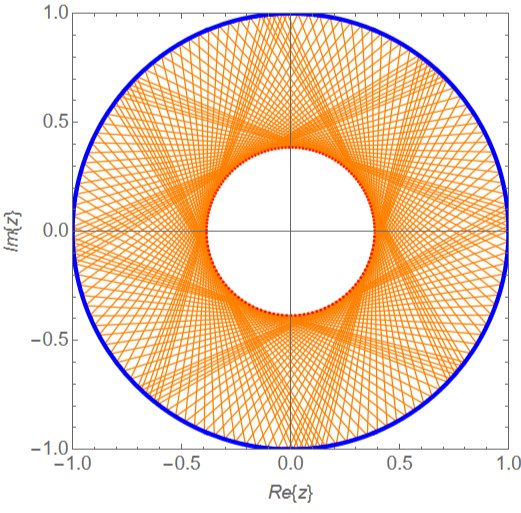
We here briefly recall the reflection law in the realm of geometric optics. Given a plane smooth reflecting surface, consider a light ray incident at an angle with respect to the normal, as shown in the figure below. The incident ray and the normal to the surface determine the incidence plane. The incident ray will thus be reflected, in the plane of incidence, at the same angle with respect to the normal. Similarly, consider a light ray coming from point of a circular cavity lying on the x-y plane and incident at point on the same cavity, making an angle with respect to the local normal , as shown in the figure below. After reflection in , this light ray will be reflected on the x-y plane along the segment making the same angle with respect to the local normal .This pattern can be repeated by considering the inner circumference , in red, in the figure above. In fact, once the point is determined, the next point of incidence can be found by tracing a segment, tangent to the circumference , ending on the reflecting walls of the circumference . If we assume that the light ray will never be able to escape from the cavity, the illustrated ruler-and-compass geometric construction of the trajectory can be repeated to infinity. In case the light ray will be able to go back to the starting point, imagining that it can exit the cavity, the number of lines composing the piecewise continuous trajectory will be limited in number.
θ
0
θ
0
P
0
P
1
θ
0
OP
1
P
1
P
1
P
2
θ
0
OP
1
S
P
2
S
C
The analytic approach
The analytic approach
To trace the trajectory of a light ray inside the circular cavity described in the figure above, notice that the points , , can be represented on the complex plane by the following complex number, respectively:=R, =R, =R,where is the radius of the circular cavity and where the angle is equal to and represents the rotation in the clockwise sense suffered by the complex number =R to obtain the number =R. The above expressions lead to the following generalized formula for the incidence point on the circular cavity after reflections =R=R, for integer.In this way, by considering and choosing =π(7, for example, we can make a list of these complex numbers in the complex plane, by writing:
P
0
P
1
P
2
z
0
-iπ
e
z
1
-i(π+α)
e
z
2
-i(π+2α)
e
R
α
π-2
θ
0
z
0
-iπ
e
z
1
-i(π+α)
e
n-1
z
n
-i(π+nα)
e
n+1
(-1)
2in
θ
0
e
n
R=1
θ
0
2
)In[]:=
θ
0
2
;z[n_]:=n+1
(-1)
2n
θ
0
To visualize the first 150 reflections inside the circumference it is then sufficient to join these points by writing:
C
In[]:=
C
+
1-
2
x
C
-
1-
2
x
S
+
2
Sin[]
θ
0
2
x
S
-
2
Sin[]
θ
0
2
x
C
+
C
-
S
+
S
-
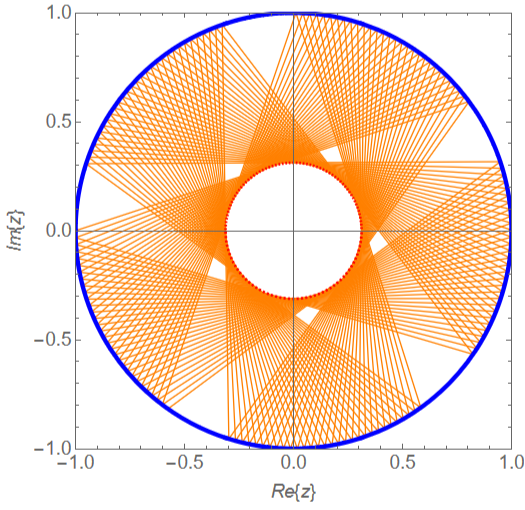
Here the inner circumference with radius is shown as a red dashed line.
S
r=
sinθ
0
Additional examples
Additional examples
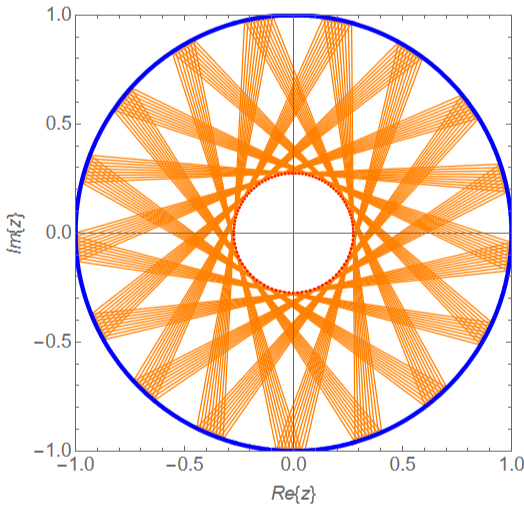
By choosing different values of the entry angle , we might generate other captivating figure for the first 150 reflections inside the cavity. As an additional examples, choose =π(8.
θ
0
θ
0
2
)
Another type of behaviour can be obtained by choosing =π to get the following figure.
θ
0
63
Semicircular cavities
Semicircular cavities
By the above comparison we notice that, in the first three cases, where light rays does not go back from the point it started from, the well-defined and captivating patterns obtained for circular cavities are somehow blurred in semicircular cavities. In the last two cases, however, the semicircular cavity pattern is obtained by a vertical cut of the circular cavity pattern along the imaginary axis.
Conclusion
Conclusion
CITE THIS NOTEBOOK
CITE THIS NOTEBOOK
Multiple reflections in a circular cavity: Mathematica example in high school physics teaching
by Roberto De Luca and Veruska Lamberti
Wolfram Community, STAFF PICKS, May 6, 2024
https://community.wolfram.com/groups/-/m/t/3171161
by Roberto De Luca and Veruska Lamberti
Wolfram Community, STAFF PICKS, May 6, 2024
https://community.wolfram.com/groups/-/m/t/3171161