This is part of live presentation series called Mathematical Games in which we explore a variety of games and puzzles using Wolfram Language. In this episode, we explore the mathematical games and puzzles involving multistate mazes.
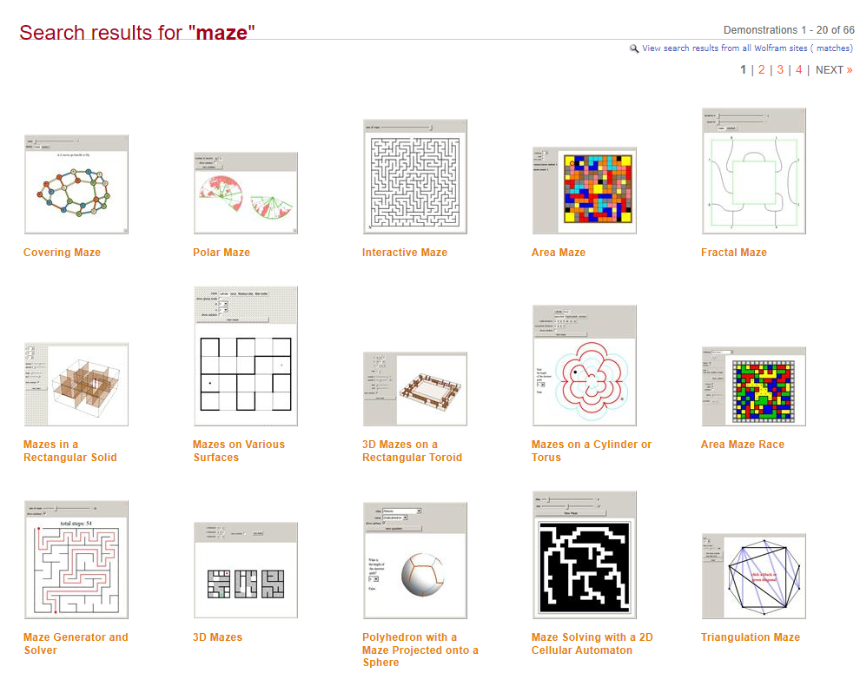
66 Demonstrations related to Mazes
66 Demonstrations related to Mazes
Labyrinth Vs Maze
Labyrinth Vs Maze
A labyrinth has a single path

A maze has collection of paths, branches and loops.
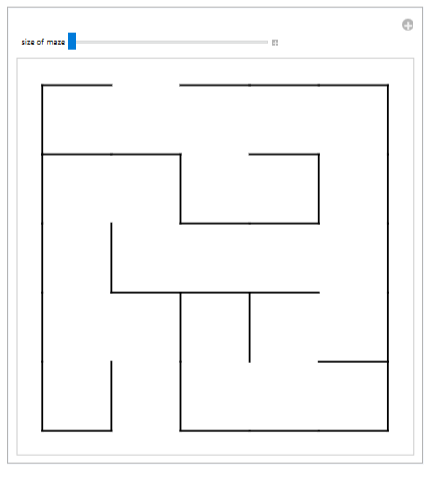
But it’s possible to make things more complicated.
Farmer Goes to Market
Farmer Goes to Market
October 1962, Robert Abbott
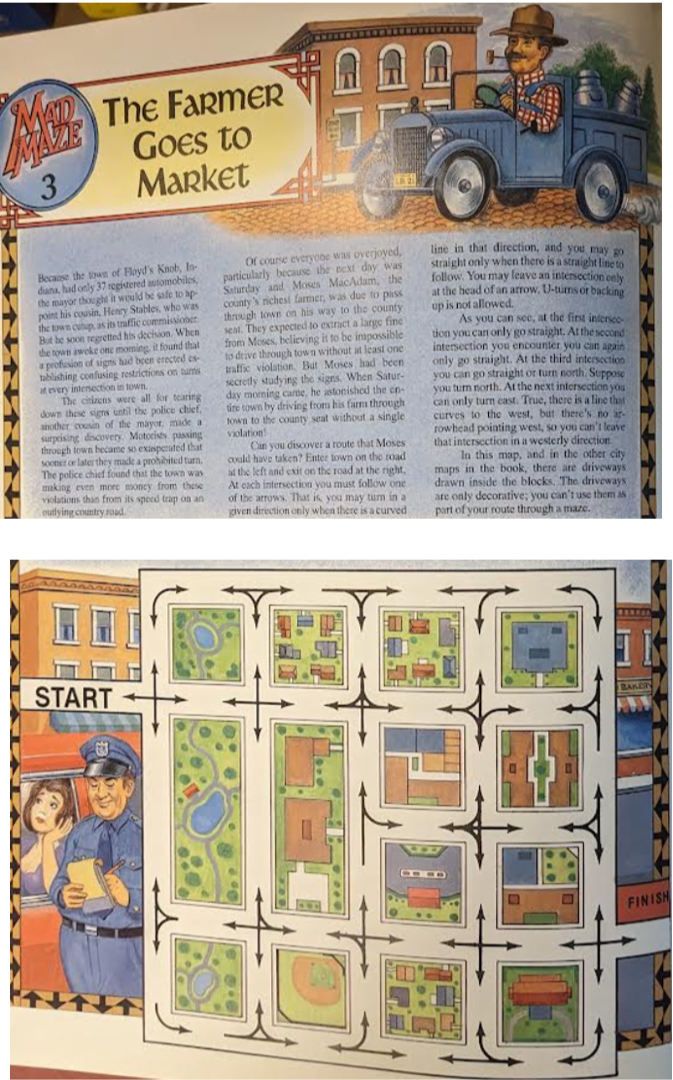
The story accompanying the maze contained a veiled reference to a feud between Henry Barns, the New York traffic commissioner, and Robert Moses, the builder of expressways for New York State in the late 1950’s.
How to solve this?
Farmer Goes to Market
Farmer Goes to Market
October 1962, Robert Abbott
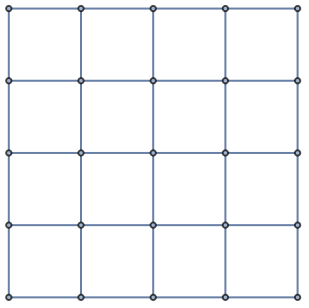
Start with a grid graph
In[]:=
GraphData[{"Grid",{5,5}}]
Out[]=
In[]:=
edges=List@@@GraphData[{"Grid",{5,5}},"Edges"];
In[]:=
verts=Join[GraphData[{"Grid",{5,5}},"VertexCoordinates"],{{0,4},{6,2}}];
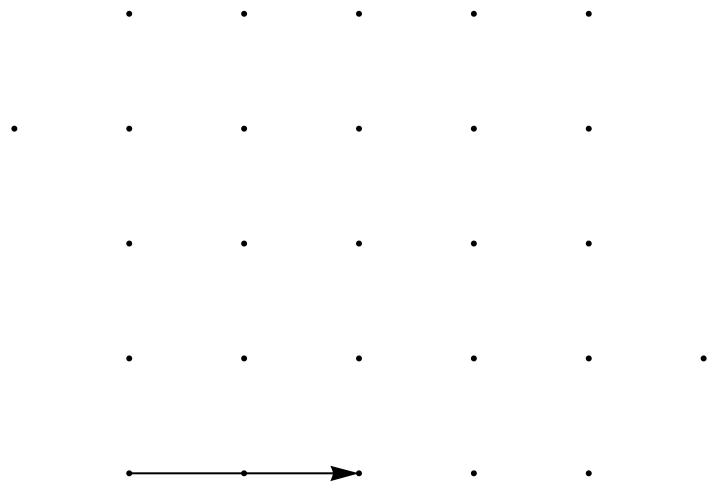
The arrows go from one edge to another joined edge.
In[]:=
arrows=Join[Sort[Select[Tuples[Join[edges,Reverse/@edges],{2}],#[[1,2]]==#[[2,1]]&&#[[1,1]]!=#[[2,2]]&]],{{{26,16},{16,17}},{{9,10},{10,27}},{{17,16},{16,26}},{{27,10},{10,9}}}];
Here’s a way to pick arrows by hand
In[]:=
Manipulate[Graphics[{Point[verts],Arrow[BSplineCurve[Flatten[verts[[#]]&/@arrows[[k]],1]]]}],{k,1,192,1},SaveDefinitions->True]
Out[]=


These are the allowed turns:
Here’s the maze again:
Farmer Goes to Market
Farmer Goes to Market
What does the graph look like?
Loopiness -- “This looks strangely familiar”
Loopiness -- “This looks strangely familiar”
“Samwise Gamgee: “Mordor. The one place in Middle Earth we don’t want to see any closer. The one place we’re trying to get to. Just where we can’t get. Let’s face it Mr. Frodo. We’re lost.”
After more trekking through the Emyn Muil, Sam comments, “This looks strangely familiar.” Frodo provides an explanation. “Because we’ve been here before. We’re going in circles.””
After more trekking through the Emyn Muil, Sam comments, “This looks strangely familiar.” Frodo provides an explanation. “Because we’ve been here before. We’re going in circles.””
A key feature of a multistate maze is to return to the same location in a different state. Here’s a smaller version:
Up / Down Maze
Up / Down Maze
Alternate going up and down.
What would happen if we slid a new card N under Start, A and G?
Meteor Storm (Robert Abbott)
Meteor Storm (Robert Abbott)
Covering Maze (Ed Pegg Jr)
Covering Maze (Ed Pegg Jr)
Two agents under your control have entered a shootout at a junkyard. The circles indicate zones of safety. An agent on a circle can cover for a partner running along a path of the same color.
123 Maze (Hiroshi Yamamoto)
123 Maze (Hiroshi Yamamoto)
123 Maze. You start on S. You can move 1 square in any direction, followed by 2 squares in any direction, then 3, and back to 1 again until you land on F.
Some code. With 1-2-3, the parity of the third move is the same.
12345 Maze (Erich Friedman)
12345 Maze (Erich Friedman)
12345 Maze. You start on S. You can move 1 square in any direction, followed by 2 squares in any direction, then 3, then 4, then 5, and back to 1 again until you land on F.
Tilt Maze (Andrea Gilbert)
Tilt Maze (Andrea Gilbert)
You can tilt only to the north, south, east, or west.
Original Rolling-Block Maze By Richard Tucker
Original Rolling-Block Maze By Richard Tucker
1×1×2 cuboid on Start. Roll to get to Goal.
No Left Turn
No Left Turn
A-Maze-In Planet by Dave Phillips
A-Maze-In Planet by Dave Phillips
A Crime in Time by Adam Fromm
A Crime in Time by Adam Fromm
Amazing Mirror Maze (Walter Wick)
Amazing Mirror Maze (Walter Wick)
Cooperation Maze by JP Ikäheimonen
Cooperation Maze by JP Ikäheimonen
1
.You’ve got two pointers, two pens maybe.
2
.Both pens start at cell marked ‘start’, in this maze top left (number 3).
3
.Goal is to have both pens arrive simultaneously to cell marked ‘goal’.
4
.A pen can move horizontally or vertically, as many squares as the current number shows.
5
.Both pens move at the same time, but one of the pens must move horizontally and the other vertically. Which pen moves which way is up to you.
Theseus and Minotaur (Robert Abbott)
Theseus and Minotaur (Robert Abbott)
Octiamond Maze (Ed Pegg Jr)
Octiamond Maze (Ed Pegg Jr)
Don’t repeat your last angle.
Other way maze
Other way maze
Two start in the center. Either can move one space as directed by the other person’s room. Get both back to center.
Penrose’s Railway Mazes
Penrose’s Railway Mazes
This Demonstration presents four railway mazes designed by Roger Penrose and his father, Lionel Penrose. In a railway maze one must go from the start (marked by S or A) to the finish (F or B) in the same way that a train with no reverse gear would travel. At each junction the train must follow the natural curve of the track; that is, the wheels of the train can turn only in the forward direction and sharp turns are forbidden. The solutions to the four examples shown here were obtained by combining the image processing capabilities of Mathematica with a breadth-first search.
Fractal maze
Fractal maze
In this fractal maze (black lines only), each green frame has a copy of itself nested inside. Knowing this, get from 1 to 8 on the outside frame (level 0). Move the sliders to show more levels.
FastMaze (Dan Fast)
FastMaze (Dan Fast)
Oskar
Oskar
Turning Maze
Turning Maze
With a friend, enter the 0 and 1 squares of the maze, both pointing ↑. Each turn, one person moves one space in the direction the other is pointing. When they reach the new square, rotate to the right that number of places. ↑↗→↘↓↙←↖↑↗→↘↓↙←↖↑. A “4” is a 180 turn. Get back to the 0 and 1 squares at the bottom, with at least one person pointing ↑.
Oskar’s counter-step maze (clickmazes.com)
Oskar’s counter-step maze (clickmazes.com)
Unite the red and blue dots by moving just the red dot. The blue dot follows the red dot, but moves in exactly in the opposite direction. A move is only permitted if the path is clear for both dots.
River Crossing (Andrea Gilbert) (clickmazes.com)
River Crossing (Andrea Gilbert) (clickmazes.com)
Color Sequence Mazes by Abbott, Fisher, Gilbert, Klee
Color Sequence Mazes by Abbott, Fisher, Gilbert, Klee
Follow the sequence red, blue, yellow
Hanayama Cast Series
Hanayama Cast Series
Mazelog (David Johnson-Davies)
Mazelog (David Johnson-Davies)
Alternate between matching shapes and matching colours.
General Solving Method:
General Solving Method:
1
.Turn it into a graph.
2
.Solve the graph.
CITE THIS NOTEBOOK
CITE THIS NOTEBOOK
Mathematical Games: Multistate Mazes
by Ed Pegg
Wolfram Community, STAFF PICKS, September 25, 2023
https://community.wolfram.com/groups/-/m/t/3021285
by Ed Pegg
Wolfram Community, STAFF PICKS, September 25, 2023
https://community.wolfram.com/groups/-/m/t/3021285