Vapor-Liquid Equilibrium Data Using Arc Length Continuation
Vapor-Liquid Equilibrium Data Using Arc Length Continuation


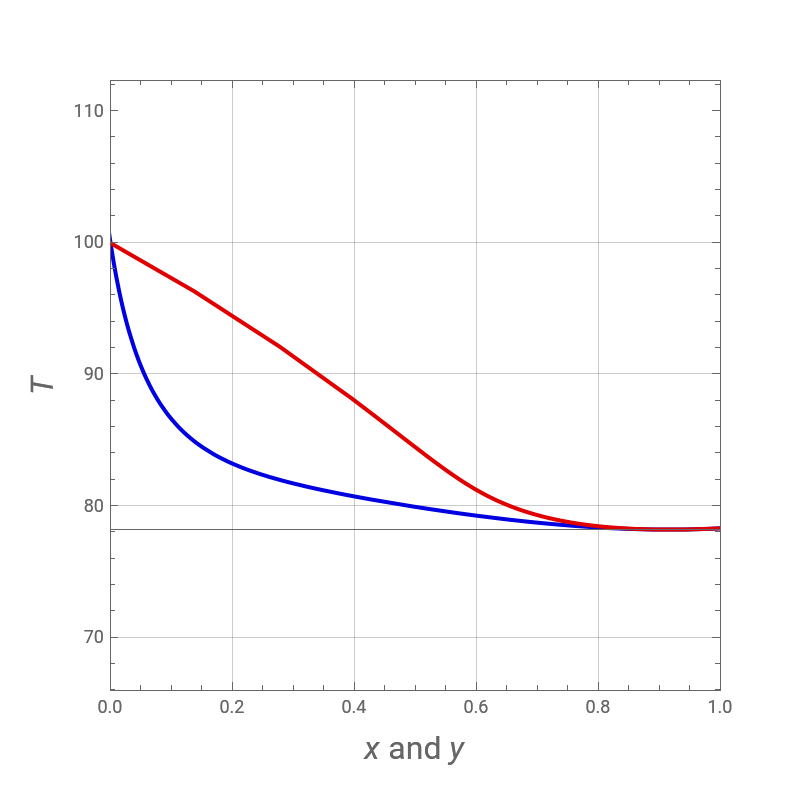
Consider two binary mixtures: (1) ethanol and water and (2) ethanol and ethyl acetate. This Demonstration computes the isobaric vapor-liquid diagram as well as the equilibrium curve at user-set values of the total pressure (expressed in ). The modified Raoult's law is used along with the van Laar model and Antoine equation. Both systems present a positive pressure-sensitive azeotrope. When present, this azeotrope is indicated on the equilibrium curve by a red dot. The loci of the azeotrope versus pressure is given in a separate plot. In both cases, the azeotrope disappears at a low enough total pressure. One particular feature of the present calculation is that it uses the arc length continuation method (see the Details section) to find the bubble/dew point temperatures versus liquid/vapor phase compositions. This takes advantage of a new function as of Mathematica 9.0, WhenEvent, which determines the loci of the azeotropes; indeed they verify , where is the arc length parameter.
P
mmHg
P
T'(s)=0
s
Details
Details
For vapor-liquid equilibrium data computations, the nonlinear equation , where is the liquid mole fraction and is the bubble temperature, is the bubble point equation derived from Dalton's law and the modified Raoult's law. Introduce an arc length parameter . The nonlinear algebraic equation becomes . We use the built-in Mathematica function NDSolve to solve this equation together with the differential equation (called the arc length constraint) in order to find and . A simple initial condition is found by taking and equal to the boiling temperature of pure ethanol at .
f(T,x)=0
x
T
s
f(T(s),x(s))=0
T'+x'=1
2
(s)
2
(s)
x(s)
T(s)
x(0)=1
T(0)
P
Permanent Citation
Permanent Citation
Housam Binous, Ahmed Bellagi, Brian G. Higgins
"Vapor-Liquid Equilibrium Data Using Arc Length Continuation"
http://demonstrations.wolfram.com/VaporLiquidEquilibriumDataUsingArcLengthContinuation/
Wolfram Demonstrations Project
Published: December 2, 2013