Comet 3I/ATLAS is the third detected interstellar visitor, identified by its hyperbolic orbit; backward integration places its origin beyond the solar system. It poses no hazard to Earth, passing no closer than about 1.8 au (~170 million miles, ~270 million km). Perihelion occurs around October 30, 2025 at roughly 1.4 au (~130 million miles, ~210 million km), just inside Mars’s orbit. Its size and physical properties are under active study worldwide. It should remain observable to ground-based telescopes through September 2025, become unobservable while near the Sun, and reappear by early December 2025 for renewed observations.
Back in July, a new interstellar visitor was discovered entering the solar system. I posted about this back then talking more about the hyperbolic orbit it exhibits. Now, as 3I/Atlas, a.k.a. comet C/2025 N1 (ATLAS), I wanted to shift the focus to observations of the comet as its approaching perihelion and where you can look for the comet and even where the comet can be seen from Mars as the comet makes a close flyby of that planet.
As covered in the previous Community post, we have an entity representation of the comet. Here I’m using Interpreter to resolve the comet into an Entity:
In[]:=
comet=Interpreter["Comet"]["3I/Atlas"]
Out[]=
Revisiting the orbit discussed in the previous post, we can then query for the orbital elements of the comet.
In[]:=
EntityValue[comet,{"SemimajorAxis","Eccentricity","Inclination","PeriapsisArgument","AscendingNodeLongitude","PeriapsisLongitude","Periapsis","PerihelionTime"},"Dataset"]
Out[]=
Of particular note is the orbital semimajor axis and eccentricity which show the string hyperbolic nature of the orbit.
In[]:=
comet["Eccentricity"]
Out[]=
6.140
In[]:=
comet["SemimajorAxis"]
Out[]=
The comet is due to come closest to the Sun on October 29, 2025:
In[]:=
FromJulianDate[comet["PerihelionTime"]]
Out[]=
Though the comet will not make a close pass of the Sun, never coming closer than about 1.36 AU of the Sun:
In[]:=
UnitConvert[comet["Periapsis"],"AstronomicalUnit"]
Out[]=
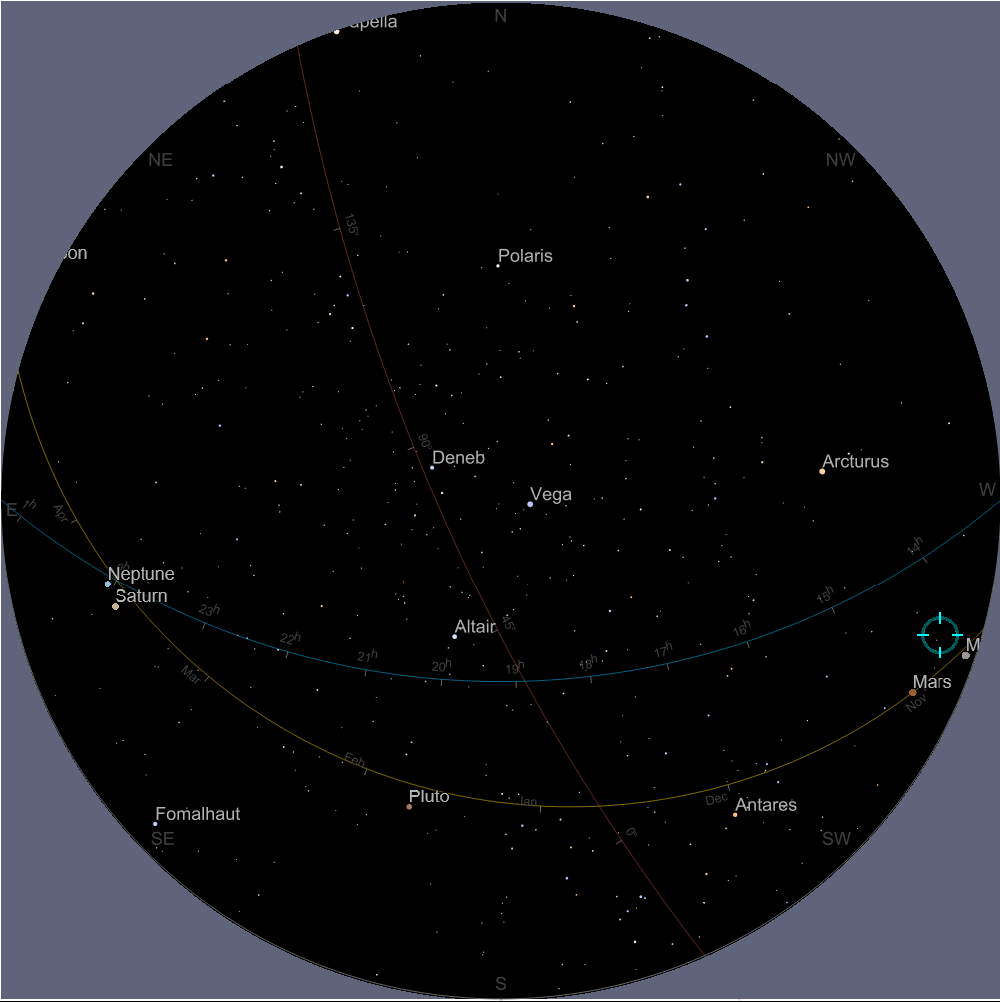
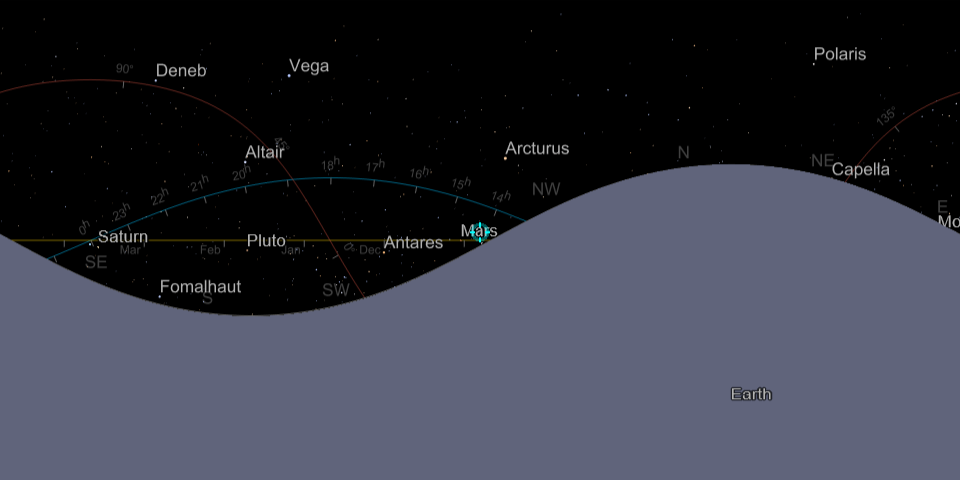
Now that we have had a review of the comet’s orbit, let’s explore where the comet can be seen in the sky by making use of a Wolfram Function Repository item called AstroListPlot which is similar to AstroGraphics, but provides a visual indicator of specified objects. As can be seen, from the northern hemisphere, the comet can be seen low in the west southwest after sunset. Here is the view from Champaign , IL at the time of this post, showing the comet next to Mars with the horizons all around the chart.
In[]:=
For a different perspective, we can look at the entire sky in the ecliptic frame where the horizon takes on a more sinusoidal appearance:
In[]:=
Out[]=
Zooming in a bit and reverting back to the horizon reference system we can see the placement of the comet relative to Mars when looking towards the west southwest horizon.
In[]:=
Out[]=
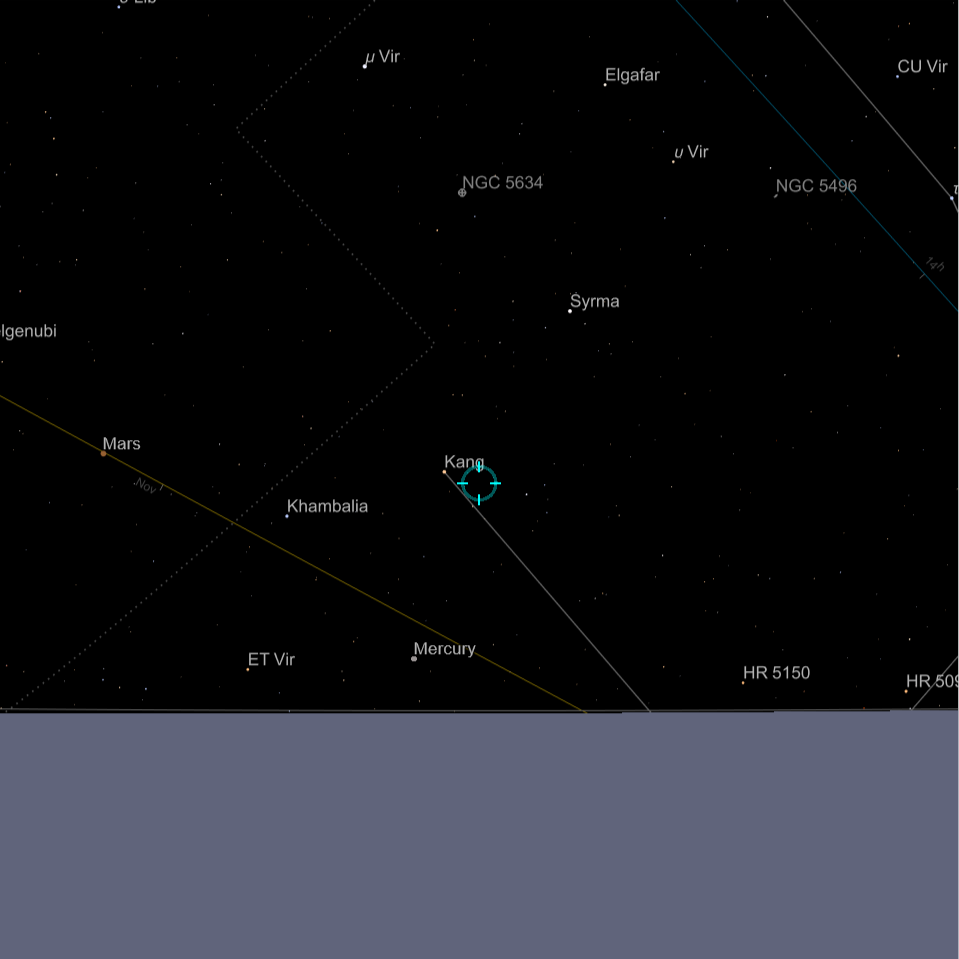
At the time of this post, the comet is about 6 degrees above the west southwest horizon when observed 30 minutes after sunset, as observed from Champaign.
In[]:=
loc=Here
Out[]=
GeoPosition[{40.11,-88.24}]
In[]:=
AstroPositioncomet,Sunsetloc,+,loc
Out[]=
AstroPosition

It’s not particularly bright so will require optical aid to see. Binoculars or a camera on a tripod that can take extended exposures may be required.
In[]:=
dr=DateRange,,;
In[]:=
createDateValuePairs[values_]:=Transpose[{dr,values}]
In[]:=
data=createDateValuePairsAstroDistance,Dated,#&/@dr;
In[]:=
DateListPlot[data,TargetUnits->"AstronomicalUnit"]
Out[]=
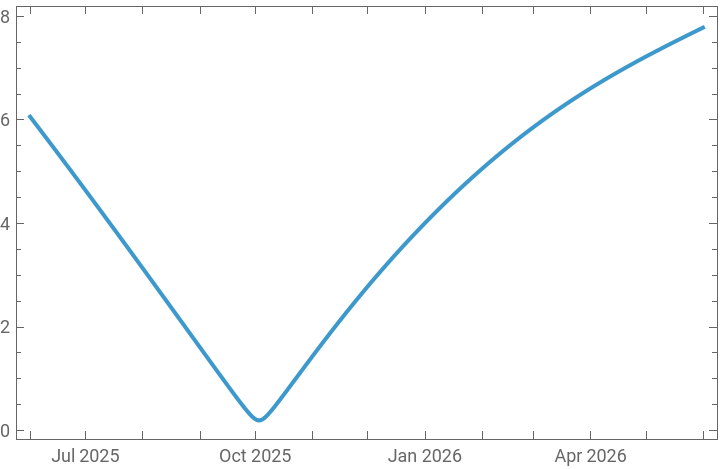
The comet makes its closest approach to Mars on October 3rd, just a few days prior to this post, coming within about 0.2 AU of Mars.
In[]:=
{marsdate,marsdist}=SortBy[data,#[[2]]&][[1]]
Out[]=
,
So what will the view from Mars be? First, we need to select a location on Mars to observe from. We will use the landing location of the Perseverance Rover.
It is in Jezero crater:
Then we can simulate that the rover saw the comet on October 3 crossing the constellation Boötes. Initially, the comet was below the horizon, but as time goes progresses, it rises. We use the "Ecliptic" frame to have the motion essentially horizontal, even if the surface of Mars looks tilted. The grid corresponds to ecliptic coordinates, with lines separated 1 degree:
Switching back to the Horizon reference system gives a view relative to the rover’s horizon.
Now change to observing from the center of our planet, so back to Earth. We see how the comet passed close to Mars during this 48 hours range. The thicker yellow line is the plane of the ecliptic, which is horizontal in the "Ecliptic" frame:
We can even choose a more exotic observation location, from the center of Ceres, for example. The blue line is the equatorial plane of the Earth, which plays no role in this case since we are not observing from Earth.
We can even observe from the cloud tops of Neptune. From this far out in the solar system, the comet and Mars are hiding in the glare of the Sun.
CITE THIS NOTEBOOK
CITE THIS NOTEBOOK
New interstellar Comet 3I/ATLAS: the views from Earth, Mars and other spots in solar system
by Jeffrey Bryant & Jose Martin-Garcia
Wolfram Community, STAFF PICKS, October 8, 2025
https://community.wolfram.com/groups/-/m/t/3558095
by Jeffrey Bryant & Jose Martin-Garcia
Wolfram Community, STAFF PICKS, October 8, 2025
https://community.wolfram.com/groups/-/m/t/3558095