ABSTRACT (original article): Driven by applications in the natural, social and computer sciences several algorithms have been proposed to enumerate all sets of vertices of a graph that induce a connected subgraph. We offer two algorithms for enumerating all ’s that induce (more exquisite) metric subgraphs. Specifically, the first algorithm, called AllMetricSets, generates these ’s in a compressed format. The second algorithm generates all (accessible) metric sets one-by-one but is provably output-polynomial. Mutatis mutandis the same holds for the convex sets , where “convex” is a natural strengthening of “metric”. The Mathematica command BooleanConvert features prominently. CITATION (original article): Marcel Wild (2024), Compression with wildcards: All induced metric subgraphs, arXiv:2409.08363. https://doi.org/10.48550/arXiv.2409.08363
X⊆V
G=(V,E)
X
X
X⊆V
For random graphs gr all induced metric (or convex) subgraphs of cardinality are produced. The algorithm is compared with an approach (called BConvert) that uses BooleanConvert. For details see my article (v2) in the arXiv : “Compression with wildcards: All metric induced subgraphs” .
<=k
Read in all the subroutines below, then follow the steps FIRST, ... SIXTH in this order (some steps not being mandatory)
FIRST (mandatory): Generate some random (or hand - typed) graph gr:
Choose number of vertices .
w=25;
Complement out exactly TWO of these THREE groups - of - lines in order to get a general graph, resp. tree, resp. GridGraph:
ka=90;(*choosenumberofedges(applicableonlyinthisgroup-of-lines)*)While[True,gr=RandomGraph[{w,ka},VertexLabels"Name"];If[ConnectedGraphQ[gr],Break[];];];(*While[True,GR=RandomGraph[{w,w+10},VertexLabels"Name"];gr=FindSpanningTree[GR];If[ConnectedGraphQ[gr],Break[];];];nl=Count[VertexDegree[gr],1];Print["so many leaves in the tree gr: ",nl];*)(*gr=GridGraph[{2,2,3,5},VertexLabels"Name"];(*makesuretheproductofthecomponentsequalsw*)*)
Visualization of gr
gr
Out[]=
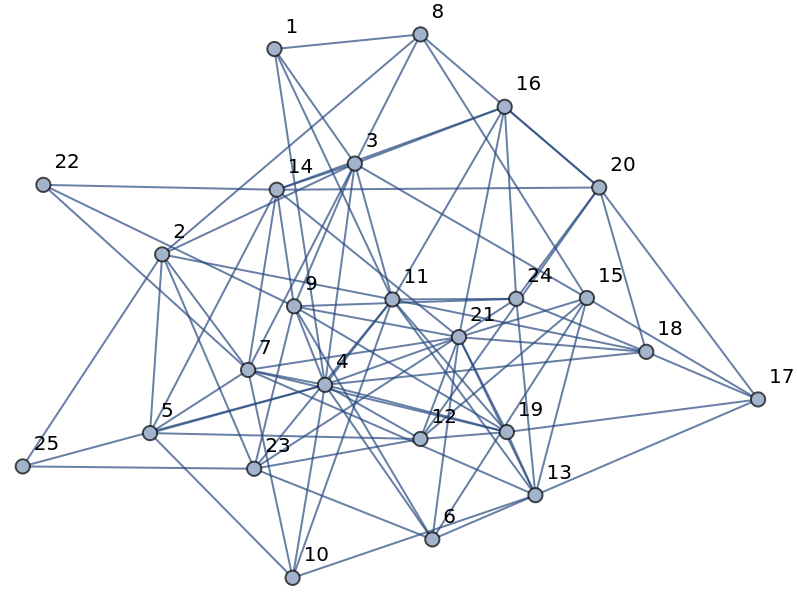
SECOND (A) (not mandatory): Count all (unbounded) connected and metric sets brute - force:
GDM=GraphDistanceMatrix[gr];Conn=Metr=0;Timing[Do[X=Subsets[Range[w],All,{i}][[1]];If[ConnectedGraphQ[Subgraph[gr,X]],Conn=Conn+1;If[IsItMetricQ[X],Metr=Metr+1;];];(*possiblycomplementthatlineout:*)If[Mod[i,20000]==333,Print[i," ",Conn," ",Metr];];,{i,2^w}];]Print["So many vertex-sets were connected: ",Conn];Print["So many vertex-sets were metric: ",Metr];
SECOND (B) (not mandatory): Estimate the numbers of connected, respectively metric sets of gr with cardinality <= k (based on 10000 random sets of vertices).
k=8;GDM=GraphDistanceMatrix[gr];ConnAmong10000=MetricAmong10000=0;SBC=Sum[Binomial[w,i],{i,0,k}];(*Print["SBC=",SBC];*)Timing[Do[RI=RandomInteger[{1,SBC}];X=Subsets[Range[w],k,{RI}][[1]];If[ConnectedGraphQ[Subgraph[gr,X]],ConnAmong10000=ConnAmong10000+1;If[IsItMetricQ[X],MetricAmong10000=MetricAmong10000+1;];];,{i,10000}];]Print["So many out of 10000 random k-bounded vertexsets were connected: ",ConnAmong10000];Print["So many out of 10000 random k-bounded vertexsets were metric: ",MetricAmong10000];
Out[]=
{4.65625,Null}
So many out of 10000 random k-bounded vertexsets were connected: 4184
So many out of 10000 random k-bounded vertexsets were metric: 261
THIRD (mandatory). Get the constraints (= superclauses, resp implications) necessary for the metric, respectively convex, subgraphs. Which of the two is decided at beginning with GeodesicallyConvexQ!
GDM=GraphDistanceMatrix[gr];GeodesicallyConvexQ=False;(*IfTrue,thenall(geodesically)convex,ifFalsethenallmetricsubgraphsaregenerated.Detailsinarticle*)Constraints={};Summe1=Summe2=h=0;(*hbecomesthenumberofconstraints,sointheendh=(wchoose2)-ka.*)Do[dist=GDM[[v1,v2]];If[v1<v2&&dist>1,premise={v1,v2};AltSubsets=GeodConvSubset={};Shortestv1v2=FindPath[gr,v1,v2,dist,All];Do[as=Complement[Shortestv1v2[[t]],premise];Summe2=Summe2+Length[as];AltSubsets=Append[AltSubsets,as];GeodConvSubset=Union[GeodConvSubset,as];,{t,Length[Shortestv1v2]}];If[GeodesicallyConvexQ,CS={premise,{GeodConvSubset}};,CS={premise,AltSubsets};];Summe1=Summe1+Length[AltSubsets];Constraints=Append[Constraints,CS];h=h+1;];,{v1,w},{v2,w}];Variablenmenge={};Clear[aa];Do[Variablenmenge=Append[Variablenmenge,aa[i]];traduit[aa[i]]=i;traduit[!aa[i]]=-i;,{i,w}];ConstraintsZuFormel;Print["The number of constraints is h=",h];If[!GeodesicallyConvexQ,Print["The average NUMBER of positive terms PER superclause is: ",N[Summe1/h]];Print["The average LENGTH of a positive term is: ",N[Summe2/Summe1]];,Print["Here the constraints are implications"];];
The number of constraints is h=210
The average NUMBER of positive terms PER superclause is: 2.97143
The average LENGTH of a positive term is: 1.31571
(*Notmandatory*)Do[Print[Constraints[[i]]];,{i,7}];
FORTH: OUR ALGORITHM (subroutines below must be read in)
In the article “our algorithm” is either AllMetricSets or AllConvexSets
FIFTH: BConvert (= terminology from article, Sec .6)
PART A:
PART B :
SIXTH: The alternative (usually slower) way of Sec . 6.3 .1 in article:
Part A : Click here in order to copy and paste the correct variables into f of Part B :
Part B:
Part C:
Subroutines to be read in beforehand, SEP 2024
This can sometimes be useful in TreatTopRow2:
This features newhaengig3, and so hopefully improves upon TreatToprow2:
Here the index of the next imposed constraint is calculated. The subroutine occurs in TreatTopRow2 :
This occurs in TreatTopRow3 but DOES NOT seem to improve newhaengig2 :
This occurs in newhaengig3 and uses parameters defined there :
This subroutine occurs in ImposePosTerms:
This subroutine occurs in TreatTopRow2 :
These subroutines translate our set - theoretic definition of the superclauses (which is necessary for Neuer Algorithmus) into a proper Boolean formula (which is necessary for our competitor BooleanConvert):
That occurs in ImposePosTermsBC:
This subroutine occurs in TreatTopRow2 and is an optional alternative (relying on BooleanConvert) to ImposePosTerms:
CITE THIS NOTEBOOK
CITE THIS NOTEBOOK
Compression with wildcards: All induced metric subgraphs
by Marcel Wild
Wolfram Community, STAFF PICKS, October 30, 2024
https://community.wolfram.com/groups/-/m/t/3312008
by Marcel Wild
Wolfram Community, STAFF PICKS, October 30, 2024
https://community.wolfram.com/groups/-/m/t/3312008