Here is an idea of yet another branchial graph flavor for our WPP formalism.
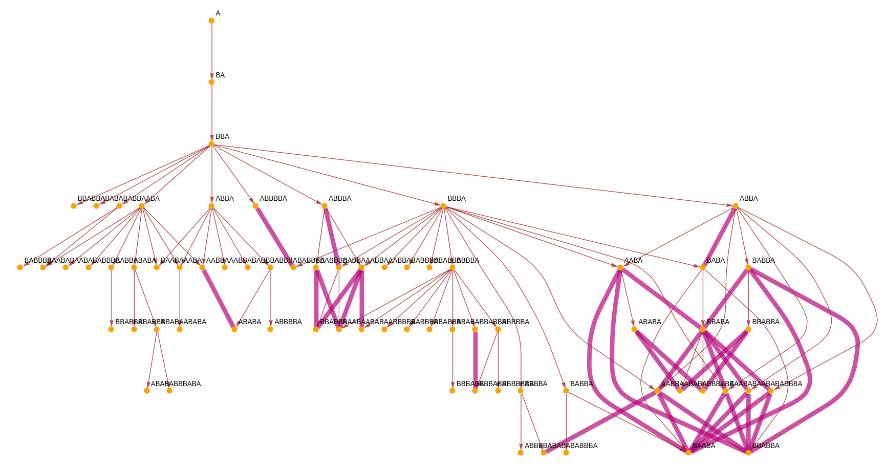
This one concerns branchial connections between events, but not the events that share immediate ancestor. Constructive events can be easily divided into spatially and branchially disconnected events based on whether their inputs overlap or not (intersecting destroyed atoms). So we draw a branchial edge only between overlapping events. The intuition is that such branchial edge encodes any correlation between these events as they are no longer independent and do not commute with each other. Existence of such edge also makes foliation of a causal graph ambiguous and not in a sense of a different reference frame (covariance), but in a genuinely different Everettian branches sense that evolve independently but with correlated outcomes. This initial branchial edge also “slides” along causal edges indicating that correlation is preserved through causality. After propagating every such edge through a causal graph this new branchial graph is created that shows “shortcuts” through spacetime by means of entanglement correlations.
This one concerns branchial connections between events, but not the events that share immediate ancestor. Constructive events can be easily divided into spatially and branchially disconnected events based on whether their inputs overlap or not (intersecting destroyed atoms). So we draw a branchial edge only between overlapping events. The intuition is that such branchial edge encodes any correlation between these events as they are no longer independent and do not commute with each other. Existence of such edge also makes foliation of a causal graph ambiguous and not in a sense of a different reference frame (covariance), but in a genuinely different Everettian branches sense that evolve independently but with correlated outcomes. This initial branchial edge also “slides” along causal edges indicating that correlation is preserved through causality. After propagating every such edge through a causal graph this new branchial graph is created that shows “shortcuts” through spacetime by means of entanglement correlations.
PacletInstall["https://wolfr.am/Multicomputation.paclet"];
In[]:=
<<Wolfram`Multicomputation`
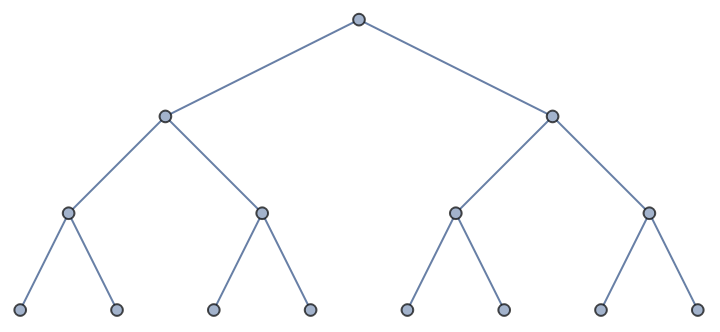
Simple multiway string substitution system example:
In[]:=
multi=HypergraphMulti[{"A"},{"BB"->"AB","A"->"BA"}]
Out[]=
Multi
multiwayGraph=multi"Graph",6,
Out[]=
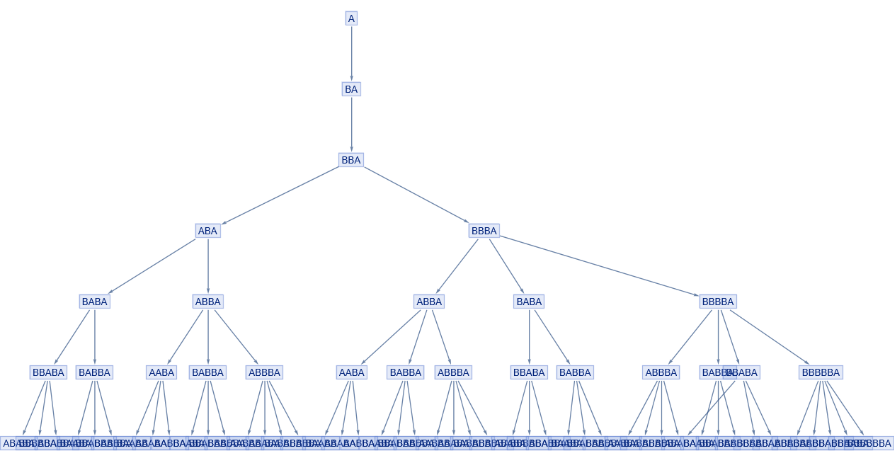
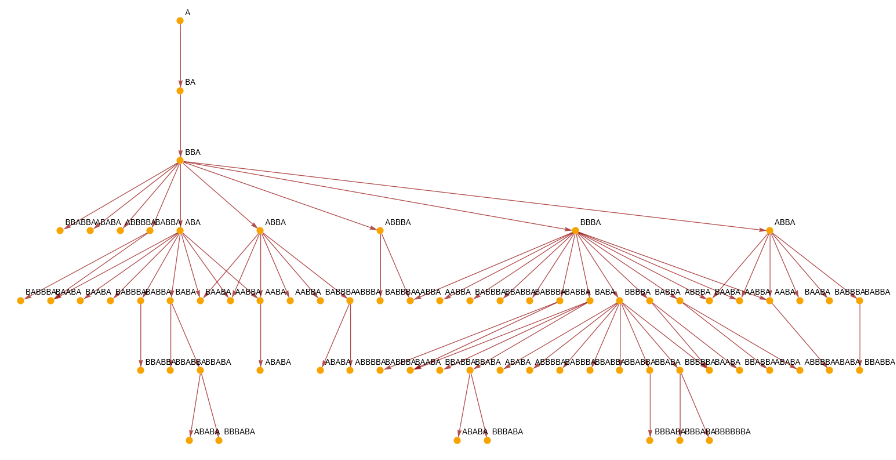
Causal graph is computed from edge tags (check the tooltips):
In[]:=
multiwayCausalGraph=CausalGraphmultiwayGraph,//TransitiveReductionGraph
Out[]=
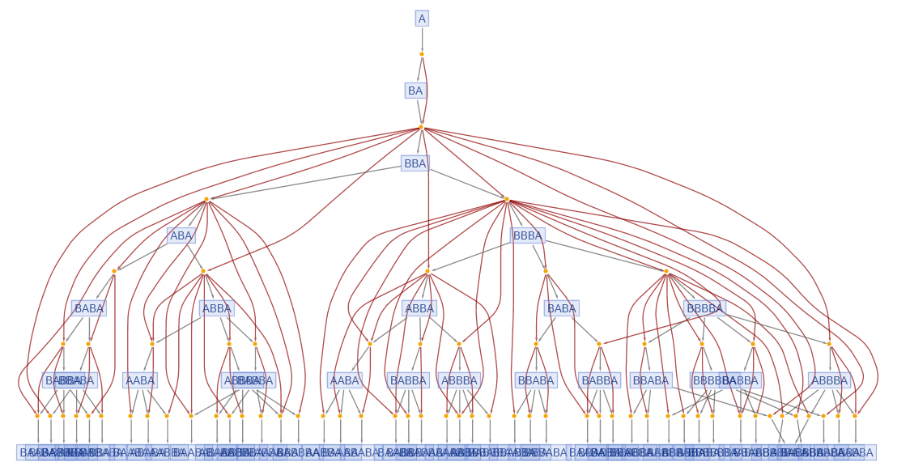
Evolution causal graph just puts back states around events:
In[]:=
ecg=EvolutionCausalGraphmultiwayCausalGraph,
Out[]=
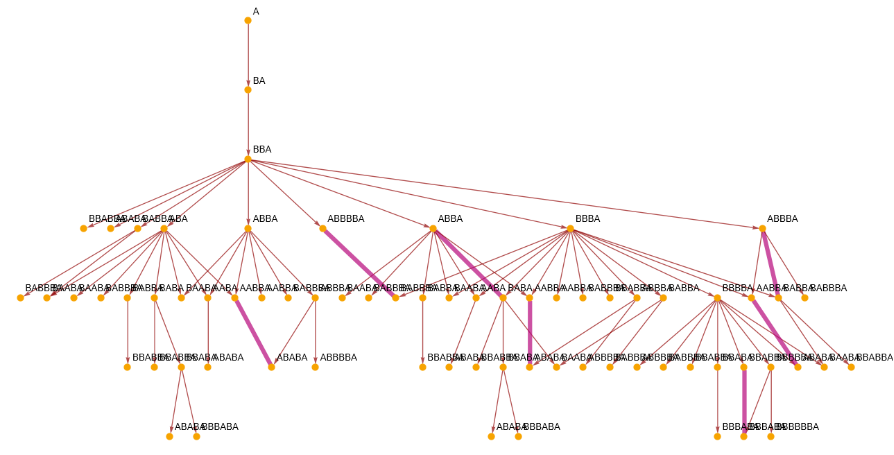
Create initial branch edges connecting overlapping events with a common parent, these are the events that do not commute (spacelike separated events are not branchially connected):
In[]:=
branchEdges=SubsetCasesVertexList[multiwayCausalGraph],a:__,b:__/;IntersectingQ[x,y]:>ab;
KeyValuePattern[{"Destroyed"->x_,"TreePosition"->{p___,_}}]
KeyValuePattern[{"Destroyed"->y_,"TreePosition"->{p___,_}}]
In[]:=
branchialMultiwayCausalGraph=GraphEdgeAdd[multiwayCausalGraph,branchEdges],
Out[]=
In[]:=
GraphEdgeAdd[ecg,branchEdges],
Out[]=
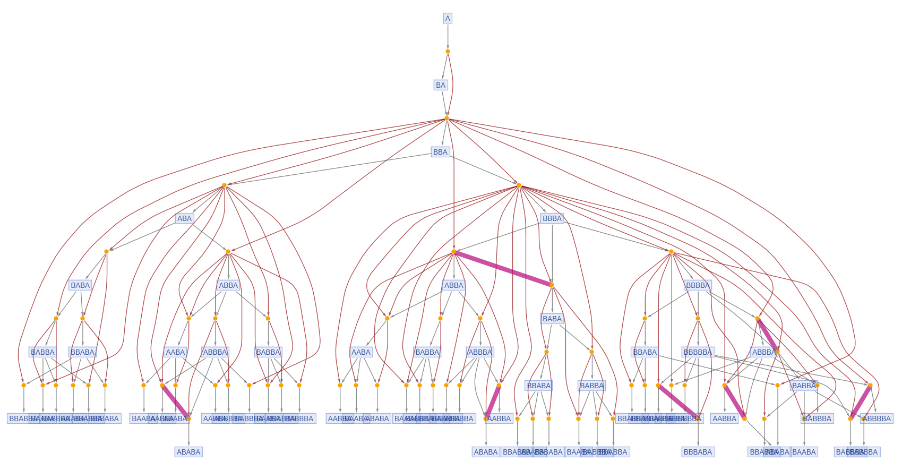
Each of these edges represent “entanglement” correlation between events, overlap details can fully describe this correlation.
Correlation “slide” along causal edges as branches evolve and propagate itself through spacetime.
All branchial edges constitute a branchial graph describing entanglement correlation between separated events.
In[]:=
slideBranchEdges=Join[branchEdges,Flatten[Table[Outer[UndirectedEdge,VertexOutComponent[multiwayCausalGraph,#[[1]],{n}],VertexOutComponent[multiwayCausalGraph,#[[2]],{n}]]&/@branchEdges,{n,4}],3]];
GraphEdgeAdd[multiwayCausalGraph,slideBranchEdges],
Out[]=
In[]:=
GraphEdgeAdd[ecg,slideBranchEdges],