Great rhombicosidodecahedron consists (GRD) of regular square, hexagonal and decagonal faces . If the sides of the faces relate to one another in proportion of the golden ratio, then such GRD is considered as golden GRD. Three different kinds of golden GRDs are shown here as associated with cluster of 30 cubes and cluster of 60 cubes.
1. Envelope of 30 cubes on small rhombicosidodecahedron (SRD).
2. Common edges with the cluster of 60 cubes.
3. Envelope of 60 cubes.
1. Envelope of 30 cubes on small rhombicosidodecahedron (SRD).
2. Common edges with the cluster of 60 cubes.
3. Envelope of 60 cubes.
In[]:=
fi=1.618;alf=ArcTan[fi];bet=ArcTan[1/fi];bet1=ArcTan[1/fi^2];y=0.5+0.5fi;x=y/fi;rte=Sqrt[x^2+y^2];el=yfi;z=el+1;tx=1.2139;r=Sqrt[0.25+tx^2];dis=Sqrt[r^2-(1/fi/2)^2];srd=GraphicsComplex[PolyhedronData["SmallRhombicosidodecahedron","VertexCoordinates"],Polygon[PolyhedronData["SmallRhombicosidodecahedron","FaceIndices"]]];srdn={Rotate[Rotate[srd,bet,{0,1,0}],Pi,{0,0,1}]};cub=GraphicsComplex[PolyhedronData["Cube","VertexCoordinates"],Polygon[PolyhedronData["Cube","FaceIndices"]]];dod=GraphicsComplex[PolyhedronData["Dodecahedron","VertexCoordinates"],Polygon[PolyhedronData["Dodecahedron","FaceIndices"]]];
In[]:=
Graphics3D[srdn,BoxedFalse,SphericalRegionTrue]
Out[]=

cub30 solid
cub30 solid
c1=Translate[cub,{0,0,-0.5-el}];c2=Rotate[c1,Pi,{1,0,0}];c3=Rotate[Rotate[{c1,c2},Pi/2+0.001,{1,0,0}],Pi/2+0.001,{0,0,1}];c4=Rotate[Rotate[{c1,c2},Pi/2+0.001,{0,1,0}],Pi/2+0.001,{0,0,1}];cub30=Table[Rotate[Rotate[{c1,c2,c3,c4},bet,{1,0,0}],i2Pi/5-Pi/2,{0,0,1}],{i,5}];Graphics3D[{cub30,Green,srdn},BoxedFalse,SphericalRegionTrue]
Out[]=

cube 30 perf
cube 30 perf
vA={0.5,-0.5,0};vB={0.5,0.5,0};vC={-0.5,0.5,0};vD={-0.5,-0.5,0};sq1={vA,vB,vC,vD};sq2=0.4{vA,vB,vC,vD};sq=Polygon[Join[sq1sq2]];cu1=Table[Rotate[Translate[sq,{0,0,-0.5}],i2Pi/4,{1,0,0}],{i,3}];cu2=Table[Rotate[Translate[sq,{0,0,-0.5}],i2Pi/4,{0,1,0}],{i,3}];cu=Scale[{cu1,cu2},0.9999];c1=Translate[cu,{0,0,0.5+el}];c2=Rotate[c1,Pi,{1,0,0}];c3=Rotate[Rotate[{c1,c2},Pi/2,{1,0,0}],Pi/2,{0,0,1}];c4=Rotate[Rotate[{c1,c2},Pi/2,{0,1,0}],Pi/2,{0,0,1}];cub30p=Table[Rotate[Rotate[{c1,c2,c3,c4},bet,{1,0,0}],i2Pi/5-Pi/2,{0,0,1}],{i,5}];Graphics3D[{srdn,Yellow,cub30p},BoxedFalse,SphericalRegionTrue]
Out[]=
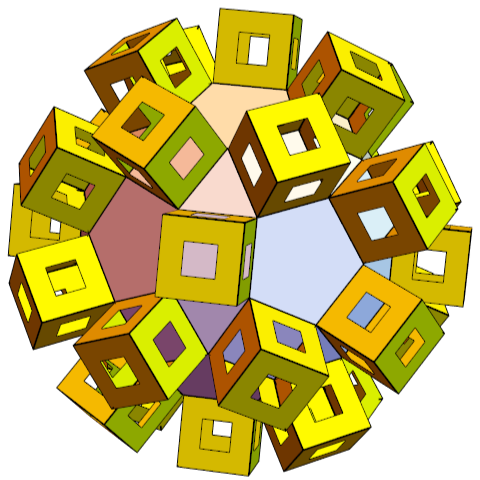
cub60
cub60
cc1=Translate[{cub},{0,0,-0.5-el}];cc5=Table[Rotate[Rotate[{cc1},-bet,{0,1,0}],i2Pi/5,{0,0,1}],{i,5}];cc6=Translate[Rotate[{cc5},0,{1,0,0}],{0,0,5.5675}];cc25={Table[Rotate[Rotate[Rotate[cc6,Pi,{0,0,1}],-2bet,{0,1,0}],i2Pi/5,{0,0,1}],{i,5}]};cc30=Rotate[{cc6,cc25},Pi,{0,1,0}];cub60={cc25,cc30,Red,cc6};Graphics3D[cub60,BoxedFalse,SphericalRegionTrue]
Out[]=

Cubes in the cluster of 60 cubes seat on the faces of dodecahedron.
In[]:=
dod=GraphicsComplex[PolyhedronData["Dodecahedron","VertexCoordinates"],Polygon[PolyhedronData["Dodecahedron","FaceIndices"]]];dodn=Rotate[Scale[dod,2.4],Pi,{0,0,1}];Graphics3D[{cub60,Green,dodn},BoxedFalse,SphericalRegionTrue]
Out[]=

The center of cubes in the cluster of 60 cubes coincide with the vertices of a SRD.
grd
grd
The frame of GRD seems to support the cluster of 60 cubes.
GRD golden 1
envelope of cub30
GRD golden 1
envelope of cub30
envelope of cub30
Enlvelope of cub30
GRD golden 2
support of cub60
GRD golden 2
support of cub60
support of cub60
Internal edges of cub60 seat on the edges of golden GRD 2.
GRD golden 3 out
framing cub60
GRD golden 3 out
framing cub60
framing cub60
GRD golden 3 out perf
GRD golden 3 out perf
Outside edges of cub60 seat on the edges of golden GRD 3.